Evening Primrose Oil: Does the Dose Depend on the Symptom?
For breast pain, studies have tested different amounts of evening primrose oil, but they don’t establish a dependable dose that reliably helps.
Breast-pain studies do not establish a proven daily dose of evening primrose oil, and they cannot set a dose for PMS or other symptoms. Trials tested 3,000 mg of oil daily or 1,000 mg twice daily for six months, but results were mixed or showed no clear benefit over control. Those amounts are study details, not dosing advice, and they don’t tell you how much gamma-linolenic acid (GLA) a product provides. 2 3 4
The symptom matters, but the evidence doesn’t set a dose
If you’re considering evening primrose oil (EPO), the most relevant studies in this area are about cyclical breast pain, also called cyclical mastalgia. They do not establish a dependable amount to take for that symptom, and they don’t establish a dose for PMS or other complaints. The NHS says there’s little evidence that EPO helps breast pain. 1
Two trials help explain why a single number on a bottle shouldn’t be treated as a proven dose. In a six-month randomized trial of 120 premenopausal women with severe chronic breast pain, pain days decreased in all groups. EPO did not outperform its control oil: the decrease was 12.3% with EPO and 13.8% with control oil. 2
A separate pilot trial enrolled 85 women with cyclical breast discomfort, but only 41 completed it. It tested EPO at 3,000 mg daily, among other treatments. Some analyses suggested improvement, but the EPO group’s decrease in pain was not statistically different from placebo in the reported group comparison. That makes the result uncertain, rather than a basis for recommending 3,000 mg daily. 3
A 2024 trial of 126 premenopausal women tested EPO at 1,000 mg twice daily, or 2,000 mg of oil per day, for six months. It also reported improvement, especially with EPO plus vitamin E. However, the reported pain changes differ between the published abstract and results table, which makes the size of the benefit difficult to interpret. This trial adds a possible positive finding, but doesn’t establish an effective dose. 4
A systematic review from 2014 concluded that EPO was not effective for mastalgia, and current NHS guidance also describes the evidence as limited. Taken together, the findings don’t support treating one trial amount as a proven dose. 5 1
Oil milligrams and GLA milligrams aren’t the same
EPO is an oil that contains gamma-linolenic acid, or GLA. A number such as “1,000 mg” may describe the amount of EPO, not the amount of GLA. These studies report EPO amounts; they don’t provide a conversion that lets you match a product’s GLA content to an effective dose. 3 4
If you’re comparing products, check whether the label separately states the amount of EPO and the amount of GLA. Don’t assume that two products listing the same milligrams of oil provide the same studied preparation, or that matching a study’s oil amount means you’re taking an established treatment. The trials haven’t established that dose-to-GLA comparison.
PMS and other symptoms need their own evidence
A study of cyclical breast pain doesn’t show that EPO treats PMS as a whole, period cramps, or another symptom. Those breast-pain findings don’t establish a useful daily dose for PMS or period cramps. In particular, period pain and breast tenderness before a period are different symptoms, even if they happen during the same part of your cycle.
Breast pain itself often follows a pattern: it may start before a period, affect both breasts, and ease when the period ends. Pain that doesn’t improve is worth getting checked. Seek prompt medical evaluation for breast pain with redness, heat or swelling, fever or chills, skin dimpling, or a new nipple rash or retraction. 1
Pregnancy, breastfeeding, and medicines are separate safety questions
The breast-pain trials don’t establish whether EPO is safe during pregnancy or breastfeeding, and they don’t provide a verified list of medicine interactions. So a breast-pain study amount can’t answer either question.
If you’re considering EPO, useful questions are: “Could this interact with any of the medicines or supplements I take?” and “Is there evidence about using it while I’m pregnant, trying to become pregnant, or breastfeeding?” Bring the product label, including its listed EPO and GLA amounts, so the discussion is about the preparation you’re actually considering. This evidence doesn’t answer those safety questions or establish specific interactions.
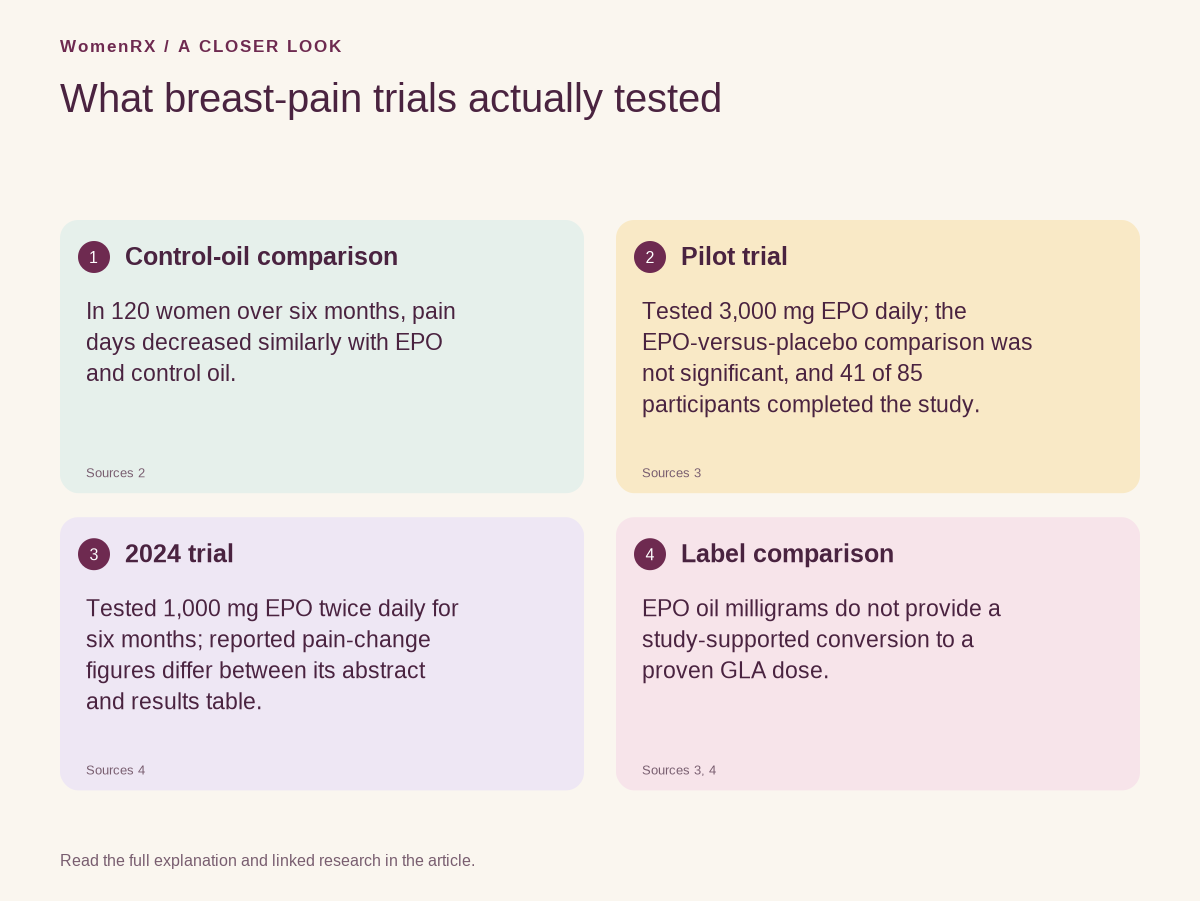
What breast-pain trials actually tested
Control-oil comparison: In 120 women over six months, pain days decreased similarly with EPO and control oil.2
Pilot trial: Tested 3,000 mg EPO daily; the EPO-versus-placebo comparison was not significant, and 41 of 85 participants completed the study.3
2024 trial: Tested 1,000 mg EPO twice daily for six months; reported pain-change figures differ between its abstract and results table.4
Label comparison: EPO oil milligrams do not provide a study-supported conversion to a proven GLA dose.34
Read the figure as text
These study findings show why trial amounts are not the same as a proven daily dose or a guaranteed product match.- Control-oil comparison: In 120 women over six months, pain days decreased similarly with EPO and control oil.2
- Pilot trial: Tested 3,000 mg EPO daily; the EPO-versus-placebo comparison was not significant, and 41 of 85 participants completed the study.3
- 2024 trial: Tested 1,000 mg EPO twice daily for six months; reported pain-change figures differ between its abstract and results table.4
- Label comparison: EPO oil milligrams do not provide a study-supported conversion to a proven GLA dose.34
More questions, answered
Can I use a breast-pain study dose for PMS?
No study discussed here establishes an EPO dose for PMS. A trial of cyclical breast pain answers a narrower question and can’t show that EPO treats PMS or period cramps.
How do I compare the amount of EPO with the amount of GLA?
They’re different quantities: EPO is the oil, and GLA is one component of it. The breast-pain trials report amounts of EPO, not a conversion to a proven GLA dose. Check whether the product lists both amounts, but don’t treat a matching label number as proof of equivalent benefit. 3 4
Sources you can check
- Breast pain - NHSAccessed 2026-09-25Return to first citation
- Evening primrose oil and fish oil for severe chronic mastalgia: a randomized, double-blind, controlled trial.Blommers J, de Lange-De Klerk ES, Kuik DJ, Bezemer PD, Meijer S. · American journal of obstetrics and gynecology · 2002Return to first citation
- Vitamin E and evening primrose oil for management of cyclical mastalgia: a randomized pilot study.Pruthi S, Wahner-Roedler DL, Torkelson CJ, Cha SS, Thicke LS, Hazelton JH, Bauer BA. · Alternative medicine review : a journal of clinical therapeutic · 2010Return to first citation
- Effectiveness of Evening Primrose and Vitamin E for Cyclical Mastalgia: A Prospective Study.Kumari J, Amrita, Sinha A, Kumari S, Biswas P, Poonam. · Cureus · 2024Return to first citation
- A systematic review of current understanding and management of mastalgia.Kataria K, Dhar A, Srivastava A, Kumar S, Goyal A. · The Indian journal of surgery · 2014Return to first citation