Estradiol patch dose: why the right strength depends on your prescription
A patch’s labeled estradiol delivery rate and how often you replace it are different details, and neither alone tells you what dose is right for you.
Estradiol patch strengths describe how much estradiol a patch is designed to deliver over time; the replacement schedule is a separate instruction. The right prescription depends on symptom response, side effects, and your health context, so a strength shown on a package isn’t a recommendation for everyone. If you have a uterus, ask how your treatment plan protects the uterine lining. 1 2 4
Two numbers, two different instructions
An estradiol patch may be described by a delivery rate, such as micrograms per day, and by how often the patch is changed. Those aren’t interchangeable. In one clinical trial, researchers compared patches delivering 25 or 50 micrograms of estradiol daily; some were designed for once-weekly application, while another was changed twice weekly. The study illustrates why the delivery rate and replacement schedule need to be read separately. It doesn’t establish a dose or schedule for every patch product. 4
Use the strength and change schedule on your own prescription and product instructions. If the package, pharmacy label, and directions you remember don’t seem to match, ask the pharmacist or prescriber to clarify them rather than trying to convert one number into another.
Why a prescribed strength is individualized
A clinician considers whether the patch is helping with the symptoms it was prescribed for, whether you’re having unwanted effects, and how your personal health factors affect the balance of benefits and risks. The North American Menopause Society says hormone-therapy risks vary with dose, duration, route, timing of initiation, and whether a progestogen is used. It recommends individualizing treatment and periodically revisiting its benefits and risks. 1
Research comparing patch strengths can help explain why the amount delivered may matter, but it can’t identify the right strength for you. For example, a 12-week randomized trial in postmenopausal participants with frequent hot flashes found that the estradiol patches studied were more effective than placebo, with effects differing by strength. The trial used particular patch products and participants, and it doesn’t provide a universal prescribing rule. 4
At follow-up, useful topics include whether symptoms have improved, any side effects, and whether the treatment still fits your goals. A review of menopausal hormone therapy recommends checking tolerability and side effects, including bleeding concerns, after treatment begins, with regular follow-up afterward. The timing of your own review depends on your prescription and circumstances. 2
If you have a uterus, check the whole plan
For someone with a uterus who uses systemic estrogen, a progestogen is generally included to protect the uterine lining from the effects of estrogen alone. That protection may be part of a combined patch or supplied by a separate progestogen treatment; the appropriate plan depends on the prescription. A patch containing estradiol alone should not be assumed to include uterine-lining protection. 2 3
The type and route matter: a review of the evidence says transdermal micronized progesterone does not provide endometrial protection, while oral micronized progesterone can do so in studied regimens. Don’t infer that a product protects the lining just because it contains a hormone called progesterone; confirm the plan with the prescriber or pharmacist. 2 3
A quick prescription check
Before using or refilling a patch, make sure you can identify the product, its labeled delivery rate, and its replacement schedule. If you have a uterus, also confirm what provides uterine-lining protection. These checks help you understand the prescription; they aren’t a reason to adjust the strength or schedule yourself.
Check the patch prescription
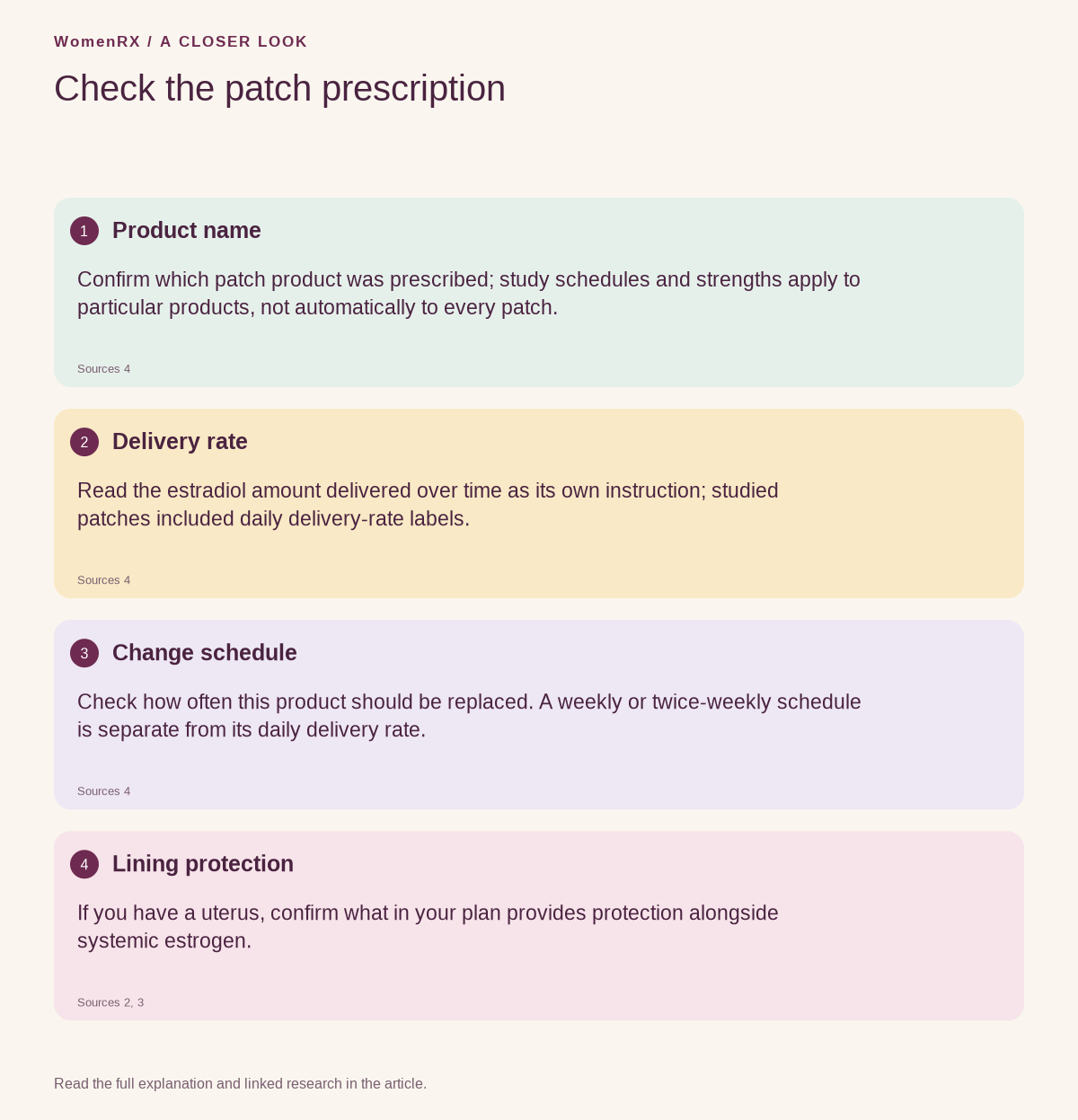
Product name: Confirm which patch product was prescribed; study schedules and strengths apply to particular products, not automatically to every patch.4
Delivery rate: Read the estradiol amount delivered over time as its own instruction; studied patches included daily delivery-rate labels.4
Change schedule: Check how often this product should be replaced. A weekly or twice-weekly schedule is separate from its daily delivery rate.4
Lining protection: If you have a uterus, confirm what in your plan provides protection alongside systemic estrogen.23
Read the figure as text
These are separate details to confirm from your prescription and product instructions. They help you understand the plan, not calculate a new dose.- Product name: Confirm which patch product was prescribed; study schedules and strengths apply to particular products, not automatically to every patch.4
- Delivery rate: Read the estradiol amount delivered over time as its own instruction; studied patches included daily delivery-rate labels.4
- Change schedule: Check how often this product should be replaced. A weekly or twice-weekly schedule is separate from its daily delivery rate.4
- Lining protection: If you have a uterus, confirm what in your plan provides protection alongside systemic estrogen.23
More questions, answered
Does a higher estradiol patch strength always work better?
Not necessarily for an individual. A trial found differing effects among the particular strengths studied, but it cannot determine which strength will best balance symptom relief and tolerability for you. 4
Does an estradiol-only patch protect the uterine lining?
Estradiol alone is not the progestogen protection generally recommended for someone with a uterus using systemic estrogen. Confirm whether your prescription includes a separate progestogen or another documented protective component. 2 3
Sources you can check
- The 2022 hormone therapy position statement of The North American Menopause Society.“The 2022 Hormone Therapy Position Statement of The North American Menopause Society” Advisory Panel. · Menopause (New York, N.Y.) · 2022Return to first citation
- Progestogens as a component of menopausal hormone therapy: the right molecule makes the difference.Stevenson JC, Rozenberg S, Maffei S, Egarter C, Stute P, Römer T. · Drugs in context · 2020Return to first citation
- The impact of micronized progesterone on the endometrium: a systematic review.Stute P, Neulen J, Wildt L. · Climacteric : the journal of the International Menopause Society · 2016Return to first citation
- Dose-response efficacy of a new estradiol transdermal matrix patch for 7-day application: a randomized, double-blind, placebo-controlled study. Italian Menopause Research Group.Rovati LC, Setnikar I, Genazzani AR. · Gynecological endocrinology : the official journal of the International Society of Gynecological Endocrinology · 2000Return to first citation