Endometrial Hyperplasia: What Your Biopsy Result Means
The words “with atypia” or “without atypia” change the treatment conversation more than an ultrasound measurement does.
Endometrial hyperplasia means a tissue sample showed abnormal growth of the uterine lining. The key distinction is whether the cells have atypia, also called endometrial intraepithelial neoplasia or EIN. Without atypia, progestin treatment or, in some cases, observation may be discussed. Atypia raises greater concern about cancer already being present, so treatment and plans to preserve the uterus need a different conversation. 56
Start with the exact words on the report
“Thickened endometrium” on an ultrasound and “endometrial hyperplasia” on a pathology report aren’t interchangeable. Ultrasound measures the lining; a biopsy lets a pathologist examine tissue. A thicker measurement alone does not tell you whether the cells show hyperplasia, atypia or cancer. This distinction matters particularly if an ultrasound found a thick lining after menopause but you have no bleeding: research has not established one thickness cutoff that reliably settles what to do in that situation. 23
If your report says hyperplasia without atypia, the lining has grown abnormally, but the sampled cells do not show the changes called atypia. If it says atypical hyperplasia or endometrial intraepithelial neoplasia (EIN), it describes the higher-concern category. Cancer can already be present in some people diagnosed with atypical hyperplasia, and distinguishing EIN from cancer in a limited sample can be difficult. Neither phrase predicts what will happen to you individually; it identifies the decision your care team needs to make next. 6
Why bleeding and life stage matter
Before menopause, hyperplasia may come to attention because bleeding becomes irregular, more frequent or heavier. Around the menopause transition, cycles without ovulation can contribute to prolonged estrogen exposure without the usual balancing effect of progesterone. Other factors associated with hyperplasia include obesity, polycystic ovary syndrome and certain hormone exposures. These factors help explain why a clinician might investigate bleeding; they don’t diagnose hyperplasia by themselves. 56
After menopause, even a single episode of vaginal bleeding deserves assessment, though causes other than hyperplasia, including thinning of the vaginal or uterine lining and polyps, are common. If bleeding persists or returns, bring that up even if an earlier ultrasound seemed reassuring. The question is what caused the bleeding, not just how thick the lining measured on one scan. 14
How the two results change treatment
Without atypia: Observation can be an option in some cases; progestin treatment is another. Progestin acts on the uterine lining and can lead to its regression. Options studied include oral progestins and a levonorgestrel-releasing intrauterine system (IUS). In a network meta-analysis of 21 randomized trials and five nonrandomized studies involving 2,268 patients with hyperplasia, the IUS was associated with a higher rate of regression than oral medroxyprogesterone acetate. That comparison is useful, but it doesn’t mean an IUS suits every woman or every pregnancy plan. 56
With atypia or EIN: The possibility of cancer already being present makes a discussion of hysterectomy much more prominent. Progestin treatment may be considered when preserving the uterus matters, including for a future pregnancy, but it is a different tradeoff from treating hyperplasia without atypia. Ask what further assessment is needed to clarify the diagnosis, what each treatment is intended to achieve and how its success would be checked. 6
The choice isn’t only about whether you want a pregnancy someday. If you hope to try soon, say so before settling on a treatment. If you’re postmenopausal or do not want to preserve your uterus, that changes how you may weigh surgery against treatment that keeps the uterus. Your pathology category, bleeding, health history and priorities all belong in the same conversation. 6
What a follow-up plan needs to answer
Two questions are worth separating: Was the first sample enough to clarify the diagnosis? And if treatment is chosen, how will its effect be assessed? A review of atypical hyperplasia describes diagnostic difficulty and discusses additional tissue assessment when cancer is suspected. In progestin studies, investigators assessed regression using a later endometrial biopsy. That supports asking about further sampling, but it does not establish one follow-up method or timetable for everyone. 56
For example, if your report says EIN and you want to preserve the possibility of pregnancy, the useful next discussion is not simply “Can I take a hormone?” It is how confidently cancer has been excluded, which uterus-preserving approach is being considered, and what finding would prompt a change of plan. If your result says hyperplasia without atypia, ask what makes observation or a particular progestin a reasonable choice for you, and what should happen if bleeding continues. 56
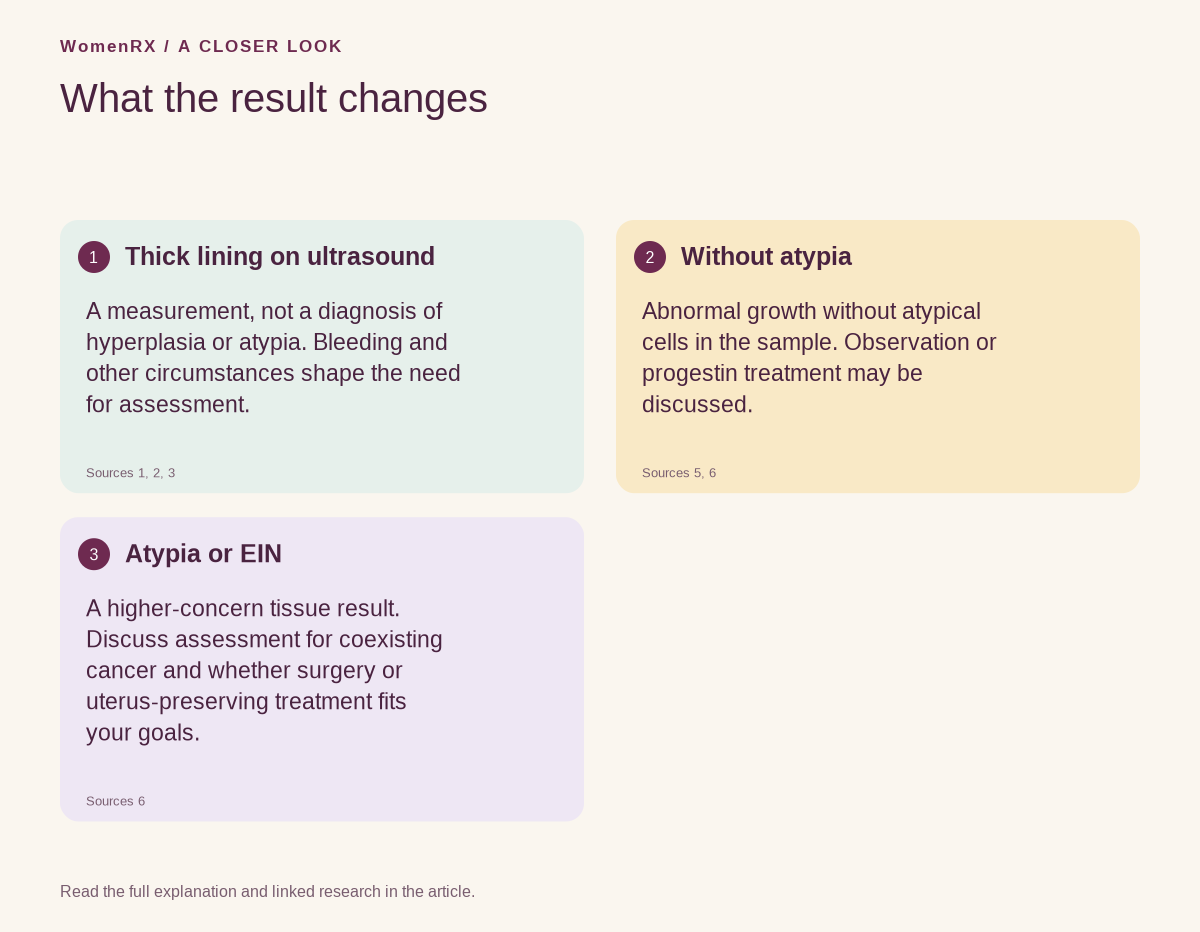
What the result changes
Thick lining on ultrasound: A measurement, not a diagnosis of hyperplasia or atypia. Bleeding and other circumstances shape the need for assessment.123
Without atypia: Abnormal growth without atypical cells in the sample. Observation or progestin treatment may be discussed.56
Atypia or EIN: A higher-concern tissue result. Discuss assessment for coexisting cancer and whether surgery or uterus-preserving treatment fits your goals.6
Read the figure as text
An ultrasound finding and the two pathology categories answer different questions.- Thick lining on ultrasound: A measurement, not a diagnosis of hyperplasia or atypia. Bleeding and other circumstances shape the need for assessment.123
- Without atypia: Abnormal growth without atypical cells in the sample. Observation or progestin treatment may be discussed.56
- Atypia or EIN: A higher-concern tissue result. Discuss assessment for coexisting cancer and whether surgery or uterus-preserving treatment fits your goals.6
More questions, answered
Does a thickened uterine lining mean I have hyperplasia?
No. Thickness is an ultrasound finding; hyperplasia describes changes seen in tissue. In postmenopausal women without bleeding, evidence does not establish a single thickness cutoff that reliably distinguishes a normal lining from hyperplasia or cancer. 23
Are atypical hyperplasia and EIN different diagnoses?
They are names used for the same higher-concern category of endometrial hyperplasia. If either appears on your report, ask what the result means for checking for cancer and choosing treatment. 6
Sources you can check
- Postmenopausal bleeding - NHSAccessed 2026-09-25Return to first citation
- Biopsy: MedlinePlusAccessed 2026-09-25Return to first citation
- The optimal endometrial thickness threshold for prediction of endometrial cancer in postmenopausal women without bleeding remains uncertain-Systematic review and meta-analysis.Kaur H, Qadri S, Nevill AM, Ewies AAA. · Journal of gynecology obstetrics and human reproduction · 2024Return to first citation
- Hysteroscopy in the assessment of postmenopausal bleeding.Bronz L. · Contributions to gynecology and obstetrics · 2000Return to first citation
- Efficacy of Oral Medications or Intrauterine Device-Delivered Progestin in Patients with Endometrial Hyperplasia with or without Atypia: A Network Meta-Analysis.Zhang YF, Fan Y, Mu Y, Li JK. · Journal of clinical medicine · 2023Return to first citation
- Endometrial hyperplasia as a risk factor of endometrial cancer.Nees LK, Heublein S, Steinmacher S, Juhasz-Böss I, Brucker S, Tempfer CB, Wallwiener M. · Archives of gynecology and obstetrics · 2022Return to first citation