Eating With Insulin Resistance: Build Meals That Fit
A flexible mix of vegetables, satisfying protein, and fiber-rich carbohydrates gives you a place to start without making familiar foods off-limits.
There isn’t one required menu for insulin resistance. Start with meals you enjoy, then look for ways to include vegetables or fruit, a protein food, and fiber-rich carbohydrates such as beans or whole grains. This is a practical framework, not a proven formula for reversing insulin resistance. Your blood sugar goals and any diabetes medicines also matter when you change how you eat. 58123
Think in components, not a prescribed menu
If you’ve been told you have insulin resistance, it’s easy to feel as though every meal needs a new set of rules. A more useful starting point is to keep the foods and flavors you like, then look at what the whole meal contains. Expert guidance on nutrition for people with type 2 diabetes emphasizes individualized plans that account for food preferences, culture, and practical constraints. It also favors fiber-rich foods, vegetables, fruit, and protein foods over a one-size-fits-all diet chart. The guidance was developed for diabetes care in India; its emphasis on familiar foods is useful when adapting meals across different kitchens. 5
Try building from three components:
- Vegetables or fruit: Add what’s accessible and appealing. Frozen vegetables can stand in for fresh ones, and whole fruit offers fiber that juice lacks. 12
- A protein food: Beans, lentils, tofu, eggs, fish, poultry, or yogurt can all fill this role, depending on your preferences. Beans and lentils also bring fiber. 12
- A carbohydrate you enjoy: When it works for the meal, choose a fiber-rich option such as beans or a whole grain. Whole grains generally retain more fiber than refined grains. You don’t have to treat rice, bread, or tortillas as forbidden foods. 12
These components can look different from kitchen to kitchen. For example, lentils with vegetables and rice, beans with vegetables in a tortilla, or fish with greens and a grain all use the same flexible idea. Use these examples as a starting point for your own meals. 512
What to change when a meal isn’t working for you
Look for an adjustment you could repeat, rather than replacing everything at once. If a meal is mostly a refined grain, you might add beans and vegetables, or try a whole-grain version you actually like. If breakfast is usually a sweet drink on its own, you might choose a less-sweet drink and include a food with protein or fiber. General healthy-eating guidance favors whole grains over refined grains and limiting sugar-sweetened drinks. 1112
Budget and convenience count. Canned beans, frozen vegetables, and familiar grains can make the framework easier to use than a list of specialty foods. The question is not whether a meal looks like someone else’s ideal plate. It’s whether its components fit your tastes, resources, and treatment plan well enough to keep eating that way. 512
Does it need to be low-carb?
Not necessarily. A lower-carbohydrate pattern is one option: an expert consensus reports clinical evidence of benefits for several risk factors associated with insulin resistance in adults. It doesn’t establish a single best carbohydrate level for every person or prove that avoiding carbohydrates reverses insulin resistance. Other balanced patterns can include whole grains, beans, vegetables, fruit, and protein foods. The more useful choice is one you can follow while meeting your nutrition needs and accounting for any treatment you use. 8511
If you have type 1 diabetes and use mealtime insulin, the amount of carbohydrate you eat is part of calculating your dose for each meal. Some people taking diabetes medicines can also have low blood sugar. Don’t change your medication on your own to match a new diet; make substantial eating-pattern changes with your treatment plan in mind. 13
Pregnancy has its own nutrition needs. If you have gestational diabetes, blood sugar management also needs an individualized plan. Breastfeeding brings different nutrition needs, and PCOS may make it worth tailoring a plan to more than a blood sugar number alone. These situations call for individualized advice rather than assuming this general meal framework is a complete plan. 49105
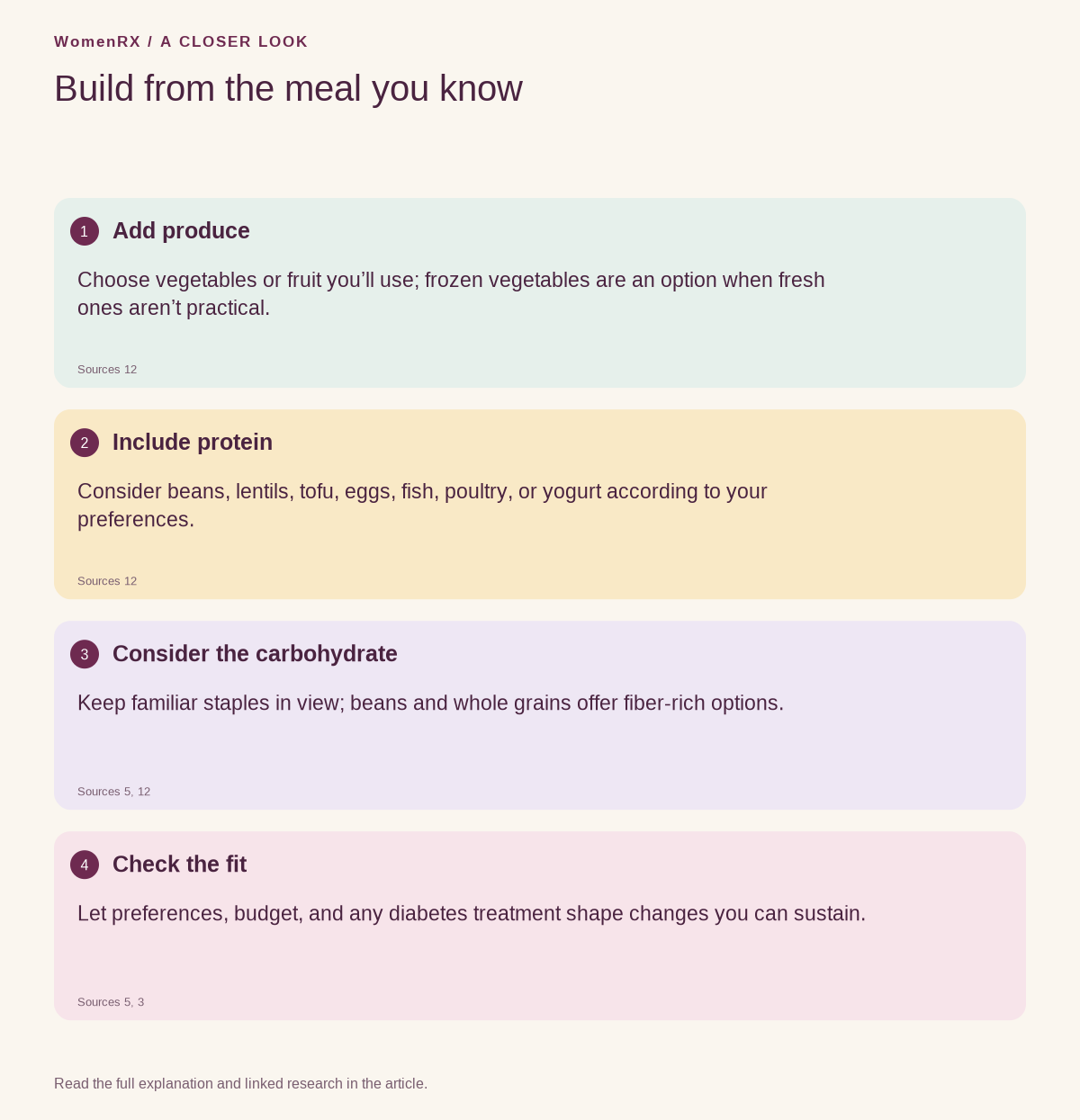
Build from the meal you know
Add produce: Choose vegetables or fruit you’ll use; frozen vegetables are an option when fresh ones aren’t practical.12
Include protein: Consider beans, lentils, tofu, eggs, fish, poultry, or yogurt according to your preferences.12
Consider the carbohydrate: Keep familiar staples in view; beans and whole grains offer fiber-rich options.512
Check the fit: Let preferences, budget, and any diabetes treatment shape changes you can sustain.53
Read the figure as text
Use these prompts to adapt a familiar meal, not to score it or follow a fixed menu.- Add produce: Choose vegetables or fruit you’ll use; frozen vegetables are an option when fresh ones aren’t practical.12
- Include protein: Consider beans, lentils, tofu, eggs, fish, poultry, or yogurt according to your preferences.12
- Consider the carbohydrate: Keep familiar staples in view; beans and whole grains offer fiber-rich options.512
- Check the fit: Let preferences, budget, and any diabetes treatment shape changes you can sustain.53
Do I have to stop eating white rice?
No single food needs to be declared off-limits by this framework. General healthy-eating guidance suggests choosing whole grains more often because they retain more fiber, and it offers adding vegetables to rice as another practical change. What fits your blood sugar treatment plan may be more specific. 123
Sources you can check
- Insulin for type 1 diabetes - NHSAccessed 2026-09-25Return to first citation
- Blood Glucose | Blood Sugar | Diabetes | MedlinePlusAccessed 2026-09-25Return to first citation
- Diabetes | Type 1 Diabetes | Type 2 Diabetes | MedlinePlusAccessed 2026-09-25Return to first citation
- Optimizing Nutrition Strategies for Diabetes Management in India: An Expert Opinion.Saboo B, Joshi A, Swar SC, M MD, Ramakrishnan A, Hajirnis A, Khaire S, Chakrabarti S, Patnala S, Siddhanta S, Patil VA, Balasubramanian P, Subash Chandra Bose U, Mohan SK, Joshi NA, Sonawale SB. · Diabetes, metabolic syndrome and obesity : targets and therapy · 2026Return to first citation
- Expert consensus on nutrition and lower-carbohydrate diets: An evidence- and equity-based approach to dietary guidance.Volek JS, Yancy WS, Gower BA, Phinney SD, Slavin J, Koutnik AP, Hurn M, Spinner J, Cucuzzella M, Hecht FM. · Frontiers in nutrition · 2024Return to first citation
- The Dietary Reference Intakes for Japanese (2025): Overview and Future Directions for the Pregnant and Lactating Women's Section.Kasuga Y, Sugiyama T, Sasaki S, Asakura K. · The journal of obstetrics and gynaecology research · 2026Return to first citation
- Effectiveness of Aerobic Exercise on Metabolic Profiles in Women with Polycystic Ovary Syndrome: A Systematic Review, Meta-Analysis, and GRADE Assessment of RCTs.Gautam R, Maan P, Sivakumar S, Arora A, Jena SK, Arora T. · Diabetes, metabolic syndrome and obesity : targets and therapy · 2026Return to first citation
- DASH Eating Plan: MedlinePlusAccessed 2026-09-25Return to first citation
- MedlinePlus: Managing weight with healthy eatingAccessed 2026-09-25Return to first citation