Does Myo-Inositol Affect Body Weight?
Studies in women with PCOS report mixed weight findings, and improvements in blood sugar or hormones don’t automatically mean weight loss.
Myo-inositol hasn’t been shown consistently to make women lose or gain weight. In PCOS studies, some participants lost weight, others had no change, and results can’t always be separated from other treatments or ingredients. Changes in glucose, insulin, or reproductive measures are different outcomes from a change on the scale. The findings don’t establish what to expect if you don’t have PCOS. 2 3 4 5
The short version: weight results are mixed
If you’re taking myo-inositol for PCOS, weight change isn’t a dependable result to count on. Human studies report different outcomes: one randomized trial found weight and body-composition measures changed over six months in women receiving either myo-inositol or metformin, while another small study in normal-weight women with PCOS found no change in BMI during treatment. 2 3
Those findings don’t show that myo-inositol causes weight loss for everyone with PCOS, or that it causes weight gain. They also don’t establish an effect in women without PCOS. The studies summarized here involved women with PCOS, and their results shouldn’t be assumed to apply across other populations or life stages.
Why a metabolic change isn’t the same as weight loss
Myo-inositol studies often measure several things at once: body weight, glucose and insulin responses, hormone levels, menstrual patterns, or ovulation. These measures may matter for different reasons, but a change in one doesn’t prove a change in another.
For example, a study can report an improvement in an insulin or hormone measure without a change in BMI. In a study of 24 normal-weight women with PCOS, BMI did not change, although some hormonal and insulin-response measures did. The supplement in that study also included other ingredients, so its results don’t isolate myo-inositol alone. 3
A six-month randomized trial in 66 women with PCOS compared myo-inositol with metformin. The researchers reported changes over time in body mass, BMI, waist circumference, and body fat, with no significant difference between the treatments on the analyzed measures. Because this trial compared two treatments rather than myo-inositol with a placebo or no treatment, it doesn’t tell us how much of the change was specifically caused by myo-inositol. 2
What the combination studies can and can’t tell you
Some studies tested myo-inositol alongside another treatment or ingredient. In a small, open-label study of 50 women with PCOS over three months, the group taking myo-inositol alone had no change in body weight. Weight decreased in the group taking myo-inositol with alpha-lactalbumin. That difference is a result for the combination, not proof that myo-inositol by itself produces weight loss. 4
Another six-month study in women with overweight or obesity and PCOS compared diet alone with diet plus myo-inositol, or diet plus a myo-inositol and D-chiro-inositol combination. Weight and BMI decreased in all three groups. Since everyone followed a diet plan, those overall losses can’t be credited to an inositol supplement alone. 5
These studies also differ in duration, participants, and what was taken alongside myo-inositol. So a result from one study may not predict what will happen for you, even if you have PCOS.
A practical way to interpret the scale
If your goal is weight change, treat myo-inositol as uncertain for that purpose rather than as a weight-loss supplement. If you’re using it for PCOS-related concerns, keep the reason for taking it separate from what the scale does: a reproductive or metabolic measure may change without body weight changing.
Weight is only one measure of health and includes muscle, bone, fat, and water. A scale reading also can’t show which of those components changed. 1 If your weight changes unexpectedly or you’re concerned about a trend, consider the change in context rather than assuming the supplement caused it.
What the PCOS weight studies show
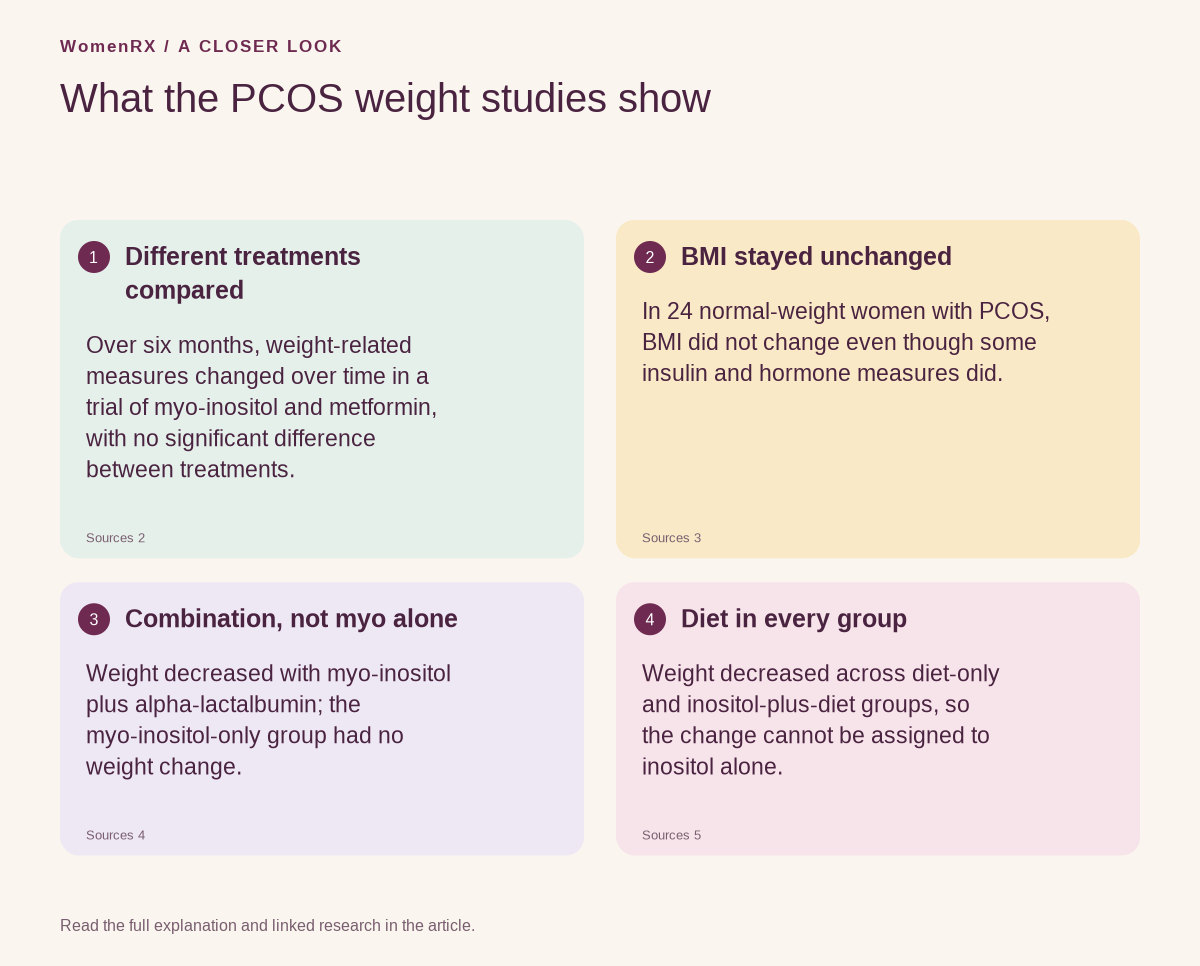
Different treatments compared: Over six months, weight-related measures changed over time in a trial of myo-inositol and metformin, with no significant difference between treatments.2
BMI stayed unchanged: In 24 normal-weight women with PCOS, BMI did not change even though some insulin and hormone measures did.3
Combination, not myo alone: Weight decreased with myo-inositol plus alpha-lactalbumin; the myo-inositol-only group had no weight change.4
Diet in every group: Weight decreased across diet-only and inositol-plus-diet groups, so the change cannot be assigned to inositol alone.5
Read the figure as text
These examples separate weight outcomes from related metabolic measures and show when other treatments or ingredients complicate interpretation.- Different treatments compared: Over six months, weight-related measures changed over time in a trial of myo-inositol and metformin, with no significant difference between treatments.2
- BMI stayed unchanged: In 24 normal-weight women with PCOS, BMI did not change even though some insulin and hormone measures did.3
- Combination, not myo alone: Weight decreased with myo-inositol plus alpha-lactalbumin; the myo-inositol-only group had no weight change.4
- Diet in every group: Weight decreased across diet-only and inositol-plus-diet groups, so the change cannot be assigned to inositol alone.5
More questions, answered
Can myo-inositol cause weight gain?
The studies summarized here don’t establish that myo-inositol causes weight gain. They report mixed weight outcomes, including no change in some groups and decreases in others. That isn’t enough to predict an individual response or prove the supplement caused a change. 2 3 4
Sources you can check
- Body Weight: MedlinePlusAccessed 2026-09-25Return to first citation
- The effect of metformin and myoinositol on metabolic outcomes in women with polycystic ovary syndrome: role of body mass and adiponectin in a randomized controlled trial.Soldat-Stanković V, Popović-Pejičić S, Stanković S, Prtina A, Malešević G, Bjekić-Macut J, Livadas S, Ognjanović S, Mastorakos G, Micić D, Macut D. · Journal of endocrinological investigation · 2022Return to first citation
- Myo-inositol modulates insulin and luteinizing hormone secretion in normal weight patients with polycystic ovary syndrome.Genazzani AD, Santagni S, Ricchieri F, Campedelli A, Rattighieri E, Chierchia E, Marini G, Despini G, Prati A, Simoncini T. · The journal of obstetrics and gynaecology research · 2014Return to first citation
- Comparing the Efficacy of Myo-Inositol Plus α-Lactalbumin vs. Myo-Inositol Alone on Reproductive and Metabolic Disturbances of Polycystic Ovary Syndrome.Kamenov Z, Gateva A, Dinicola S, Unfer V. · Metabolites · 2023Return to first citation
- Effects of three treatment modalities (diet, myoinositol or myoinositol associated with D-chiro-inositol) on clinical and body composition outcomes in women with polycystic ovary syndrome.Le Donne M, Metro D, Alibrandi A, Papa M, Benvenga S. · European review for medical and pharmacological sciences · 2019Return to first citation