Can Magnesium Supplements Affect Body Weight?
Trials suggest a small average weight difference, but they don’t show that magnesium is a dependable weight-loss supplement.
A 2026 review of 78 randomized trials found that magnesium supplements were linked with an average 0.70 kg lower body weight than control, a modest difference. The review found no significant effects on body fat percentage, BMI, or waist circumference, and its reported results don’t give a separate estimate for women. Magnesium-related diarrhea can also change the scale without meaningfully reducing body fat. 3 1
What the supplement trials found
The clearest direct evidence comes from a systematic review and meta-analysis of 78 randomized controlled trials. Compared with control groups, people taking magnesium supplements had an average body weight 0.70 kg lower at the end of the studies. The confidence interval ran from 0.09 to 1.30 kg lower, so the pooled difference was small. The review also found no significant effect on body fat percentage, BMI, or waist circumference. 3
That combination matters: a small difference on the scale is not the same as evidence that magnesium reduces body fat. The reported results don’t provide a separate weight estimate for women. They also don’t tell us whether the result applies equally across cycling years, perimenopause, or postmenopause. 3
So, magnesium might be associated with a slight average weight difference in trial data, but the evidence doesn’t establish it as a reliable way to lose weight. The review describes the effects as modest and says their clinical relevance is uncertain. 3
Weight, appetite, and body composition aren’t interchangeable
Body weight includes more than fat. It also reflects water, muscle, and bone, so a change in scale weight doesn’t by itself show what changed in the body. 2 In the magnesium review, body fat percentage, BMI, and waist circumference did not show significant changes, which limits what the small pooled weight difference can tell us about fat loss. 3
Appetite is a separate question. The review reported on several body measurements and cardiometabolic outcomes, but its summary does not establish that magnesium supplements curb appetite. A proposed mechanism or an individual’s experience would not be enough to show that supplements reliably reduce hunger or food intake.
Food magnesium is a different question
Magnesium-rich foods include leafy greens, beans and other legumes, nuts, seeds, and whole grains. 1 Eating these foods is not the same exposure as taking a magnesium pill, and a supplement trial cannot show that people who eat more magnesium-rich foods will lose weight. Nor does including magnesium-rich foods in a balanced eating pattern make magnesium itself a weight-loss ingredient.
A review of trials in people with polycystic ovary syndrome (PCOS) included studies of several trace-element supplements, including magnesium. Across the trace-element interventions, weight-related measures did not change significantly. Because the review combined different supplements, this result does not isolate magnesium’s effect. 5
Why a laxative effect can fool the scale
Magnesium is used in some laxatives, and large supplemental or medicinal amounts can cause diarrhea, nausea, and abdominal cramping. 1 If the scale drops after loose or frequent stools, that may reflect changes in fluid and stool passing through the gut, not a reduction in body fat. Since body weight includes water as well as other tissue, a short-term scale change is not a measure of fat loss. 1 2
That’s a side effect, not a weight-management strategy. It doesn’t turn magnesium into a fat-loss supplement. 1
How to use this evidence
If you’re considering magnesium mainly for weight management, the current trial evidence doesn’t give a strong reason to expect meaningful fat loss. If you’re considering it for another reason, keep that question separate from weight: magnesium has established roles in the body, and food sources can contribute to dietary intake. 1
One women-specific study sometimes relevant to this question followed 52 Chinese women aged 45 and older who took a combination of five nutrients, including magnesium, for 12 weeks. It was retrospective. Because the supplement combined magnesium with four vitamins, it cannot show whether magnesium caused the observed weight change. 4
The useful bottom line: the pooled trial result points to a small average difference in weight, not demonstrated appetite suppression or body-fat loss. Don’t interpret a laxative-related scale dip as progress in losing fat.
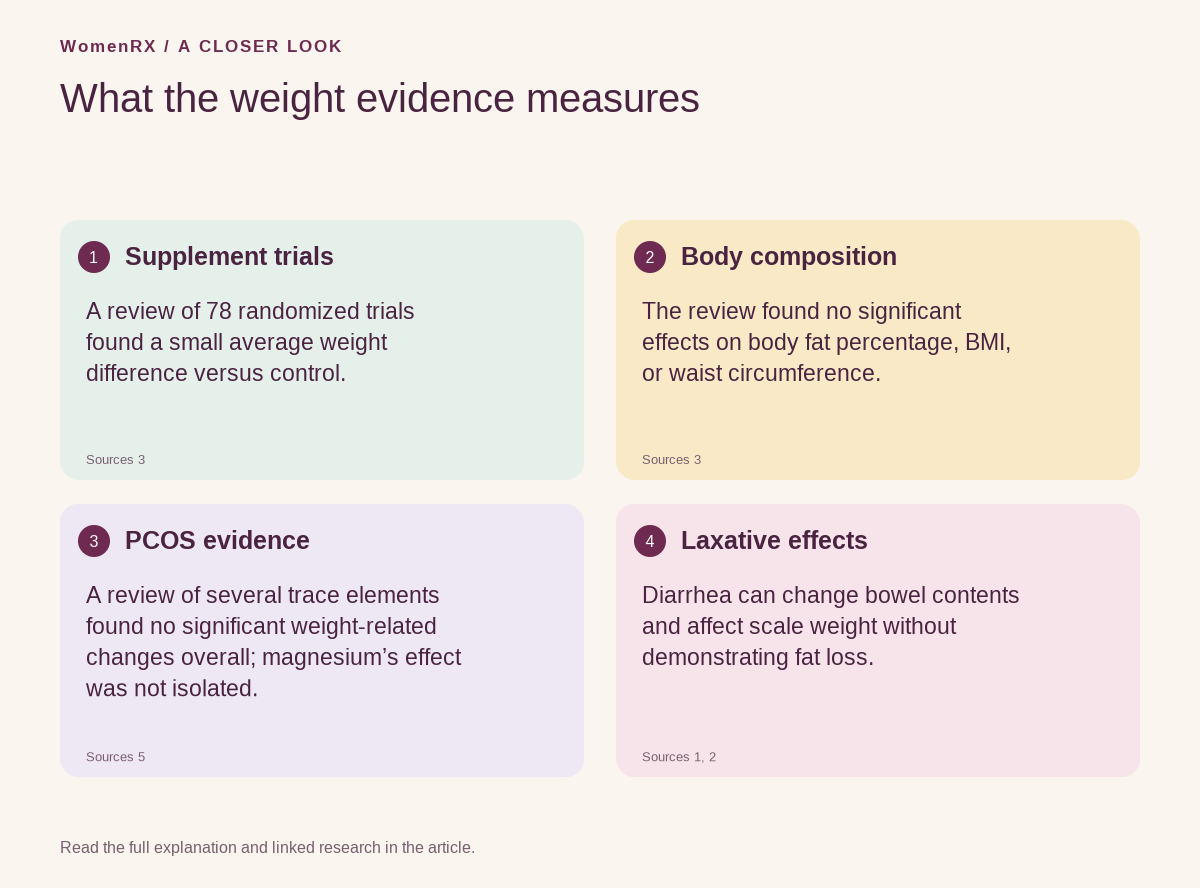
What the weight evidence measures
Supplement trials: A review of 78 randomized trials found a small average weight difference versus control.3
Body composition: The review found no significant effects on body fat percentage, BMI, or waist circumference.3
PCOS evidence: A review of several trace elements found no significant weight-related changes overall; magnesium’s effect was not isolated.5
Laxative effects: Diarrhea can change bowel contents and affect scale weight without demonstrating fat loss.12
Read the figure as text
These distinctions help separate the scale result from fat loss, dietary intake, and laxative-related changes.- Supplement trials: A review of 78 randomized trials found a small average weight difference versus control.3
- Body composition: The review found no significant effects on body fat percentage, BMI, or waist circumference.3
- PCOS evidence: A review of several trace elements found no significant weight-related changes overall; magnesium’s effect was not isolated.5
- Laxative effects: Diarrhea can change bowel contents and affect scale weight without demonstrating fat loss.12
More questions, answered
Does magnesium make you gain weight?
The trial review found a small average difference in the direction of lower, not higher, body weight compared with control. It does not establish a predictable weight effect for an individual woman. 3
Can magnesium-rich foods help with weight loss?
Foods such as beans, nuts, seeds, leafy greens, and whole grains provide magnesium, but that fact alone does not show that magnesium causes weight loss. Supplement trials and dietary patterns answer different questions. 1 3
Sources you can check
- Magnesium - Health Professional Fact SheetAccessed 2026-09-25Return to first citation
- Body Weight: MedlinePlusAccessed 2026-09-25Return to first citation
- Comprehensive Effects of Magnesium Supplementation on Cardiometabolic Risk Factors: A Systematic Review and Dose-Response Meta-Analysis.Mohammadi S, Palermo A, Ojani P, Alaghemand N, Pirayvatlou PS, Mirkarimi M, Mavi SA, Tahouri K, Shokouhifar S, Ettehad Y, Borzabadi A, Ashtary-Larky D, Suzuki K, Bouzas C, Rodrigue... · Nutrients · 2026Return to first citation
- Effects of 12-Week Multiple Micronutrient Supplementation on Immune Function, Body Weight, and Metabolic Parameters in Middle-Aged Women: A Retrospective Study.Sun Y. · Cureus · 2025Return to first citation
- The effects of trace element supplementation on glycolipid metabolism in PCOS: a systematic review and meta-analysis.Yang L, Gao Y, Zhao W, Qi Y, Duo X, Wang H. · Frontiers in nutrition · 2025Return to first citation