Does Flibanserin Affect Weight? What the Studies Show
Women taking flibanserin lost more weight on average than women taking placebo in a later analysis of clinical trials, but weight loss wasn’t the treatment goal.
In a post hoc analysis of placebo-controlled trials, women taking flibanserin lost more weight on average over 24 weeks than women taking placebo, both before and after menopause. That’s a group average, not a prediction of what will happen to you. Weight change isn’t listed in the current U.S. prescribing information’s common or less-common adverse-reaction tables, but those tables don’t capture every possible experience. 31
What the weight measurements found
If you’re considering flibanserin and wondering whether the scale might change, there’s more to go on than an adverse-effect list. Researchers went back to weight measurements from placebo-controlled trials of women treated for acquired, generalized hypoactive sexual desire disorder (HSDD). Weight had been measured to assess possible adverse effects, not to test flibanserin as a weight-loss treatment. 3
Among premenopausal women who completed 24 weeks, the adjusted average weight change was a loss of 1.4 kg for 1,010 women taking flibanserin, compared with 0.1 kg for 1,066 women taking placebo. Among postmenopausal women who completed 24 weeks, the corresponding losses were 1.8 kg for 385 women taking flibanserin and 0.1 kg for 425 taking placebo. These are averages among women with end-of-treatment weight measurements, not the amount every participant lost. 3
The separation from placebo makes the finding worth knowing before you start. It doesn’t make weight loss a reliable personal outcome or a reason to choose flibanserin for weight management. The weight analysis was done after the trials, and the women weren’t enrolled with a goal of losing weight. 3
What the product information does and doesn’t tell you
The current U.S. prescribing information presents adverse reactions separately for premenopausal women and postmenopausal women under 65. Its common and less-common adverse-reaction tables do not list weight gain or weight loss. They do list effects such as nausea, dizziness and sleepiness; peripheral edema, or swelling, appears among less-common reactions in the postmenopausal group. The postmarketing reaction list also does not identify weight change. An effect’s absence from these lists doesn’t mean it can’t happen to an individual. 1
That’s why the measured-weight study and the adverse-reaction lists answer different questions. The study compares average weight change between treatment groups. The lists report reactions meeting the labeling criteria, rather than showing how every woman’s weight moved during treatment. Neither tells you that your weight will stay steady, go down or go up. 31
Could nausea explain the average loss? The researchers examined that possibility and did not find that women who lost at least 5% of their starting weight reported more nausea than women who lost less. That finding doesn’t identify what caused the weight difference. 3
If your weight changes, put the change in context
A useful starting point is your usual weight before treatment. If you notice a change, note when it began and whether anything else changed around the same time, such as eating, activity, sleep, stress or another medicine. Weight includes water as well as fat, muscle and bone, so a scale reading alone can’t explain the cause. 2
Bring an unexpected gain or loss to the clinician who prescribes flibanserin, especially if the change is sudden. You can describe the pattern rather than trying to prove the medicine caused it: for example, “My weight began changing a few weeks after I started, and I’ve also noticed swelling.” Unintentional weight change can have causes other than a medicine, and sudden change warrants attention. 2 The trial averages are helpful context for that conversation, not a substitute for looking at what’s happening to you.
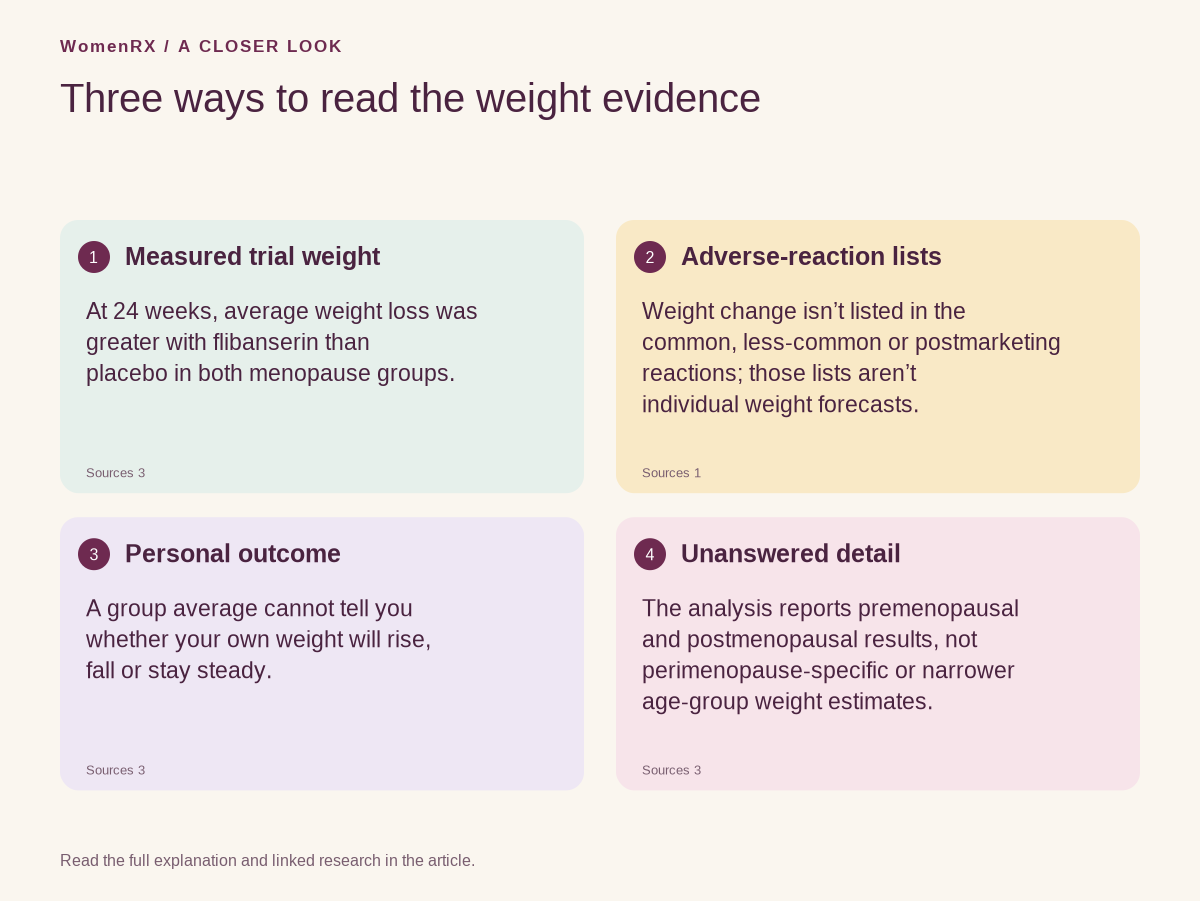
Three ways to read the weight evidence
Measured trial weight: At 24 weeks, average weight loss was greater with flibanserin than placebo in both menopause groups.3
Adverse-reaction lists: Weight change isn’t listed in the common, less-common or postmarketing reactions; those lists aren’t individual weight forecasts.1
Personal outcome: A group average cannot tell you whether your own weight will rise, fall or stay steady.3
Unanswered detail: The analysis reports premenopausal and postmenopausal results, not perimenopause-specific or narrower age-group weight estimates.3
Read the figure as text
These findings answer different questions about weight during flibanserin treatment.- Measured trial weight: At 24 weeks, average weight loss was greater with flibanserin than placebo in both menopause groups.3
- Adverse-reaction lists: Weight change isn’t listed in the common, less-common or postmarketing reactions; those lists aren’t individual weight forecasts.1
- Personal outcome: A group average cannot tell you whether your own weight will rise, fall or stay steady.3
- Unanswered detail: The analysis reports premenopausal and postmenopausal results, not perimenopause-specific or narrower age-group weight estimates.3
More questions, answered
Were weight results reported for different ages?
The weight analysis reports separate results for premenopausal and postmenopausal women, but it doesn’t provide weight-change estimates for narrower age groups or for perimenopause specifically. The prescribing information’s postmenopausal adverse-reaction tables concern women under 65, so they shouldn’t be read as a weight prediction for older women. 31
Sources you can check
- ADDYI (FLIBANSERIN) TABLET, FILM COATED [SPROUT PHARMACEUTICALS, INC.] | US prescribing information and patient instructionsAccessed 2026-09-25Return to first citation
- Body Weight: MedlinePlusAccessed 2026-09-25Return to first citation
- Effect of Flibanserin Treatment on Body Weight in Premenopausal and Postmenopausal Women with Hypoactive Sexual Desire Disorder: A Post Hoc Analysis.Kornstein SG, Simon JA, Apfel SC, Yuan J, Barbour KA, Kissling R. · Journal of women's health (2002) · 2017Return to first citation