Does a Mirena IUD Change How You Recognize Menopause?
A Mirena can change bleeding and provide contraception, but a quiet period calendar doesn’t tell you whether your ovaries have reached menopause.
Yes, it can make menopause harder to recognize by changing or stopping bleeding. Levonorgestrel IUDs can control bleeding, and some users have no periods, so absent bleeding alone doesn’t establish menopause. The IUD may also continue to provide contraception, but its contraceptive duration and any role in protecting the uterus during estrogen therapy need separate review. 2 3
When bleeding stops, the reason may not be menopause
A Mirena releases levonorgestrel in the uterus and can help manage bleeding. Some users stop bleeding altogether. That means a missed period or no periods while the IUD is in place can’t, by itself, tell you whether menopause has occurred: the device may have changed the bleeding pattern. 2
The IUD is not a menopause test. If you’re also noticing symptoms such as hot flashes or vaginal and urinary changes, those are useful to discuss, but they don’t make the IUD’s bleeding pattern a reliable way to date menopause. Menopause hormone therapy can treat certain symptoms, and whether it suits you depends on your health and circumstances. 1
Keep contraception separate from menopause status
Pregnancy may still be possible during the menopause transition, so an IUD can remain useful for contraception even when bleeding is light or absent. How long it can be used for contraception depends on the specific device and its approved use. Don’t assume that no bleeding means contraception is no longer needed, or that every levonorgestrel IUD has the same approved duration. 2 3
When reviewing your IUD, find the brand and insertion date. Ask how long that particular device can be relied on for contraception, and whether you still need contraception based on your situation. Those are separate questions from whether you’re in menopause.
Estrogen therapy raises a different question
If you have a uterus and are considering systemic estrogen, ask specifically about protection of the uterine lining. Estrogen without a progestogen can raise the risk of endometrial hyperplasia. A levonorgestrel IUD may be used as the progestogen component of hormone therapy, but this use is off-label in the United States. 2 3
The time an IUD can be used for contraception isn’t automatically the same as the time it can provide adequate uterine-lining protection alongside estrogen. A 2026 review notes that some IUDs have contraceptive approvals for up to eight years, while questions remain about endometrial protection beyond five years when estrogen is used. Don’t apply those durations to your device without checking its model and intended use. 3
Hormone therapy decisions also depend on factors such as the type, dose, route, duration, and whether a progestogen is included. The menopause symptoms being treated and your individual health matter too. 1
Make the conversation specific
Rather than asking only, “Am I menopausal?”, bring four details into the discussion: your IUD’s brand, when it was inserted, how your bleeding has changed, and whether you’re considering estrogen. Ask separately whether you still need contraception and whether your IUD is suitable and within the relevant time limit for uterine protection if you use systemic estrogen.
That separates what the device can do from what it can tell you. It can alter bleeding, help prevent pregnancy, and sometimes be part of an estrogen-therapy plan. None of those roles, on its own, establishes whether menopause has occurred.
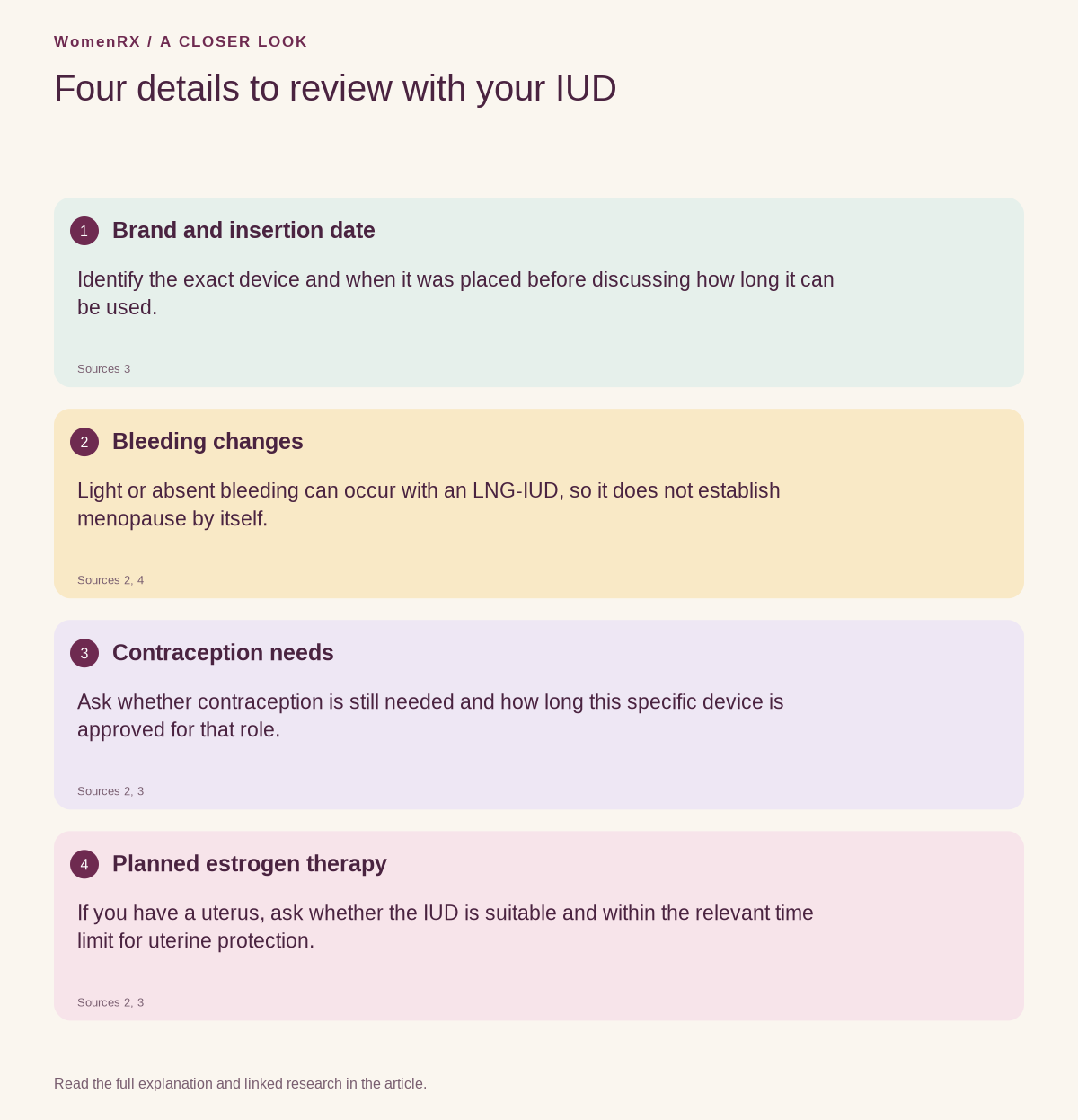
Four details to review with your IUD
Brand and insertion date: Identify the exact device and when it was placed before discussing how long it can be used.3
Bleeding changes: Light or absent bleeding can occur with an LNG-IUD, so it does not establish menopause by itself.24
Contraception needs: Ask whether contraception is still needed and how long this specific device is approved for that role.23
Planned estrogen therapy: If you have a uterus, ask whether the IUD is suitable and within the relevant time limit for uterine protection.23
Read the figure as text
This checklist separates bleeding, contraception, and estrogen-therapy questions. It is not a test for menopause.- Brand and insertion date: Identify the exact device and when it was placed before discussing how long it can be used.3
- Bleeding changes: Light or absent bleeding can occur with an LNG-IUD, so it does not establish menopause by itself.24
- Contraception needs: Ask whether contraception is still needed and how long this specific device is approved for that role.23
- Planned estrogen therapy: If you have a uterus, ask whether the IUD is suitable and within the relevant time limit for uterine protection.23
Sources you can check
- The 2022 hormone therapy position statement of The North American Menopause Society.“The 2022 Hormone Therapy Position Statement of The North American Menopause Society” Advisory Panel. · Menopause (New York, N.Y.) · 2022Return to first citation
- The levonorgestrel-releasing intrauterine system for endometrial protection during estrogen replacement therapy: a clinical review.Depypere H, Inki P. · Climacteric : the journal of the International Menopause Society · 2015Return to first citation
- Use of progestin-containing intrauterine systems in hormone therapy regimens: what are the data?Voedisch AJ. · Menopause (New York, N.Y.) · 2026Return to first citation
- Is it possible to investigate menopausal age? A comparative cross-sectional study of five cohorts between 1968 and 2017 from the Population Study of Women in Gothenburg, Sweden.Rödström K, Weman L, Sandin L, Hange D, Björkelund C. · Menopause (New York, N.Y.) · 2020Return to first citation