Do Women and Men Lose Weight Differently? Here’s What Studies Show
Some studies find similar weight-loss responses by sex, while others find differences in specific fat depots or hormone changes, so group averages aren’t personal predictions.
The evidence doesn’t support a blanket rule that women lose weight more slowly than men. In some intervention studies, researchers found no sex-related difference in response; in another, men lost more visceral fat on one diet comparison, which isn’t the same as losing more pounds overall. Life stage and the outcome being measured matter, too. 2 5 6
“Weight loss” can mean more than pounds
The scale combines fat, muscle, bone, and water. So two people can lose a similar amount of weight but differ in which tissues changed, and a change in a particular kind of body fat doesn’t automatically mean a bigger change on the scale. 1
That distinction helps make sense of mixed findings about women and men. Studies may measure total body weight, waist size, or a specific fat depot. Those outcomes answer different questions, and a result about one shouldn’t be treated as a result about all the others.
What direct comparisons have found
In a financial-incentive weight-loss trial analysis of 668 adults with obesity, 81% of whom were women, researchers found no differences in weight loss by sex. The incentives increased weight loss compared with providing weight-management resources alone, but their effect did not appear to vary across the demographic subgroups examined. This is evidence against assuming women respond less well to that particular approach. It doesn’t show that every woman and man will lose the same amount. 2
A secondary analysis of a 14-week trial of early time-restricted eating in adults with obesity also reported no differences in measured effects by sex. That’s one eating schedule, over a short period; it can’t establish that every diet works equally for everyone or that results will last. 5
A different picture appeared when researchers looked at visceral fat, the fat around internal organs, in a one-year comparison of low-carbohydrate and low-fat diets. Among the participants analyzed, the low-carbohydrate group lost more visceral fat than the low-fat group, and men had greater diet-related visceral-fat loss than women. That finding concerns a particular fat depot and diet comparison, not a general difference in pounds lost by women and men. 6
Taken together, these studies don’t point to one universal sex difference. They suggest that findings can depend on the intervention, the outcome measured, and the people included in a study.
Biology matters, but it isn’t a prediction
In adults with type 2 diabetes in the Look AHEAD sex-hormone study, the effects of an intensive lifestyle intervention on hormone levels differed between postmenopausal women and men. At one year, for example, women had decreases in estradiol and bioavailable testosterone, while men had an increase in testosterone; the hormone effects were less pronounced over four years. These changes show that weight loss can affect physiology differently in this group. They don’t establish that women lose weight more slowly, or tell any individual what her results will be. 4
A related analysis in people with type 2 diabetes found sex-specific links between hormone changes and later changes in body composition. In women, a decrease in bioavailable testosterone was associated with decreases in both fat mass and lean mass. That’s a reason to distinguish fat loss from changes in muscle and other lean tissue, not a basis for using hormone changes to predict an individual’s weight-loss response. 3
These findings apply to studied groups, including people with type 2 diabetes and postmenopausal women. They shouldn’t be automatically extended to cycling years, pregnancy, postpartum, or every stage of menopause. And the studies compare categories such as women and men; they don’t separate biological effects from gendered differences in daily demands, resources, or access to support.
Choose an approach around your actual goal
If you’re deciding between approaches, first ask what you want to change: overall weight, waist size, or a health measure. A study showing a difference in visceral fat doesn’t tell you which approach will produce the greatest scale change for you. These findings also don’t justify choosing a plan simply because you’re a woman or a man.
Consider the personal details a group average can’t capture: your health conditions, current life stage, and whether an approach fits your everyday routine. Weight itself is only one part of health, and BMI doesn’t distinguish fat from muscle or bone. 1 A more useful question than “Do women lose weight differently?” may be “What outcome matters to me, and which approach can I realistically sustain?”
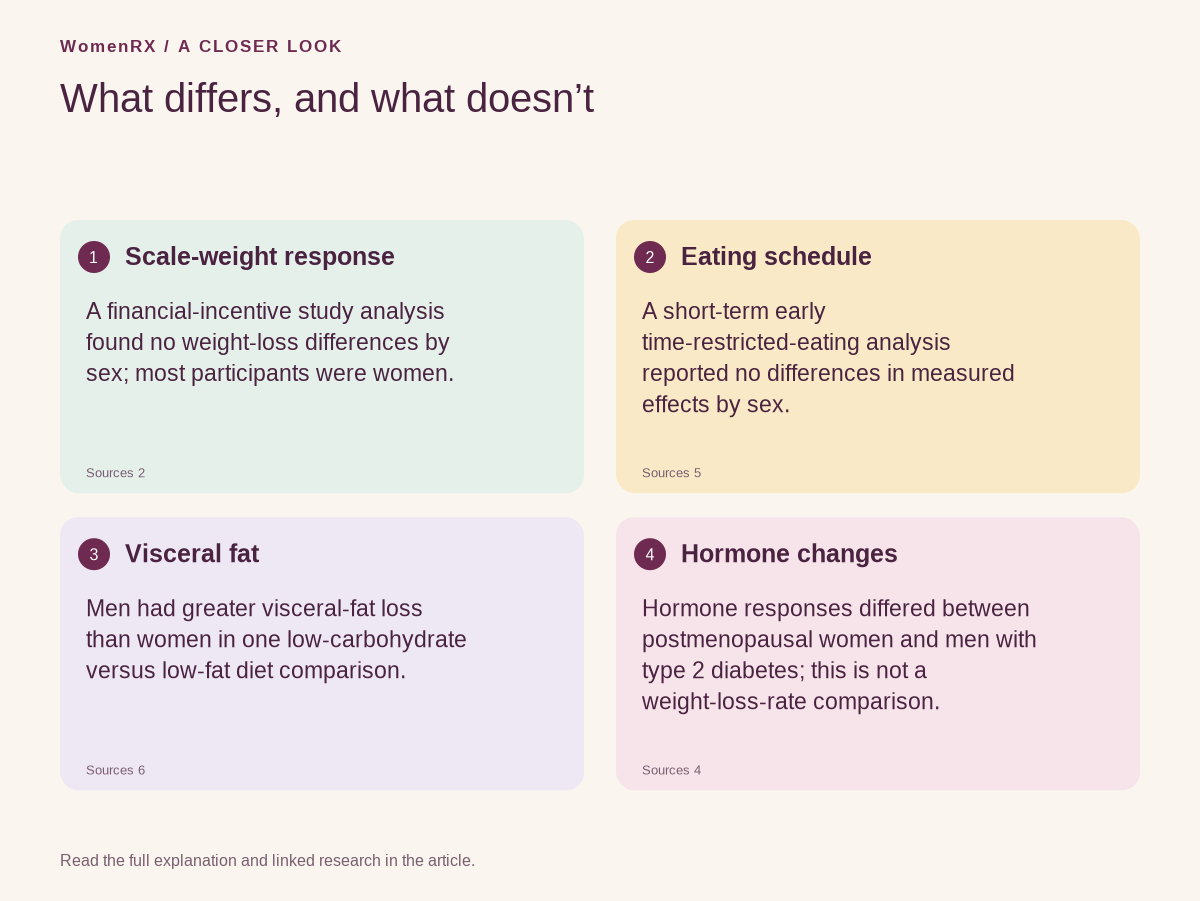
What differs, and what doesn’t
Scale-weight response: A financial-incentive study analysis found no weight-loss differences by sex; most participants were women.2
Eating schedule: A short-term early time-restricted-eating analysis reported no differences in measured effects by sex.5
Visceral fat: Men had greater visceral-fat loss than women in one low-carbohydrate versus low-fat diet comparison.6
Hormone changes: Hormone responses differed between postmenopausal women and men with type 2 diabetes; this is not a weight-loss-rate comparison.4
Read the figure as text
These findings concern different outcomes and study groups. Keep the measured result separate from a broad prediction about women’s or men’s weight loss.- Scale-weight response: A financial-incentive study analysis found no weight-loss differences by sex; most participants were women.2
- Eating schedule: A short-term early time-restricted-eating analysis reported no differences in measured effects by sex.5
- Visceral fat: Men had greater visceral-fat loss than women in one low-carbohydrate versus low-fat diet comparison.6
- Hormone changes: Hormone responses differed between postmenopausal women and men with type 2 diabetes; this is not a weight-loss-rate comparison.4
More questions, answered
Does a change in scale weight show how much fat I’ve lost?
No. Body weight includes muscle, bone, fat, and water, so the number on the scale doesn’t identify which part changed. 1
Do the hormone findings mean menopause makes weight loss slower?
The hormone study found different hormone changes in postmenopausal women and men with type 2 diabetes who took part in an intensive lifestyle intervention. It did not establish that menopause makes women lose weight more slowly. 4
Sources you can check
- Body Weight: MedlinePlusAccessed 2026-09-25Return to first citation
- Association Between Sociodemographic Characteristics and Weight Loss in a Financial Incentive Intervention for Adults With Obesity Living in Low-Income Neighborhoods.Ladapo JA, Orstad SL, Sheer AJ, Tseng CH, Rebecca Chung UY, Shu SB, Goldstein NJ, Jay M, Wali S. · American journal of health promotion : AJHP · 2026Return to first citation
- Role of Sex Hormones in Mediating Adiposity Changes From Weight Loss in People With Type 2 Diabetes: Look AHEAD Sex Hormone Study.Oyeka CP, He JH, Ma J, Michos ED, Kalyani RR, Woodward M, Vaidya D, Bennett WL. · The Journal of clinical endocrinology and metabolism · 2025Return to first citation
- Weight Loss Differentially Impacts Sex Hormones in Women and Men With Type 2 Diabetes: Look AHEAD Sex Hormone Study.Bennett WL, He JH, Michos ED, Kalyani RR, Clark JM, Woodward M, Syed N, Ma J, Everett AD, Yang J, Graham D, Ellis G, Vaidya D. · The Journal of clinical endocrinology and metabolism · 2025Return to first citation
- Do the Effects of Early Time-Restricted Eating Vary by Cardiometabolic Phenotype, Age, Sex, or Race? A Secondary Analysis of a Randomized Controlled Trial.Rehman Z, Altonji OM, Steger FL, Jamshed H, Richman JS, Warriner AH, Peterson CM. · The Journal of nutrition · 2026Return to first citation
- Effect of low-carbohydrate vs low-fat diet intervention on visceral fat estimated from dual energy X-ray absorptiometry in a 12-month randomized controlled trial.Follis S, Landry MJ, Cunanan KM, Stefanick ML, Ward CP, Gardner CD. · International journal of obesity (2005) · 2026Return to first citation