D-Chiro-Inositol Labels: How to Check the Study Match
A study of one inositol blend can’t tell you whether a different D-chiro-inositol product will help with PCOS.
Start with the D-chiro-inositol (DCI) amount in the full daily serving, then check myo-inositol and other ingredients separately. One observational PCOS study reported a combination described as 550 mg MI and 150 mg DCI, but it doesn’t establish a DCI-alone dose or an optimal daily regimen. A ratio or “clinically studied” claim matters only if you can identify the formulation and outcome. 5
First, work out what’s in the daily serving
A prominent number on the front of a bottle may describe one serving, a full day’s suggested servings, or a blend of ingredients. Use the Supplement Facts panel to find DCI per serving, then check the label’s suggested number of servings per day. Keep that daily DCI amount separate from the amount of myo-inositol (MI).
If a label gives only a combined inositol amount, you can’t tell how much of it is DCI. And if it gives only an MI-to-DCI ratio, the ratio alone doesn’t tell you either ingredient’s amount. If the label gives both a combined amount and a clearly defined ratio, you may be able to calculate the individual amounts, as long as the combined amount refers only to those two ingredients. Verify the result against the label or the manufacturer’s ingredient breakdown.
A studied blend isn’t a studied DCI dose
DCI and MI are different forms of inositol. Both are discussed in PCOS research, but a finding about a product containing both forms doesn’t show what DCI would do on its own. A 2025 narrative review discusses their potentially different effects on ovarian steroid production and describes a 40:1 MI-to-DCI ratio. It also says that whether inositol treatment works similarly across PCOS phenotypes needs further assessment. That discussion doesn’t make 40:1 the right ratio for every woman with PCOS. 3
The distinction matters when a product cites a clinical study. One observational study followed 283 women with PCOS who received an MI-DCI combination reported in the abstract as 550 mg MI and 150 mg DCI. The abstract does not specify a daily schedule, establish an optimal dose, or show that DCI alone caused the reported changes in metabolic and hormonal measures. 5
Another observational PCOS study evaluated a product containing MI and DCI plus chromium, antioxidants, and vitamins. Its findings cannot be assigned to DCI, or even to the two inositols together, apart from the other ingredients. 6
To assess a “clinically studied” claim, look for the actual study and compare four things: the amounts of each ingredient, the other ingredients, who participated, and what outcome was measured. A match on the word inositol isn’t enough.
Pregnancy research answers a different question
If you’re planning pregnancy or receiving fertility care, be especially careful about borrowing a dose from a pregnancy study. Researchers have tested inositol for gestational diabetes prevention, which is not the same question as whether DCI helps with PCOS symptoms, ovulation, or fertility treatment.
A 2022 review of randomized pregnancy trials reported a benefit for a formulation providing 4 grams of MI per day compared with control. It found no difference from control on the evaluated outcomes for a separate formulation providing 1.1 grams of MI plus 27.6 milligrams of DCI per day. An earlier review likewise found a significant effect only in the MI-only subgroup after separating those two types of formulation. Neither result supplies a DCI-alone dose for PCOS or establishes that a retail DCI product is safe during pregnancy. 1 2
If a fertility or pregnancy claim appears on the label, ask which formulation and outcome support it. If you’re pregnant, trying to conceive, or in fertility treatment, the complete ingredient list is more useful to your care team than the product name alone.
Keep safety claims tied to the formula tested
“No adverse effects reported” doesn’t mean every dose and combination has been shown safe. For example, a pilot study followed 15 adults taking lithium or valproic acid who also took one MI-DCI combination with alpha-lactalbumin for six months. The researchers reported that the participants’ medicine regimens needed no adjustment. That small study is not a general interaction clearance for DCI-only products, different blends, or everyone taking those medicines. 4
The PCOS narrative review also raises a concern about high DCI levels and ovarian steroid production. It does not establish that a particular product causes harm, but it undercuts the marketing assumption that more DCI must be better. 3
A label check you can take with you
Write down the DCI amount in the full suggested daily serving, the MI amount, and every additional active ingredient. Then note the study a seller cites, if any. If its formula or research question differs from yours, treat the claim as a poor match rather than a dose to copy.
Two focused questions for a clinician or pharmacist are: “Does this study test the same ingredients and amounts as this label?” and “Do any ingredients matter for my PCOS care, medicines, or pregnancy plans?”
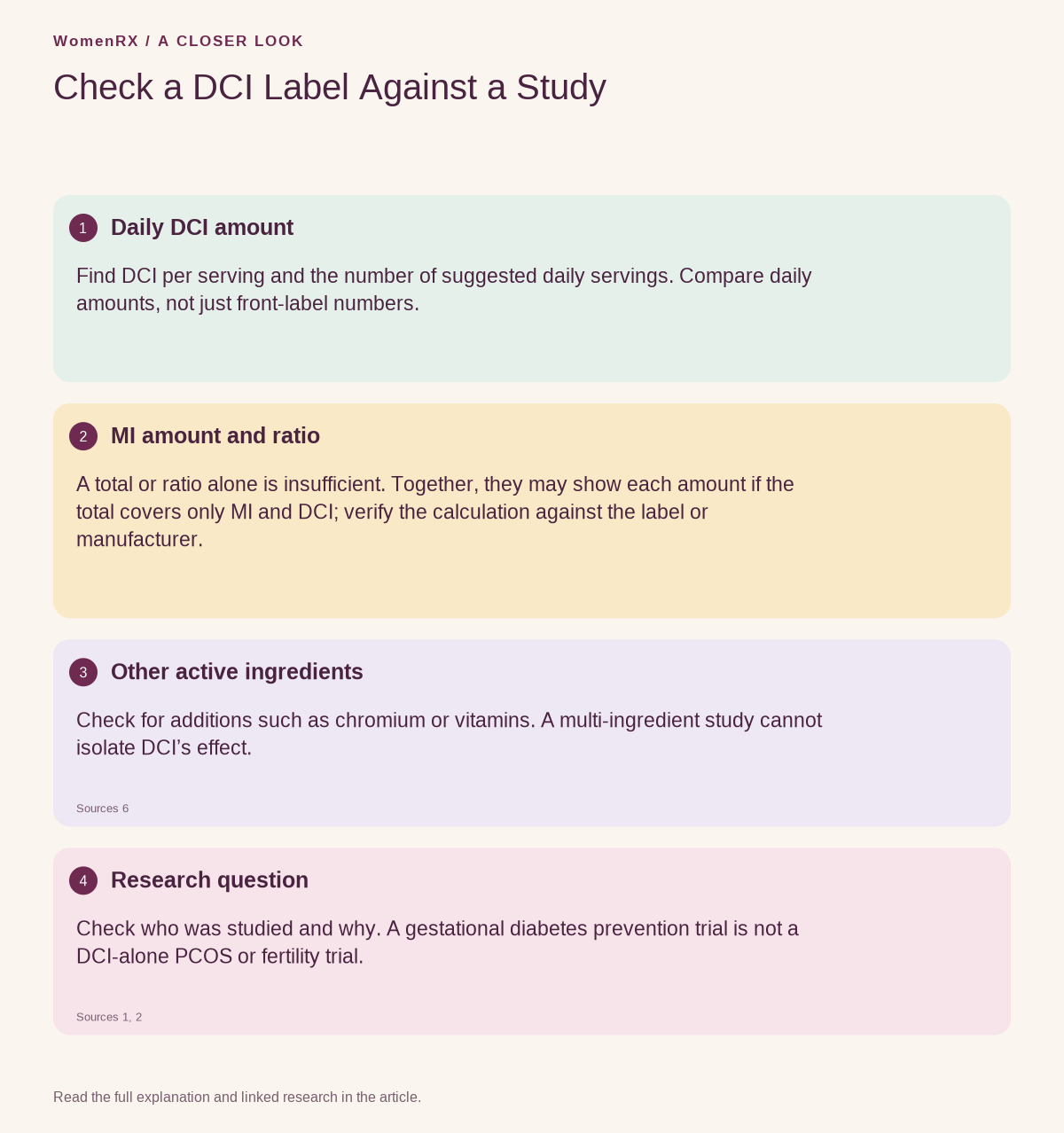
Check a DCI Label Against a Study
Daily DCI amount: Find DCI per serving and the number of suggested daily servings. Compare daily amounts, not just front-label numbers.
MI amount and ratio: A total or ratio alone is insufficient. Together, they may show each amount if the total covers only MI and DCI; verify the calculation against the label or manufacturer.
Other active ingredients: Check for additions such as chromium or vitamins. A multi-ingredient study cannot isolate DCI’s effect.6
Research question: Check who was studied and why. A gestational diabetes prevention trial is not a DCI-alone PCOS or fertility trial.12
Read the figure as text
Use these four checks to tell whether a product resembles the formulation behind its marketing claim.- Daily DCI amount: Find DCI per serving and the number of suggested daily servings. Compare daily amounts, not just front-label numbers.
- MI amount and ratio: A total or ratio alone is insufficient. Together, they may show each amount if the total covers only MI and DCI; verify the calculation against the label or manufacturer.
- Other active ingredients: Check for additions such as chromium or vitamins. A multi-ingredient study cannot isolate DCI’s effect.6
- Research question: Check who was studied and why. A gestational diabetes prevention trial is not a DCI-alone PCOS or fertility trial.12
Sources you can check
- Inositol Nutritional Supplementation for the Prevention of Gestational Diabetes Mellitus: A Systematic Review and Meta-Analysis of Randomized Controlled Trials.Wei J, Yan J, Yang H. · Nutrients · 2022Return to first citation
- Inositol for the prevention of gestational diabetes: a systematic review and meta-analysis of randomized controlled trials.Vitagliano A, Saccone G, Cosmi E, Visentin S, Dessole F, Ambrosini G, Berghella V. · Archives of gynecology and obstetrics · 2019Return to first citation
- PCOS and Inositols - Advances and Lessons We are Learning. A Narrative Review.Lentini G, Querqui A, Monti N, Bizzarri M. · Drug design, development and therapy · 2025Return to first citation
- Safety of inositol supplementation in patients taking lithium or valproic acid: a pilot clinical study.Cantelmi T, Lepore E, Unfer VR, Unfer V. · European review for medical and pharmacological sciences · 2022Return to first citation
- Management of polycystic ovary syndrome among Indian women using myo-inositol and D-chiro-inositol.Vyas L, Raiturker AP, Sud S, Goyyal P, Abhyankar M, Revankar S, Walia S. · Bioinformation · 2022Return to first citation
- Efficacy of combination therapy of inositols, antioxidants and vitamins in obese and non-obese women with polycystic ovary syndrome: an observational study.Advani K, Batra M, Tajpuriya S, Gupta R, Saraswat A, Nagar HD, Makwana L, Kshirsagar S, Kaul P, Ghosh AK, Pradhan S, Mehta A, Jaiswal A, Nakhate KT, Kamdi S. · Journal of obstetrics and gynaecology : the journal of the Institute of Obstetrics and Gynaecology · 2020Return to first citation