Chasteberry Dosage: What Trial Labels Can Actually Tell You
Studies report amounts for particular Vitex extracts, not one interchangeable dose for every chasteberry product.
Trials of chasteberry for cyclic breast pain and premenstrual symptoms commonly used 20-40 mg a day, but those figures refer to specific preparations and don’t establish a universal dose. One PMS study used a named 40 mg extract for three menstrual cycles. Check the product’s extract details, and get medication-specific advice before using it, especially during pregnancy or breastfeeding. 1 3 4
A chasteberry label can show a number of milligrams without telling you whether that product matches one used in a study. Research on Vitex agnus-castus has tested different extracts for different menstrual concerns, so the amount alone isn’t enough to choose a product or predict what it might do.
The trial amounts came with specific preparations
Reviews of studies for cyclic breast pain and premenstrual symptoms report amounts commonly in the range of 20-40 mg daily. Those are study amounts, not a recommended dose for every product. The breast-pain review also found that treatment commonly lasted three months. 1 3
A review of premenstrual-symptom trials describes one study using 40 mg daily of BNO1095, identified as a 70% extract, over three menstrual cycles. That detail helps show why a number without the preparation name and study context can mislead: the finding was about that extract and study, not every capsule containing 40 mg of chasteberry. 3
The broader evidence is encouraging but not uniform. A review of randomized trials found that seven of eight PMS studies reported better results with Vitex than with a comparator, but the trials varied in quality and in what they compared. For cyclic breast pain, a meta-analysis reported a benefit over placebo in its analysis of six studies, while noting that most studies had unclear risk of bias. Neither review establishes one best product or dose for all menstrual symptoms. 1 2
A practical way to read the label
Use the label to gather information, not to assume equivalence with a research product. Compare:
- The named preparation: Does it identify an extract or just say chasteberry or Vitex?
- The amount and serving: What amount is listed, and is it per capsule or per serving?
- Any extract details: Does the label give information that lets you compare the preparation with the one studied?
- Other ingredients: Is it a single-ingredient product or a combination? Combination products don’t match trials of Vitex used on its own. 2 3
If the label doesn’t provide enough detail to identify the preparation, you can’t reliably match its milligram amount to a trial. The available reviews describe different extracts and treatment schedules, rather than showing that all products with the same listed amount have the same evidence. 1 2 3
Situations that call for specific advice
Pregnancy or breastfeeding: A systematic review of adverse events advises avoiding Vitex during pregnancy or lactation. The studies don’t establish that it is safe in either situation, so don’t treat a menstrual-symptom dose as appropriate during pregnancy or breastfeeding. 4
Medicines that affect dopamine: The adverse-event review found no reported drug interactions in the material it assessed, but it also noted a theoretical possibility that Vitex could interfere with dopamine-blocking medicines. If you take one, ask a pharmacist or prescriber about your specific medication before trying the supplement. 4
Hormonal treatment or contraception: Some trials compared Vitex with pharmaceutical treatments, including hormonal contraceptives. A comparison of treatments doesn’t show that taking them together is safe or useful. If you use hormonal treatment, ask about the specific product and medicine combination rather than assuming the trial results apply to co-use. 1 2
Reported adverse effects in the systematic safety review were generally mild and reversible; they included nausea, headache, digestive symptoms, menstrual changes, acne, itching, and rash. That doesn’t guarantee an individual product will be free of side effects. If symptoms appear after starting it, contact a pharmacist or prescriber about symptoms you think may be related before continuing or switching products. 4
The useful question isn’t simply “How many milligrams?” It’s “Which preparation was studied for my concern, and can I identify that preparation on this label?” If you can’t answer the second part, the trial dose isn’t a dependable shortcut.
Compare the label with the study
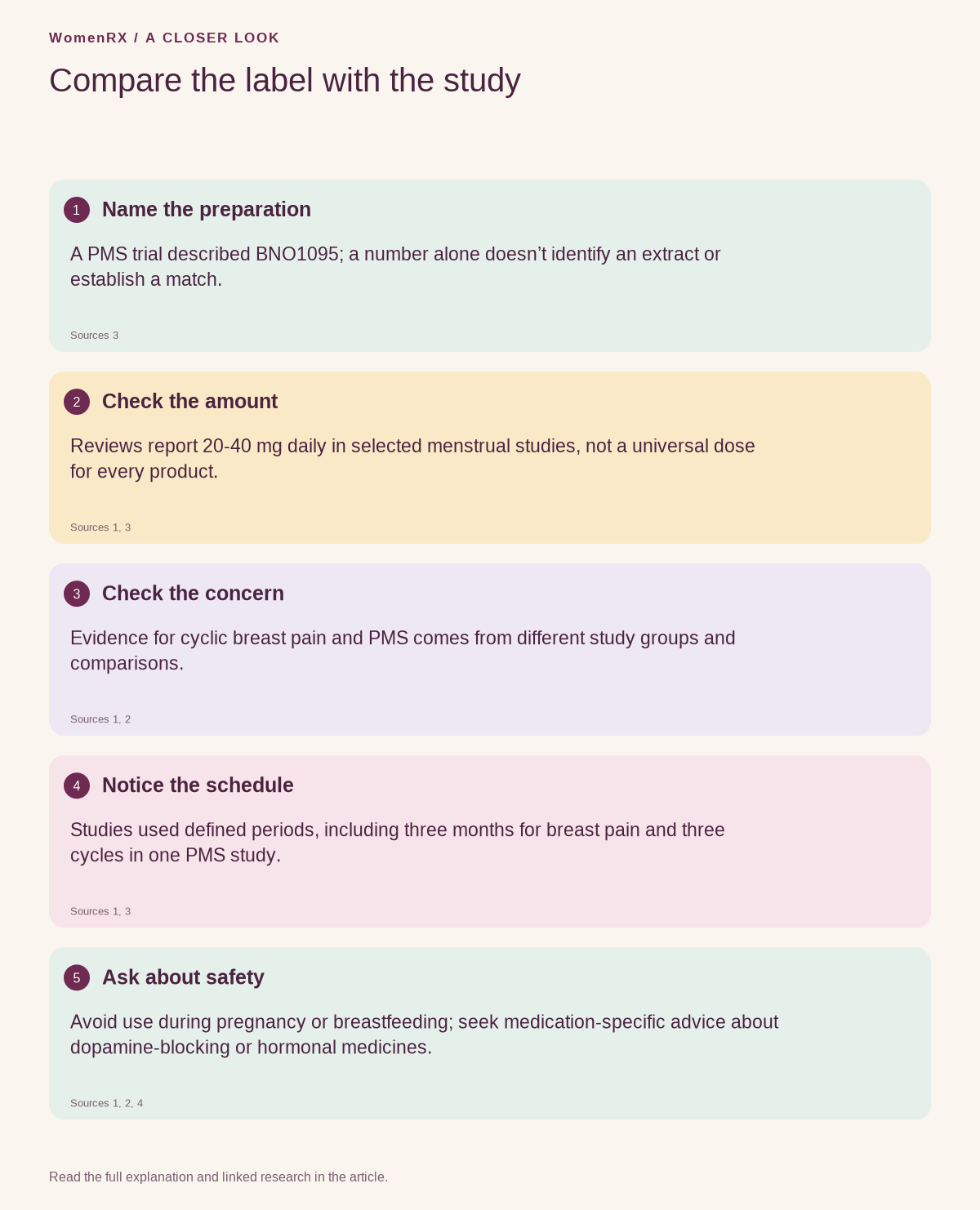
Name the preparation: A PMS trial described BNO1095; a number alone doesn’t identify an extract or establish a match.3
Check the amount: Reviews report 20-40 mg daily in selected menstrual studies, not a universal dose for every product.13
Check the concern: Evidence for cyclic breast pain and PMS comes from different study groups and comparisons.12
Notice the schedule: Studies used defined periods, including three months for breast pain and three cycles in one PMS study.13
Ask about safety: Avoid use during pregnancy or breastfeeding; seek medication-specific advice about dopamine-blocking or hormonal medicines.124
Read the figure as text
A listed milligram amount is only one part of a comparison. These checks help distinguish a trial preparation from a product that merely shares its number.- Name the preparation: A PMS trial described BNO1095; a number alone doesn’t identify an extract or establish a match.3
- Check the amount: Reviews report 20-40 mg daily in selected menstrual studies, not a universal dose for every product.13
- Check the concern: Evidence for cyclic breast pain and PMS comes from different study groups and comparisons.12
- Notice the schedule: Studies used defined periods, including three months for breast pain and three cycles in one PMS study.13
- Ask about safety: Avoid use during pregnancy or breastfeeding; seek medication-specific advice about dopamine-blocking or hormonal medicines.124
More questions, answered
Does 40 mg on a label mean the product matches a 40 mg trial?
Not by itself. A PMS trial described 40 mg daily of a particular extract, BNO1095. The broader reviews include different preparations, so the number alone doesn’t establish a match. 2 3
Did studies show chasteberry is safe to take with hormonal birth control?
The studies described don’t establish safety when they’re taken together. Trials comparing Vitex with hormonal contraceptives studied it as an alternative treatment, not as proof that combining them is safe. 1
Sources you can check
- Vitex Agnus-Castus for the Treatment of Cyclic Mastalgia: A Systematic Review and Meta-Analysis.Ooi SL, Watts S, McClean R, Pak SC. · Journal of women's health (2002) · 2020Return to first citation
- Vitex agnus-castus extracts for female reproductive disorders: a systematic review of clinical trials.van Die MD, Burger HG, Teede HJ, Bone KM. · Planta medica · 2013Return to first citation
- Effects and treatment methods of acupuncture and herbal medicine for premenstrual syndrome/premenstrual dysphoric disorder: systematic review.Jang SH, Kim DI, Choi MS. · BMC complementary and alternative medicine · 2014Return to first citation
- Vitex agnus castus: a systematic review of adverse events.Daniele C, Thompson Coon J, Pittler MH, Ernst E. · Drug safety · 2005Return to first citation