Can Menopause Cause Nausea? What Else to Check
Nausea can coincide with midlife, but its timing alone doesn’t identify the cause, so pregnancy, medicines, supplements, and other possibilities deserve a look too.
Nausea may occur while you’re going through menopause, but that timing alone doesn’t show that menopause caused it. Pregnancy is one possibility if you can become pregnant. 1 GLP-1 medicines can contribute, and mild nausea has been reported among people taking evening primrose oil for hot flashes. 3 6 Check for recent changes and related symptoms. Seek medical help immediately if you have reason to think vomiting is due to poisoning or have signs of dehydration, such as very infrequent urination or dark urine. 1 2
Nausea by itself doesn’t point to menopause
Feeling nauseated during midlife doesn’t tell you why it’s happening. A small trial of a supplement studied for menopausal symptoms reported nausea as a mild adverse event during the trial in one treatment group. That tells us nausea can occur while someone is using a menopause-related product; it doesn’t show that menopause itself caused the symptom. 5
It’s reasonable to consider menopause as part of the context, especially if you’re also experiencing other changes, but don’t let that explanation crowd out other possibilities. Nausea has many potential causes. MedlinePlus names pregnancy and intestinal obstruction among them, and evaluation may include a review of symptoms, an exam, and, for women, a pregnancy test. 1
Three useful checks
Could pregnancy be possible? Nausea and vomiting are common during pregnancy. If pregnancy is possible, include it in your thinking rather than assuming midlife symptoms are menopause-related. A pregnancy test may be part of a medical evaluation for nausea. 1 4
Did a medicine or supplement change? Look for something new, a recent change, or a product you’ve started taking. GLP-1 receptor agonists are one specific example: a review reports that gastrointestinal symptoms, particularly nausea, vomiting, and diarrhea, are among their most common adverse events. 3 A systematic review of evening primrose oil studies for hot flashes also reported mild nausea among participants. These examples don’t mean a particular product is the cause of your nausea, but they make a medication and supplement check worthwhile. 6
What else is happening with the nausea? Notice whether you’re vomiting, having diarrhea, or struggling to drink. These details matter because fluid loss and reduced intake can lead to dehydration. If nausea is repeated or doesn’t ease, describing when it began, what changed around that time, and any other symptoms can help a clinician assess possible causes. The evaluation may involve questions about your medical history, a physical exam, and sometimes tests. 1 2
What you can try while you assess it
If you’re able to drink, take small, frequent sips of clear fluids. Bland foods and smaller, more frequent meals may be easier to manage; avoid foods or strong smells that seem to trigger nausea. These steps may help you feel better, but they don’t identify or treat the underlying cause. 1
If you’re pregnant, treatment for pregnancy-related nausea depends on severity. 4
When to get help
Seek medical help immediately if you have signs of dehydration, such as a dry mouth, urinating much less often, or dark urine. MedlinePlus also advises contacting a health care provider immediately if you have reason to think vomiting is due to poisoning. Confusion can be a sign of severe dehydration and needs immediate medical help. 1 2
If you can’t keep liquids down, don’t wait for a menopause explanation to resolve the problem. Severe vomiting can require medical treatment, including fluids. 1 4
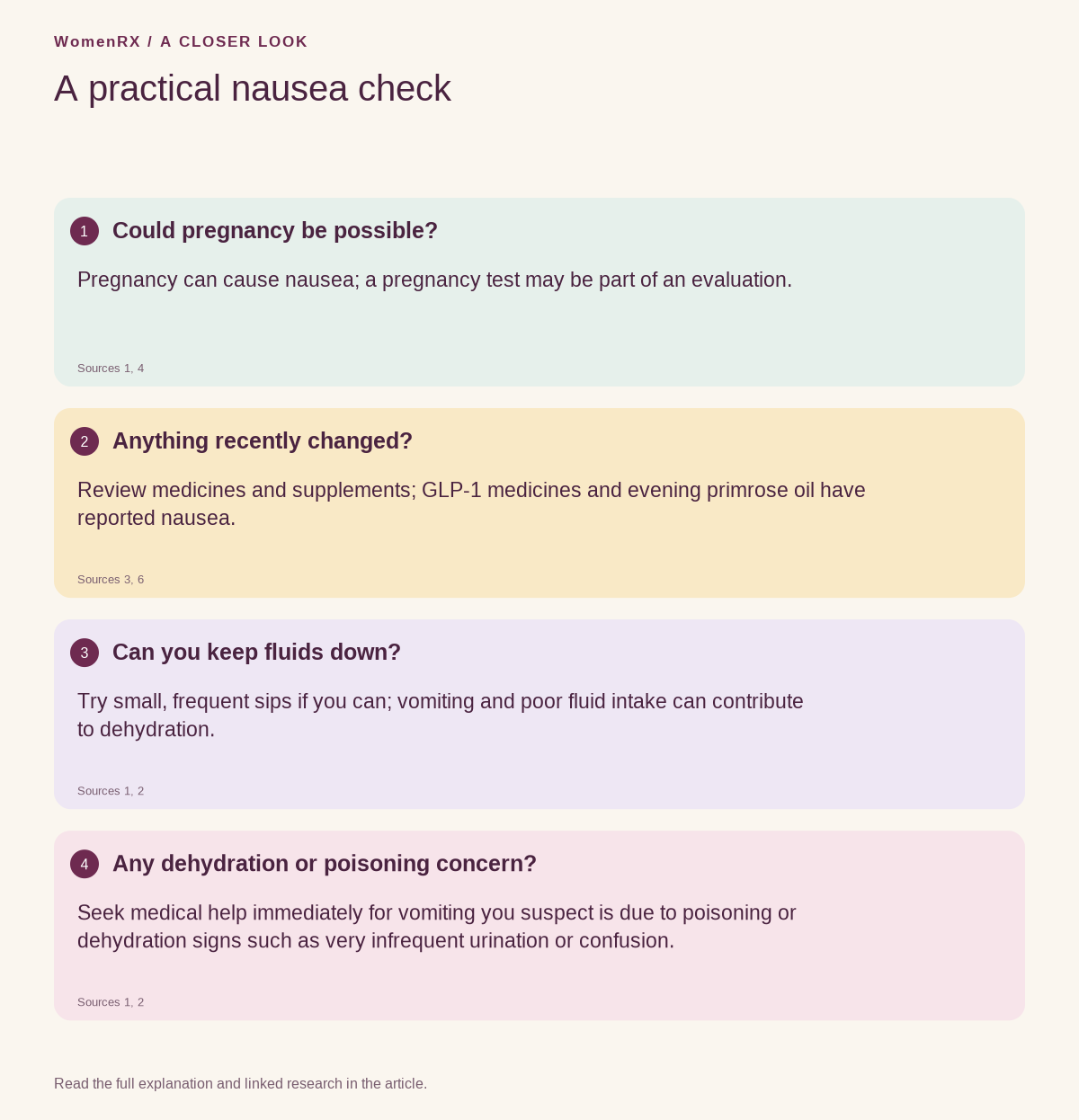
A practical nausea check
Could pregnancy be possible?: Pregnancy can cause nausea; a pregnancy test may be part of an evaluation.14
Anything recently changed?: Review medicines and supplements; GLP-1 medicines and evening primrose oil have reported nausea.36
Can you keep fluids down?: Try small, frequent sips if you can; vomiting and poor fluid intake can contribute to dehydration.12
Any dehydration or poisoning concern?: Seek medical help immediately for vomiting you suspect is due to poisoning or dehydration signs such as very infrequent urination or confusion.12
Read the figure as text
Use these questions to decide what to consider first and when symptoms need immediate attention.- Could pregnancy be possible?: Pregnancy can cause nausea; a pregnancy test may be part of an evaluation.14
- Anything recently changed?: Review medicines and supplements; GLP-1 medicines and evening primrose oil have reported nausea.36
- Can you keep fluids down?: Try small, frequent sips if you can; vomiting and poor fluid intake can contribute to dehydration.12
- Any dehydration or poisoning concern?: Seek medical help immediately for vomiting you suspect is due to poisoning or dehydration signs such as very infrequent urination or confusion.12
More questions, answered
Does nausea mean I’m entering menopause?
No. Nausea alone can’t identify menopause as the cause. Consider pregnancy if possible, and check medicines and supplements as well. 1 3 6
Could a supplement for menopause symptoms cause nausea?
It’s possible. Mild nausea was reported in studies of evening primrose oil for hot flashes, and a small trial of Shatavari reported nausea as a mild adverse event in one treatment group. Those reports concern products used for menopausal symptoms, not proof that menopause itself causes nausea or that Shatavari caused the reported nausea. 5 6
Sources you can check
- Nausea | Vomiting | MedlinePlusAccessed 2026-09-25Return to first citation
- Dehydration: MedlinePlusAccessed 2026-09-25Return to first citation
- Potential oral and maxillofacial adverse events associated with glucagon-like peptide-1 receptor agonist administration: a narrative review.Brooks JK, Sultan AS. · Quintessence international (Berlin, Germany : 1985) · 2026Return to first citation
- Nausea and Vomiting During Pregnancy.Williamson B, Light KJ, Chapa H. · American family physician · 2026Return to first citation
- Efficacy and safety of Shatavari root extract (Asparagus racemosus) for menopausal symptoms: a randomized, double-blind, three-arm, placebo-controlled study.Ademola J, Ajgaonkar A, Debnath T, Debnath K, Langade J. · Frontiers in reproductive health · 2025Return to first citation
- Evening Primrose Oil for Menopause Hot Flashes: Systematic Review and Meta-Analysis.Thevi T, De S, Soe HHK. · Journal of menopausal medicine · 2024Return to first citation