Can Grief Affect Your Physical Health?
Sleep, appetite, energy, and pain can change after a loss, but a new symptom deserves attention on its own terms.
Yes. Grief can come with sleep problems and appetite changes, while stress or too little sleep can leave you fatigued. Stress may also affect how pain feels. None of that proves grief caused a particular symptom. If fatigue hasn’t improved after several weeks, or you have pain you can’t explain, make room for a medical assessment as well as support for your loss. 1 2 3
What grief can feel like in your body
After a loss, you might find yourself awake at night, uninterested in meals, or worn out by an ordinary day. Bereavement can involve physical reactions, including sleep problems and appetite changes. It can also bring sadness, anger, guilt, or anxiety. There’s no fixed schedule for how long those reactions last. 1
Sleep and energy are closely connected in everyday life: too little sleep and emotional stress are both possible contributors to fatigue. But fatigue is a symptom, not a diagnosis. Anemia, thyroid disease, infections, sleep disorders, depression, and other conditions can also be involved. You can recognize that your energy changed after a loss without having to decide that grief explains it completely. 2
Pain needs the same care in interpretation. Stress can affect how pain feels, but pain may also signal an injury or another health problem. Its location, pattern, and effect on your daily life are more useful clues than the fact that it started during a difficult time. 3
Give the symptom its own attention
A simple distinction can help: What has changed since the loss, and what needs checking even if grief is part of the picture? For example, if you’re tired after several nights of poor sleep, note both the sleep change and the fatigue. If an ache is new, note where it is, whether it comes and goes, and what makes it better or worse. These notes aren’t a test for whether a symptom is “just grief.” They help you see a pattern and describe it clearly. MedlinePlus suggests a fatigue diary for noticing changes in energy; its pain guidance emphasizes location, relief, and effects on daily life. 2 3
If fatigue hasn’t improved after several weeks, contact a healthcare provider to look for possible causes. Pain with no clear cause, especially when it affects what you can do, is also worth discussing rather than automatically attributing it to stress. An assessment can address the physical symptom without asking you to set your grief aside. 2 3
The kind of loss can change what else is going on
If you’ve lost someone you cared for day to day, the loss may come with a sudden change in routine. As an example, you might notice that your sleep or meals now happen at different times. Include those changes when you describe fatigue; sleep and appetite are relevant to understanding it. A pilot support program for bereaved caregivers reported improvements in depressive symptoms, anxiety, stress, and anger among participants. Those findings don’t tell us whether the program improves physical symptoms. 1 2 5
After a pregnancy loss, emotional grief and questions about physical symptoms may arrive together. General bereavement information can help make sense of sleep or appetite changes, but it cannot tell you whether a particular new pain or ongoing fatigue is part of physical recovery. Describe the symptom on its own terms and seek assessment when its cause is unclear or fatigue continues for weeks. 1 2 3
Nor is there one physical response that applies to women. In a longitudinal study of independent adults aged 65 and older in Japan, women who had lost a spouse were more likely to attend health screening but became more sedentary. That’s a finding about health behaviors in an older, widowed population, not a prediction of how you’ll grieve or what symptoms you’ll have. 4
Physical care and grief support can happen together. Friends, family, or a faith community may be sources of support, and some people find grief counseling or therapy helpful. Reaching for that support doesn’t mean your grief is a disorder, just as getting a symptom checked doesn’t mean your grief isn’t real. 1
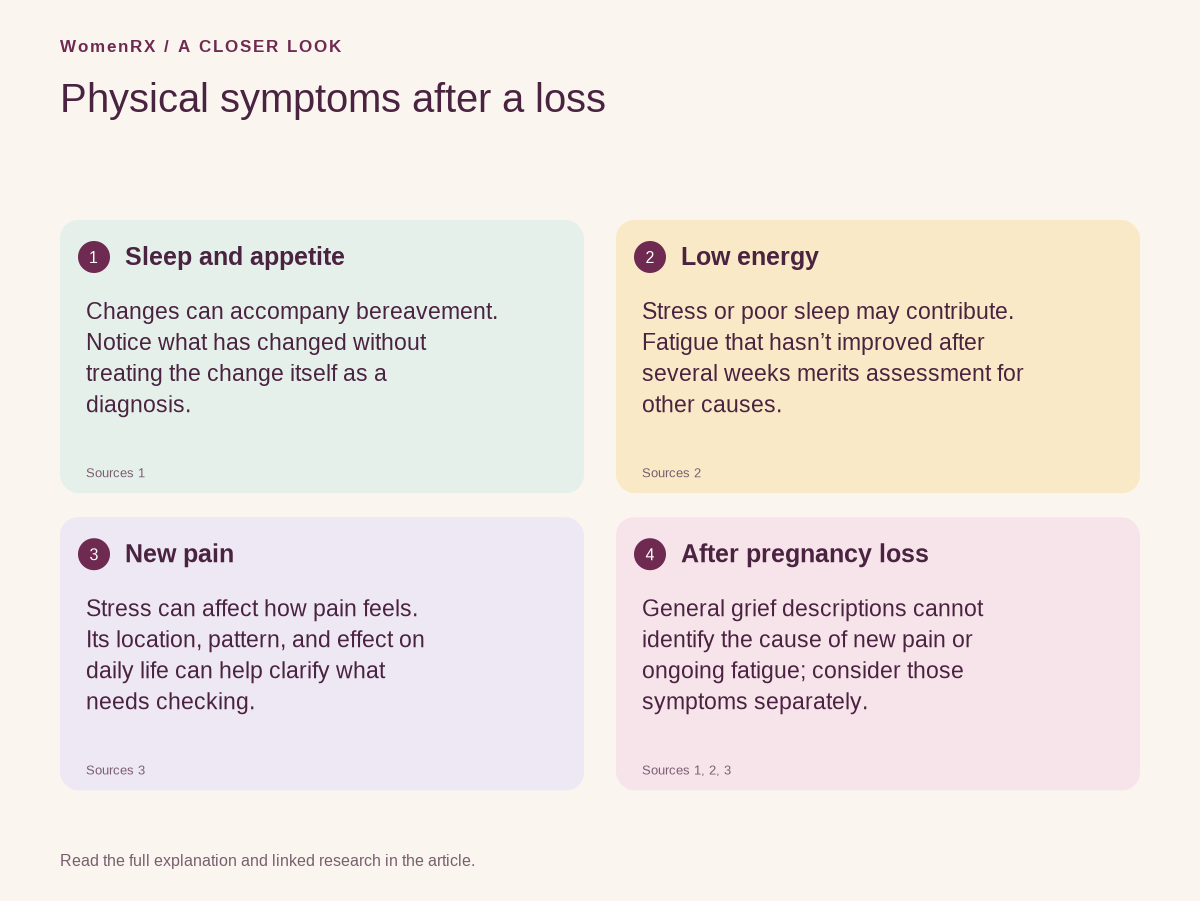
Physical symptoms after a loss
Sleep and appetite: Changes can accompany bereavement. Notice what has changed without treating the change itself as a diagnosis.1
Low energy: Stress or poor sleep may contribute. Fatigue that hasn’t improved after several weeks merits assessment for other causes.2
New pain: Stress can affect how pain feels. Its location, pattern, and effect on daily life can help clarify what needs checking.3
After pregnancy loss: General grief descriptions cannot identify the cause of new pain or ongoing fatigue; consider those symptoms separately.123
Read the figure as text
These distinctions show what may accompany bereavement and what still calls for its own attention.- Sleep and appetite: Changes can accompany bereavement. Notice what has changed without treating the change itself as a diagnosis.1
- Low energy: Stress or poor sleep may contribute. Fatigue that hasn’t improved after several weeks merits assessment for other causes.2
- New pain: Stress can affect how pain feels. Its location, pattern, and effect on daily life can help clarify what needs checking.3
- After pregnancy loss: General grief descriptions cannot identify the cause of new pain or ongoing fatigue; consider those symptoms separately.123
More questions, answered
Do physical symptoms mean I’m grieving the wrong way?
No. Sleep and appetite changes can be part of bereavement, and grief varies from person to person. A symptom can still deserve medical attention, particularly if fatigue continues for several weeks or the cause of pain is unclear. 1 2 3
Sources you can check
- Bereavement: MedlinePlusAccessed 2026-09-25Return to first citation
- Fatigue: MedlinePlusAccessed 2026-09-25Return to first citation
- Pain | MedlinePlusAccessed 2026-09-25Return to first citation
- Health and well-being after spousal loss among older men and women.Kawaguchi K, Nakagomi A, Ide K, Shirai K, Koga C, Chen YR, Kondo K, Shiba K. · Journal of affective disorders · 2026Return to first citation
- Supporting Bereaved Caregivers: Adaptation of the REACH Behavioral Intervention.Martindale-Adams J, Zuber JK, Stark D, Nichols LO. · Omega · 2025Return to first citation