Bupropion Experiences: What Studies and Reviews Can Tell You
Studies can compare average results, but they can’t predict exactly how bupropion will affect your mood, sleep, or anxiety.
In adults with depression, studies suggest bupropion can improve depressive symptoms, including anxiety symptoms for some people. In comparisons with SSRIs, anxiety improvement was broadly similar overall, while one review found insomnia more often and sexual dysfunction less often with bupropion. These are group averages, not a forecast for you. Online reviews offer personal accounts, not a reliable way to estimate how often an effect happens. 2 4
A review can help you learn which effects have shown up in studies and how bupropion compares with another treatment. A personal testimonial can show what one person noticed. Neither can tell you exactly what your experience will be.
What studies say about mood and anxiety
In a pooled analysis of 10 double-blind randomized trials involving 2,890 people with major depressive disorder, bupropion and SSRIs produced similar average improvements in anxiety symptoms. The analysis used anxiety measures collected as part of depression studies, rather than treating anxiety as a separate diagnosis. 4
A more recent systematic review of six studies in adults with depression and significant anxiety symptoms also found improvement on anxiety measures. But anxiety was a secondary or exploratory outcome in some studies, and the review rated the evidence as low certainty. Its findings suggest bupropion need not worsen anxiety for everyone, but they don’t establish how it will affect a particular person. 2
One small randomized study looked at people who had not improved after two SSRI trials. Among 49 participants assigned to bupropion or duloxetine, the researchers reported response rates of about 60% to 70% and remission rates of about 30% to 40% across the two treatment groups at six weeks. They found no significant difference between the groups. Because the study was small and had no placebo group, it can’t show how much improvement was due to either medication or estimate what a new patient should expect. 3
These studies answer different questions: some compare average symptom changes, while another examines a specific group changing treatment after SSRI nonresponse. They don’t establish one “typical” bupropion experience.
Unwanted effects: comparisons, not guarantees
The recent review found insomnia more often with bupropion than with SSRIs, and a lower risk of sexual dysfunction. Those are comparative findings across studies, not promises that you will or won’t experience either effect. The review also notes that tolerability evidence comes from studies with limitations, so it can’t supply a precise personal prediction. 2
The same review found no clear worsening signal on the anxiety measures it examined. That doesn’t mean no individual can feel more anxious or restless; it means the studies it reviewed did not show a consistent worsening pattern on those measures. 2
How to read online reviews
A review is a real account of one person’s experience, but it has no comparison group. It can’t show whether bupropion caused a change, how common that change is among everyone who takes it, or whether someone with a similar story will have the same result. People who choose to post may also differ from people who don’t, so a collection of comments isn’t the same as a representative study.
Use testimonials to identify experiences or questions you might want to raise, not to calculate your odds. For example, if several accounts mention sleep changes, that can remind you to pay attention to sleep. It can’t tell you how likely that effect is for you.
Make your own response easier to interpret
Before starting or changing treatment, consider noting how you’re doing in a few areas that matter in daily life: mood, interest or enjoyment, energy, sleep, anxiety, and any effects that concern you. Revisit the same areas over time and describe concrete changes, such as whether getting through work or a usual routine feels different. This isn’t a diagnostic score; it’s a way to make the conversation with your prescriber more specific.
If a change feels troubling, or your mood gets worse, tell your prescriber rather than relying on online comparisons to decide what it means. Depression treatment can involve trying different medicines, and a person’s response to one treatment doesn’t determine how another person will respond. 1
What women’s evidence can’t yet answer here
The studies described above don’t provide enough sex-specific or reproductive-stage results to predict whether bupropion works differently for women, or how experiences vary during pregnancy, postpartum, perimenopause, or after menopause. That leaves an important gap: the overall findings may inform a discussion, but they can’t tell you how your individual circumstances will shape your response.
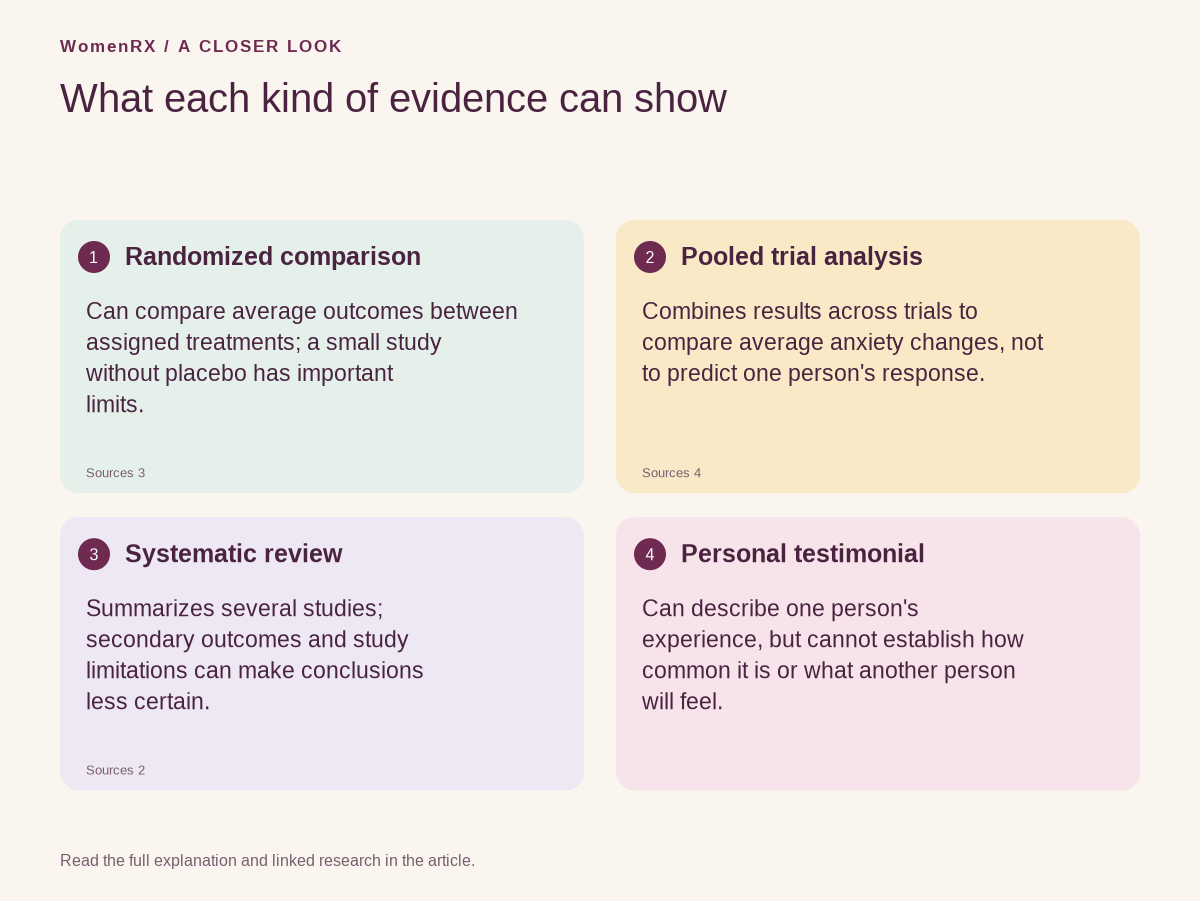
What each kind of evidence can show
Randomized comparison: Can compare average outcomes between assigned treatments; a small study without placebo has important limits.3
Pooled trial analysis: Combines results across trials to compare average anxiety changes, not to predict one person's response.4
Systematic review: Summarizes several studies; secondary outcomes and study limitations can make conclusions less certain.2
Personal testimonial: Can describe one person's experience, but cannot establish how common it is or what another person will feel.
Read the figure as text
These evidence types answer different questions. Study averages can compare groups; they cannot specify your personal outcome.- Randomized comparison: Can compare average outcomes between assigned treatments; a small study without placebo has important limits.3
- Pooled trial analysis: Combines results across trials to compare average anxiety changes, not to predict one person's response.4
- Systematic review: Summarizes several studies; secondary outcomes and study limitations can make conclusions less certain.2
- Personal testimonial: Can describe one person's experience, but cannot establish how common it is or what another person will feel.
More questions, answered
Can online reviews tell me whether bupropion will work for me?
No. Reviews can help you recognize experiences people choose to describe, but they can’t estimate your personal chance of benefit or side effects. Controlled studies compare groups; an individual testimonial does not.
What’s useful to track while taking bupropion?
Note changes in mood, interest, energy, sleep, anxiety, day-to-day functioning, and effects that bother you. Comparing the same areas over time can make it easier to explain what has changed to your prescriber.
Sources you can check
- Depression: MedlinePlusAccessed 2026-09-25Return to first citation
- Efficacy and Tolerability of Bupropion in Major Depressive Disorder with Comorbid Anxiety Symptoms: A Systematic Review.Pinzi M, Cuomo A, Koukouna D, Gualtieri G, Pierini C, Rescalli MB, Pardossi S, Patrizio B, Fagiolini A. · International journal of molecular sciences · 2025Return to first citation
- A randomized, single-blind, comparison of duloxetine with bupropion in the treatment of SSRI-resistant major depression.Rosso G, Rigardetto S, Bogetto F, Maina G. · Journal of affective disorders · 2012Return to first citation
- Efficacy of bupropion and the selective serotonin reuptake inhibitors in the treatment of anxiety symptoms in major depressive disorder: a meta-analysis of individual patient data from 10 double-blind, randomized clinical trials.Papakostas GI, Trivedi MH, Alpert JE, Seifert CA, Krishen A, Goodale EP, Tucker VL. · Journal of psychiatric research · 2008Return to first citation