Bloating on Mounjaro: What the Timing Can Tell You
Bloating is reported during Mounjaro treatment, but its timing can suggest a connection without proving the medicine caused it.
Mounjaro’s U.S. prescribing information reports abdominal distension and gas in adult trials, though these reports don’t prove the medicine caused any one person’s bloating. Note when it began, whether it followed starting or increasing treatment, and any bowel changes, pain, vomiting, or fever. Share persistent or concerning symptoms with your prescriber; sudden severe abdominal pain needs urgent assessment. 12
What “bloating” means in the safety information
Bloating can mean an uncomfortable feeling of fullness, more gas, or a visibly swollen abdomen. Those experiences overlap, but they aren’t identical. In adult placebo-controlled trials, Mounjaro’s prescribing information listed abdominal distension and flatulence separately. Abdominal distension was reported by 0.4% of placebo recipients and by 0.4%, 2.9%, and 0.8% of people taking 5 mg, 10 mg, and 15 mg, respectively. Flatulence was reported by 0% with placebo and 1.3%, 2.5%, and 2.9% at those doses. These trial reports show that the symptoms occurred; they don’t establish the cause of an individual’s bloating, and the distension figures don’t show a steady increase across doses. 1
The same prescribing information reports that gastrointestinal side effects overall were more frequent with Mounjaro than placebo in pooled adult trials. Most reports of nausea, vomiting, and diarrhea occurred during dose escalation and decreased over time. That timing may be useful to discuss if your bloating began after starting treatment or a dose change, but the label’s timing statement is about those symptoms, not bloating specifically. 1
Look for a pattern, not proof
A close link in time can be a useful clue. Record when the bloating started, when your dose changed, and whether the symptom comes and goes or is getting worse. Also note whether you feel full, pass more gas, or see a change in abdominal size. This helps your prescriber consider the pattern without assuming that Mounjaro is the only explanation.
Other common possibilities include gas related to foods or drinks, swallowing air while eating, irritable bowel syndrome, or bloating around a menstrual period. 2 If the symptom repeats in a recognizable pattern, that context is worth including too. Don’t treat the timing alone as a diagnosis or change your treatment plan based only on a bloating record; use it to ask your prescriber what the pattern means for you.
What to write down before you report it
A short, specific record is more useful than “I feel bloated.” Include:
- When it began, and whether it followed starting Mounjaro or a dose change.
- Whether it feels like fullness or gas, or your abdomen looks swollen.
- Any constipation, diarrhea, vomiting, or change in your usual bowel pattern.
- Whether there’s pain, when it occurs, and whether it is getting worse.
- Other symptoms, such as fever, and whether the bloating is occasional or persistent.
You don’t need a perfect log. A few clear details can help distinguish a brief symptom from one that is continuing or appearing alongside other problems.
When bloating needs medical attention
Contact your prescriber about bloating that keeps returning, doesn’t go away, or comes with a change in bowel habits or pain. Seek prompt medical assessment if bloating occurs with vomiting, diarrhea or constipation, stomach pain, or fever. A swollen abdomen with sudden, severe pain needs emergency assessment. 2
Vomiting or diarrhea can also contribute to dehydration. Mounjaro’s prescribing information flags kidney injury reported after gastrointestinal reactions that led to volume depletion, and calls for particular attention when these reactions occur during treatment initiation or dose escalation. 1 If those symptoms are part of your pattern, report them along with the bloating rather than treating the issue as gas alone.
What is known about women specifically
The adult trial figures report abdominal distension and gas for the overall study groups; the information here does not provide women-specific rates for bloating. A separate analysis of spontaneous adverse-event reports found differences in reported gastrointestinal disorders by sex, including more such reports from males. That kind of database cannot show how often an event occurs among all people taking a medicine, or establish that women have a lower or higher risk of bloating. It also does not provide a women-specific estimate for this symptom. 3
The practical takeaway is to describe your own symptoms and timing clearly. Neither a dose change nor being a woman can, by itself, confirm what is causing the bloating.
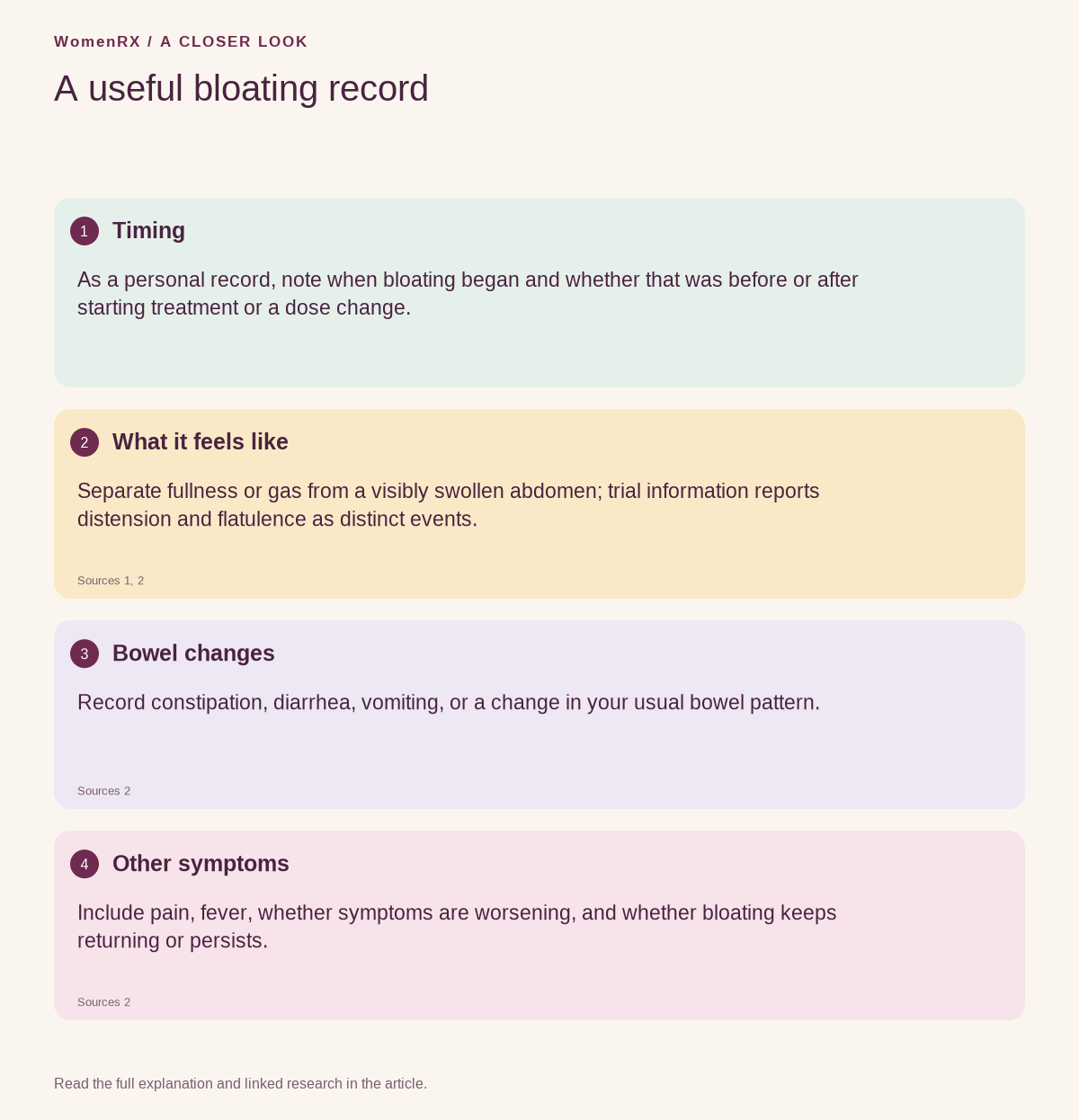
A useful bloating record
Timing: As a personal record, note when bloating began and whether that was before or after starting treatment or a dose change.
What it feels like: Separate fullness or gas from a visibly swollen abdomen; trial information reports distension and flatulence as distinct events.12
Bowel changes: Record constipation, diarrhea, vomiting, or a change in your usual bowel pattern.2
Other symptoms: Include pain, fever, whether symptoms are worsening, and whether bloating keeps returning or persists.2
Read the figure as text
Use these details to describe the pattern to your prescriber. Timing can offer a clue, but a record cannot prove what caused the symptom.- Timing: As a personal record, note when bloating began and whether that was before or after starting treatment or a dose change.
- What it feels like: Separate fullness or gas from a visibly swollen abdomen; trial information reports distension and flatulence as distinct events.12
- Bowel changes: Record constipation, diarrhea, vomiting, or a change in your usual bowel pattern.2
- Other symptoms: Include pain, fever, whether symptoms are worsening, and whether bloating keeps returning or persists.2
More questions, answered
Does bloating mean Mounjaro is causing it?
Not by itself. Abdominal distension and gas were reported in adult trials, but bloating can have other causes too. Timing, other symptoms, and whether it persists can help your prescriber assess the possibility. 12
Do the trial reports show that women are less likely to get bloating?
No. The trial figures provided are not broken down by sex for abdominal distension or gas. A spontaneous-report analysis found sex differences in reports of gastrointestinal disorders generally, but it cannot establish women’s actual bloating risk. 13
Sources you can check
- MOUNJARO (TIRZEPATIDE) INJECTION, SOLUTION MOUNJARO KWIKPEN (TIRZEPATIDE) INJECTION, SOLUTION [ELI LILLY AND COMPANY] | US prescribing information and patient instructionsAccessed 2026-09-25Return to first citation
- Bloating - NHSAccessed 2026-09-25Return to first citation
- Adverse events associated with tirzepatide: a focus on subgroup-specific differences.Yu Z, Qi Y, Gan Q, Wu G, Zhang X, Jiang C, Li J. · BMC pharmacology & toxicology · 2026Return to first citation