Before You Accept Compounded Tirzepatide, Check These Five Things
A prescription and a pharmacy’s assurances don’t answer every question about a compounded tirzepatide product.
Before accepting compounded tirzepatide, get the exact formulation, the names of the prescriber and dispensing pharmacy, and a clear explanation of why that formulation was prescribed. Advertised compounded products have differed in ingredients and form. 4 Verify the prescriber and pharmacy separately, check current federal and state information, and review whether tirzepatide fits your health. If you’re pregnant, include your current medicines in that review. 2 Mention any pregnancy plans, too.
Compounded tirzepatide can sound straightforward when an offer uses the familiar drug name. But the name alone doesn’t tell you what’s in the finished product, who prepared it, or whether it’s appropriate for you. An examination of compounding websites found advertised semaglutide and tirzepatide products with different formulations, including products combined with other ingredients. Their safety and effectiveness can’t be assumed to match an FDA-approved product. 4
Start with the exact product, not the sales pitch
Ask the prescriber and dispensing pharmacy to identify the formulation you would actually receive: its ingredients, strength, form, and route of administration. Ask what each added ingredient is meant to do and what evidence supports that particular formulation. This matters especially if the offer describes a combination product or a form other than an injection. A survey of websites advertising semaglutide and tirzepatide products found combination products and alternative forms across the group, but did not establish that those formulations offer a clinical advantage. 4
Also ask who will prepare the medication and how the finished product will be labeled, stored, and supplied. The website survey found that information about storage and how long a product could be used was not consistently reported online. That finding is a reason to ask the dispensing pharmacy directly, not proof that any particular pharmacy lacks that information. 4
Verify the prescriber and pharmacy separately
Get the prescriber’s full name and practice location. Check their current license with the relevant official state licensing authority, and ask that authority how to confirm they’re authorized to prescribe to you in your state. This is a separate check from verifying the pharmacy.
A clinician’s involvement doesn’t, by itself, tell you who made the medication. Get the dispensing pharmacy’s name and location. Then check its current standing with the state board of pharmacy for the state where it operates, and ask the board how to verify a pharmacy dispensing to you in your state. If an online seller won’t identify the dispensing pharmacy before you pay, you can’t complete that check.
Quality questions deserve their own conversation with the pharmacist: Where did the ingredients come from? What preparation and quality checks apply to this formulation? Who can answer questions about its label or storage? These questions aren’t a home test for purity. They help you find out whether someone accountable can explain the product you’re being offered. In an analysis of FDA adverse-event reports covering several GLP-1 medications, reports involving compounded products included preparation and product-quality concerns. Reporting data can flag problems, but they cannot tell you the chance that a particular product will cause harm. 3
Check today’s rules, not an old shortage claim
Ask the prescriber or pharmacy to explain the current basis for offering this formulation to you. To check that explanation, search the FDA’s website for “tirzepatide compounding” and find your state board of pharmacy through your state government’s website. Have the pharmacy’s name and location, your state, the proposed ingredients, strength, form, and route ready. Ask the relevant board which of its current information applies to a pharmacy dispensing that product to you. If the explanation rests on a shortage claim, a special ingredient, or a different form of the drug, ask how that claim applies now. Don’t treat a marketing page, or a document from an earlier period, as the final word.
An editorial reporting a search of compounding websites examined products advertised between February and March 2025. It cannot establish whether a product offered to you today complies with current federal and state requirements. Nor does calling a formulation “customized” settle whether it’s lawful or clinically useful. 4
Keep your own health decision in view
Even a clearly identified product from a verifiable pharmacy still needs to make sense for you. Ask why your prescriber recommends the compounded formulation rather than an FDA-approved option, what difference they expect it to make, and how you’ll reach them if there’s a problem. The approved Zepbound Medication Guide mentions a personal or family history of medullary thyroid carcinoma, having MEN 2, and a previous serious allergic reaction to tirzepatide or its ingredients. Bring up any of those histories during the medication review. 1
If you’re pregnant or planning pregnancy, say so before deciding to start any tirzepatide product, and review your current medicines together. Pregnancy changes the risk-benefit decision for medicines; it isn’t a question a compounding pharmacy’s quality claims can answer. The questions about pharmacy oversight and legal status apply to everyone, not only women. 2
The useful outcome of these checks is a specific, verifiable answer to four different questions: What product am I getting? Who is prescribing it? Who is responsible for preparing it? Why is it appropriate and permissible for me now? If the people offering it can’t answer those separately, pause before accepting it.
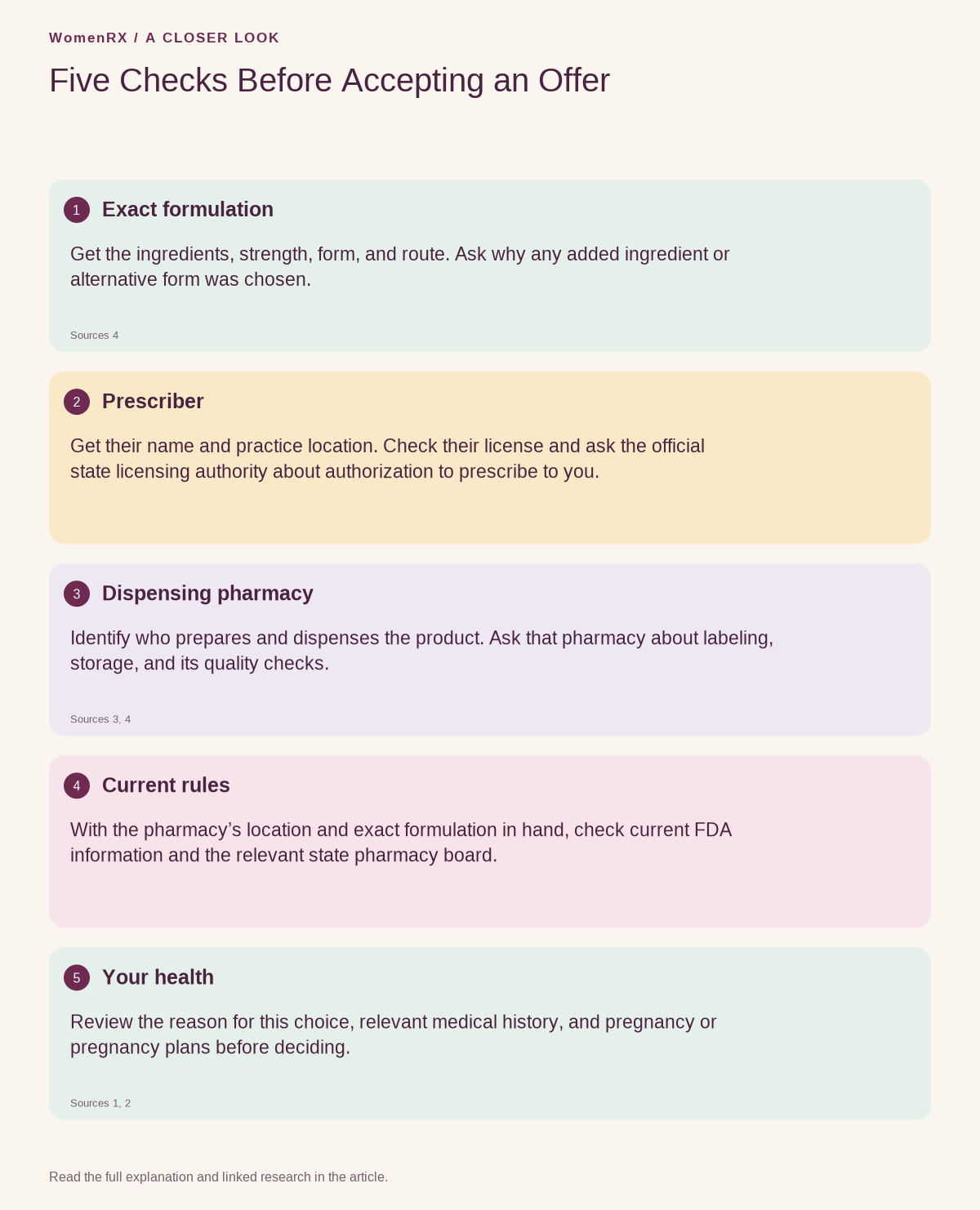
Five Checks Before Accepting an Offer
Exact formulation: Get the ingredients, strength, form, and route. Ask why any added ingredient or alternative form was chosen.4
Prescriber: Get their name and practice location. Check their license and ask the official state licensing authority about authorization to prescribe to you.
Dispensing pharmacy: Identify who prepares and dispenses the product. Ask that pharmacy about labeling, storage, and its quality checks.34
Current rules: With the pharmacy’s location and exact formulation in hand, check current FDA information and the relevant state pharmacy board.
Your health: Review the reason for this choice, relevant medical history, and pregnancy or pregnancy plans before deciding.12
Read the figure as text
Each question addresses a different part of the decision; no single document answers all five.- Exact formulation: Get the ingredients, strength, form, and route. Ask why any added ingredient or alternative form was chosen.4
- Prescriber: Get their name and practice location. Check their license and ask the official state licensing authority about authorization to prescribe to you.
- Dispensing pharmacy: Identify who prepares and dispenses the product. Ask that pharmacy about labeling, storage, and its quality checks.34
- Current rules: With the pharmacy’s location and exact formulation in hand, check current FDA information and the relevant state pharmacy board.
- Your health: Review the reason for this choice, relevant medical history, and pregnancy or pregnancy plans before deciding.12
More questions, answered
Does adding a vitamin make compounded tirzepatide safer or better?
Not on its own. Researchers found advertised products combining tirzepatide or semaglutide with other ingredients, but reported little justification for some additions and did not establish the safety or effectiveness of the finished formulations. Ask what the addition is intended to accomplish and what supports its use in your product. 4
Sources you can check
- ZEPBOUND (TIRZEPATIDE) INJECTION, SOLUTION ZEPBOUND (TIRZEPATIDE) INJECTION, SOLUTION ZEPBOUND KWIKPEN (TIRZEPATIDE) INJECTION, SOLUTION [ELI LILLY AND COMPANY] | US prescribing information and patient instructionsAccessed 2026-09-25Return to first citation
- Pregnancy and Medicines | MedlinePlusAccessed 2026-09-25Return to first citation
- Safety analysis of compounded GLP-1 receptor agonists: a pharmacovigilance study using the FDA adverse event reporting system.McCall KL, Mastro Dwyer KA, Casey RT, Samana TN, Sulicz EK, Tso SY, Yalanzhi ER, Piper BJ. · Expert opinion on drug safety · 2026Return to first citation
- Compounded Semaglutide and Tirzepatide Products Use Unique Formulations but Efficacy and Safety Largely Unknown.Belcourt J, Sapowadia A, White CM. · The Annals of pharmacotherapy · 2026Return to first citation