Are Probiotics Safe for Women? Know the Strain and the Situation
Usually mild digestive effects, different concerns with serious illness, and what pregnancy research actually found.
For healthy people, probiotic side effects are usually minor digestive symptoms such as gas. Serious infections have been reported mainly in people who are very ill or have weakened immune systems. 1 Pregnancy and breastfeeding research is generally reassuring, but the results apply to the studied products and reporting was incomplete. 13 “Probiotic” alone is not enough information to judge a particular supplement.
Start with the full name on the label
Probiotics are live microorganisms, and different strains can have different effects. A result for one strain and purpose should not be assigned to every product in the same species or to an entire blend. 1
Write down the full strain name, the amount per serving and the reason you want to use it. Keep the packaging instructions with those details. That is a better starting point than choosing whichever bottle lists the most organisms or has “for women” on the front.
A practical question is: Has this strain, in this form, been studied for the problem I want to change? Then ask what would count as a useful improvement for you. Those questions help separate a specific trial of a product from an indefinite routine with no clear purpose.
Minor symptoms and higher-risk situations
In healthy people, side effects are usually mild gastrointestinal symptoms, including gas. However, clinical trials do not always collect safety information adequately. Serious infections involving probiotic organisms have been reported, mainly in people who were severely ill or immunocompromised. 1
If you have a weakened immune system or a serious underlying illness, involve your treating team before starting a probiotic. A reassuring study in healthy volunteers may not fit your situation. General guidance for these higher-risk groups favors strains and uses with demonstrated benefit rather than a broad assumption that live microbes are harmless. 1
If a supplement gives you side effects, stop and contact your clinician. Keep its name and the timing of symptoms; this helps evaluate what happened without assuming the probiotic caused every change. 12
Pregnancy and breastfeeding: reassuring, with limits
A 2021 systematic review examined maternal probiotic and prebiotic use during pregnancy and lactation. It found no associated serious adverse effects or deaths in the included reports. However, only 11 of 100 eligible studies reported adverse effects for the quantitative analysis, and details such as severity and duration were often missing. 13
One study reported more vaginal discharge and changes in stool consistency with a particular probiotic combination. Products, strains and timing varied across the research, so the review supports a generally reassuring picture rather than a guarantee for every bottle. It also concerns supplements taken by mothers, not direct dosing of a newborn. 13
If you already have a prenatal or postpartum care plan, bring the specific product and the symptom you want to address into that plan. There is no need to turn the general word “probiotic” into a yes-or-no judgment about every formulation.
Do not label significant diarrhea an adjustment phase
Diarrhea has many causes. Get medical advice right away for severe abdominal pain, blood or black tarry stools, frequent vomiting, signs of dehydration or a high fever. Adults also need prompt advice when diarrhea lasts more than two days. These thresholds apply whether or not you recently started a probiotic. 14
Pregnancy, current antibiotic use and a weakened immune system increase the risk of problems from diarrhea. Stay in contact with your care team if those circumstances apply. An antibiotic can itself cause diarrhea, so timing alone cannot tell you which product is responsible. 14
Keep the benefit as specific as the product
A useful probiotic choice has a named strain, a purpose, directions you can follow and a point at which you reassess. If the expected benefit remains vague while symptoms or costs keep accumulating, revisit the reason for taking it. The goal is a useful result for you, not the longest possible supplement routine.
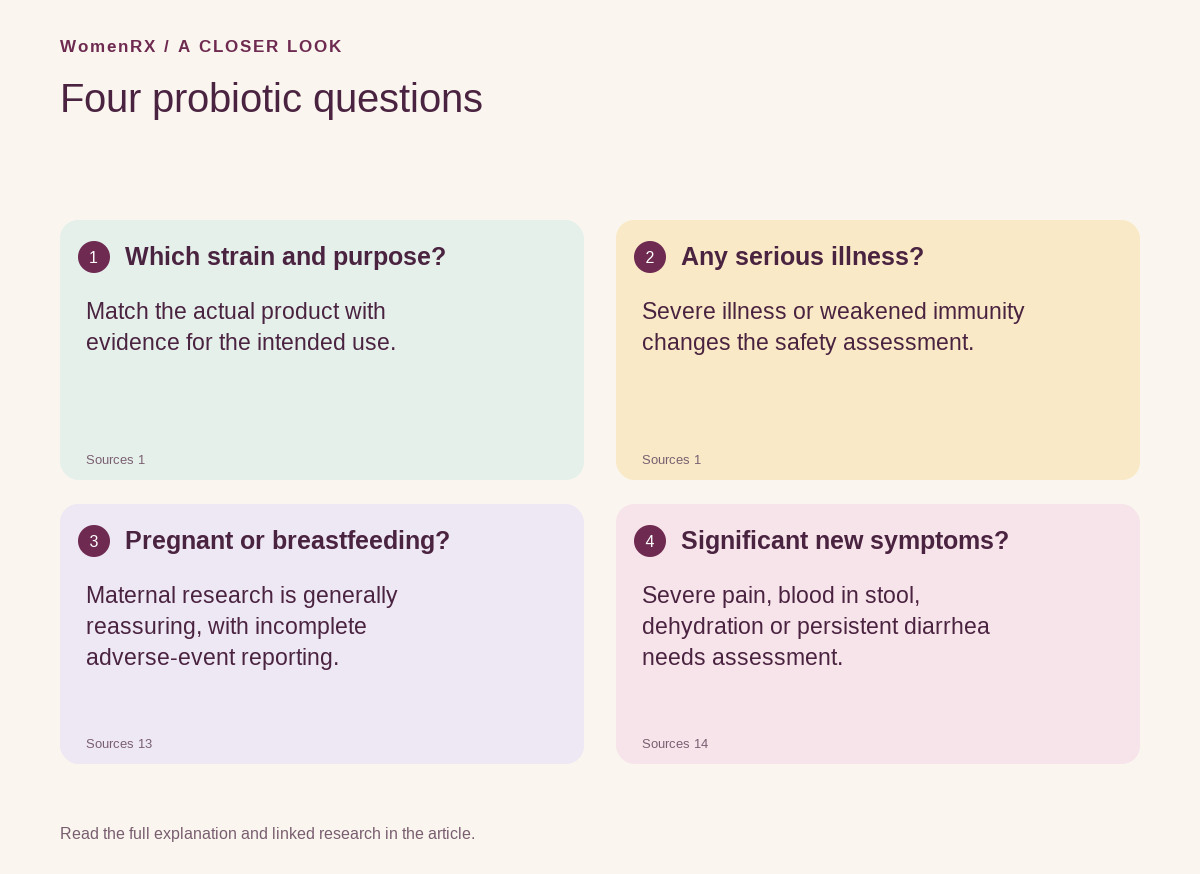
Four probiotic questions
Which strain and purpose?: Match the actual product with evidence for the intended use.1
Any serious illness?: Severe illness or weakened immunity changes the safety assessment.1
Pregnant or breastfeeding?: Maternal research is generally reassuring, with incomplete adverse-event reporting.13
Significant new symptoms?: Severe pain, blood in stool, dehydration or persistent diarrhea needs assessment.14
Read the figure as text
A strain name is only one part of the decision.- Which strain and purpose?: Match the actual product with evidence for the intended use.1
- Any serious illness?: Severe illness or weakened immunity changes the safety assessment.1
- Pregnant or breastfeeding?: Maternal research is generally reassuring, with incomplete adverse-event reporting.13
- Significant new symptoms?: Severe pain, blood in stool, dehydration or persistent diarrhea needs assessment.14
Sources you can check
- Probiotics - Health Professional Fact SheetAccessed 2026-09-25Return to first citation
- NCCIH: Using Dietary Supplements WiselyAccessed 2026-09-26Return to first citation
- Probiotics and prebiotics during pregnancy and lactation: systematic review and meta-analysisAccessed 2026-09-26Return to first citation
- NIDDK: Symptoms and Causes of DiarrheaAccessed 2026-09-26Return to first citation