A Glucose Monitor Without Diabetes: What It Can Tell You
A continuous glucose monitor can show patterns across the day, but whether those patterns should change your meals or health decisions is still uncertain.
A continuous glucose monitor (CGM) tracks glucose in fluid just beneath the skin, giving you a stream of readings rather than a few blood-test snapshots. Research has found differences in CGM patterns between groups with prediabetes and normoglycemia, but it doesn’t establish individual diagnostic cutoffs or show that tracking improves health. Its usefulness depends on what decision the data could actually change. 3 4
A moving picture, not a diagnosis
A CGM uses a small sensor on the skin to estimate glucose in interstitial fluid, which reflects the glucose concentration in blood. Instead of a single result, it provides readings over time, making rises and falls around meals or other parts of the day easier to see. 4
That stream can be interesting, but more information isn’t automatically more useful. A systematic review and meta-analysis found that people with prediabetes had higher average CGM readings and greater glucose variability than people with normoglycemia across the studies analyzed. The authors described CGM as a possible complement to conventional tests, while noting that more prospective research is needed to determine whether its measures predict progression to type 2 diabetes. A difference between groups doesn’t, by itself, tell you what an individual’s reading means or what action will help. 3
Fasting plasma glucose, A1C, and an oral glucose tolerance test are conventional tests discussed for assessing glucose status. This research doesn’t establish individual diagnostic cutoffs for CGM readings. A review focused on cystic-fibrosis-related diabetes found that CGM-based criteria identified more glucose abnormalities than the oral glucose tolerance test; the authors cautioned that a sensor reading alone wasn’t appropriate for diagnosis in that specific population. That finding is about cystic-fibrosis-related diabetes, not a general-population diagnostic rule. 3 5
When the pattern may be useful
A CGM may be worth discussing if you have a specific question that a pattern could help explore, such as whether glucose changes repeatedly in a way that merits formal testing or follow-up. It can offer context to share with a clinician; it doesn’t establish that a particular meal or activity caused a change, or that reacting to every rise will improve health.
For general wellness tracking, the decision is less clear. A scoping review of research and nonmedical sources on glucose spikes found uncertainty about their health significance in people without diabetes, especially for isolated short-term spikes. It also described a much larger volume of nonmedical than medical material in its review. The evidence doesn’t support treating every brief rise as harmful or assuming that lowering CGM readings will prevent disease. 4
Before paying for a device or taking on the data, ask yourself:
- What specific decision am I hoping the readings will inform?
- If the sensor shows a rise, what would I do differently, and is that change supported by evidence?
- Would a clinician use the results to decide whether I need a standard glucose test or further evaluation?
- Is the cost and attention the device requires worthwhile if the main result is more information, rather than a proven health benefit?
If there isn’t a clear next step, the readings may add worry or distraction without answering the question you started with.
Pregnancy and PCOS need their own context
Pregnancy shouldn’t be lumped together with general wellness tracking. The meta-analysis comparing prediabetes and normoglycemia excluded pregnancy. NHS guidance describes an oral glucose tolerance test for gestational-diabetes screening and CGM as a possible monitoring option for some people with gestational diabetes who use insulin and have unstable glucose or low-glucose problems. These are pregnancy-specific clinical circumstances, not evidence that a CGM is a general screening test. 1 2 3
The findings from the prediabetes meta-analysis don’t establish a women-specific or PCOS-specific benefit. A general difference in CGM readings between prediabetes and normoglycemia shouldn’t be assumed to apply specifically to PCOS or to guide PCOS care. 3
A practical bottom line
Think of a CGM without diabetes as a pattern-finding tool with uncertain value for routine wellness use. It can offer an extra view of glucose changes, but this research doesn’t provide individual diagnostic cutoffs or show that reacting to an isolated spike improves health. The strongest reason to use one is a defined question and a plan for interpreting the answer, not the promise that more data is always better. 3 4
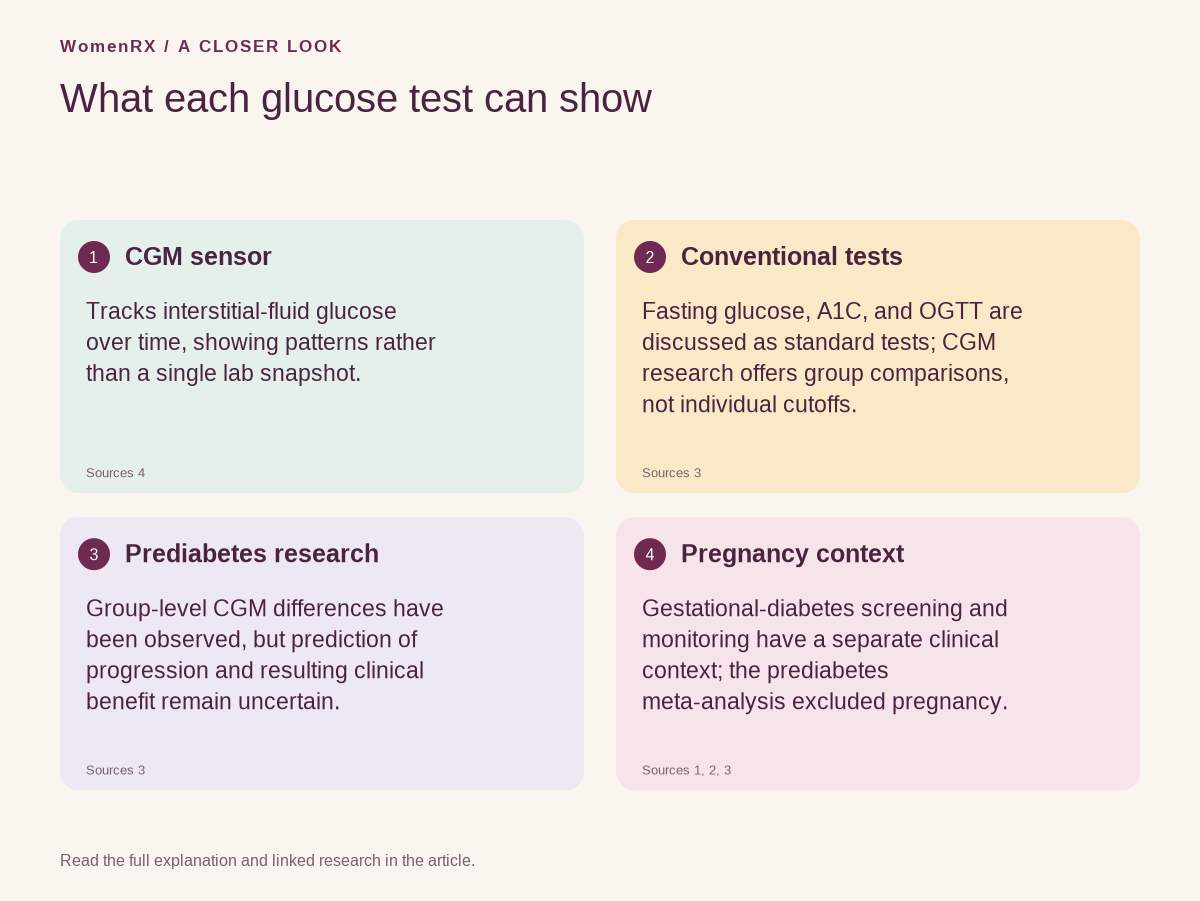
What each glucose test can show
CGM sensor: Tracks interstitial-fluid glucose over time, showing patterns rather than a single lab snapshot.4
Conventional tests: Fasting glucose, A1C, and OGTT are discussed as standard tests; CGM research offers group comparisons, not individual cutoffs.3
Prediabetes research: Group-level CGM differences have been observed, but prediction of progression and resulting clinical benefit remain uncertain.3
Pregnancy context: Gestational-diabetes screening and monitoring have a separate clinical context; the prediabetes meta-analysis excluded pregnancy.123
Read the figure as text
Compare the continuous pattern from a sensor with conventional tests used to assess glucose status, and see where current evidence leaves a decision uncertain.- CGM sensor: Tracks interstitial-fluid glucose over time, showing patterns rather than a single lab snapshot.4
- Conventional tests: Fasting glucose, A1C, and OGTT are discussed as standard tests; CGM research offers group comparisons, not individual cutoffs.3
- Prediabetes research: Group-level CGM differences have been observed, but prediction of progression and resulting clinical benefit remain uncertain.3
- Pregnancy context: Gestational-diabetes screening and monitoring have a separate clinical context; the prediabetes meta-analysis excluded pregnancy.123
More questions, answered
Can one high CGM reading mean I have diabetes?
This research doesn’t establish an individual diagnostic cutoff for CGM readings. The prediabetes research compared CGM patterns between groups; it didn’t set cutoffs for diagnosing an individual. Fasting plasma glucose, A1C, and an oral glucose tolerance test are the conventional tests discussed in that research. A finding that a single high sensor reading wasn’t appropriate for diagnosis comes from research on cystic-fibrosis-related diabetes specifically, not a general-population diagnostic guideline. 3 5
Does CGM evidence show a special benefit for women with PCOS?
The findings comparing prediabetes with normoglycemia don’t establish a women-specific or PCOS-specific benefit. They shouldn’t be treated as proof that CGM improves PCOS care. 3
Sources you can check
- Gestational diabetes - NHSAccessed 2026-09-25Return to first citation
- Gestational diabetes - Treatment - NHSAccessed 2026-09-25Return to first citation
- Differences in Continuous Glucose Monitoring Metrics Between Prediabetes and Normoglycemia: A Systematic Review and Meta-Analysis.Rákóczi G, Nagy J, Jozaee S, Jozaee S, Szentes BL, Lee J, Rancz A, Hegyi P, Agócs G, Sipter E. · Journal of diabetes science and technology · 2026Return to first citation
- A Scoping Review of Glucose Spikes in People Without Diabetes: Comparing Insights from Grey Literature and Medical Research.Avner S, Robbins T. · Clinical medicine insights. Endocrinology and diabetes · 2025Return to first citation
- Comparison of continuous glucose monitoring to reference standard oral glucose tolerance test for the detection of dysglycemia in cystic Fibrosis: A systematic review.Kumar S, Pallin M, Soldatos G, Teede H. · Journal of clinical & translational endocrinology · 2022Return to first citation