Why Semaglutide Doses Increase Gradually
Semaglutide is increased in steps to help with stomach-related side effects, and the right schedule depends on your exact product.
Gradual dose increases are used to improve tolerability: an early trial in people with type 2 diabetes found that gastrointestinal side effects rose with the semaglutide dose and were eased by dose escalation. 5 In weight-management trials, these effects occurred most often around increases. 4 Follow the plan for your exact product, and ask your prescriber what to do if symptoms make the next step difficult.
Why the dose changes in steps
Semaglutide can cause nausea, diarrhea, vomiting, or constipation. Gradual increases are used to improve gastrointestinal tolerability. In an early, 12-week semaglutide trial involving people with type 2 diabetes, nausea, vomiting, and withdrawal because of gastrointestinal side effects increased with the dose; the researchers reported that escalation eased those effects. 5 In a separate pooled analysis of trials in adults with overweight or obesity taking semaglutide 2.4 mg for weight management, gastrointestinal side effects were most common during or shortly after dose escalation. Most were mild to moderate and transient. 4
In that analysis of three 68-week trials, nausea was reported by 43.9% of participants assigned semaglutide and 16.1% assigned placebo. A separate analysis found gastrointestinal symptoms contributed less than one percentage point of the additional weight loss attributed to semaglutide compared with placebo. Feeling sick isn’t a measure of whether treatment is working. 4
Your product determines your instructions
Semaglutide products and forms have separate instructions. The US prescribing information for Rybelsus and Ozempic tablets is distinct from the information for Wegovy, which has injection and tablet forms. Don’t assume a schedule or instruction for one product applies to another. Check the medicine name and form on your prescription, and use the directions for that exact product. 23
A study schedule isn’t a personal dosing plan. For example, the STEP weight-management trials used a particular weekly escalation pattern. That helps explain how escalation was studied, but it doesn’t mean you should copy the trial schedule or make changes on your own. 4
If symptoms make the next increase difficult
Tell your prescriber what you’re experiencing and when it began, especially if symptoms appeared after an increase or aren’t settling. Ask what to do within your own plan. Don’t speed up, delay, repeat, or skip doses based on a schedule for a different product.
For oral Rybelsus and Ozempic tablets, product information notes reports of kidney injury in people whose gastrointestinal symptoms, such as nausea, vomiting, or diarrhea, led to dehydration. It advises monitoring kidney function when these reactions could cause fluid loss, especially during treatment initiation and dose escalation. 2 If you’re vomiting and have signs of dehydration, such as a dry mouth or infrequent or dark urine, contact your healthcare provider promptly. 1
If you’re pregnant or planning pregnancy, bring that up with your prescriber and review the instructions for your exact product and treatment plan. This is a reason to get individualized guidance, not a different titration schedule for women.
Make the next step specific
Before a planned dose increase, make sure you know which product and form you’re taking, what the next step in your own plan is, and whom to contact if symptoms interfere. If you’re struggling, the goal isn’t to force the next increase or invent a new schedule. It’s to get product-specific guidance that takes your symptoms and treatment plan into account.
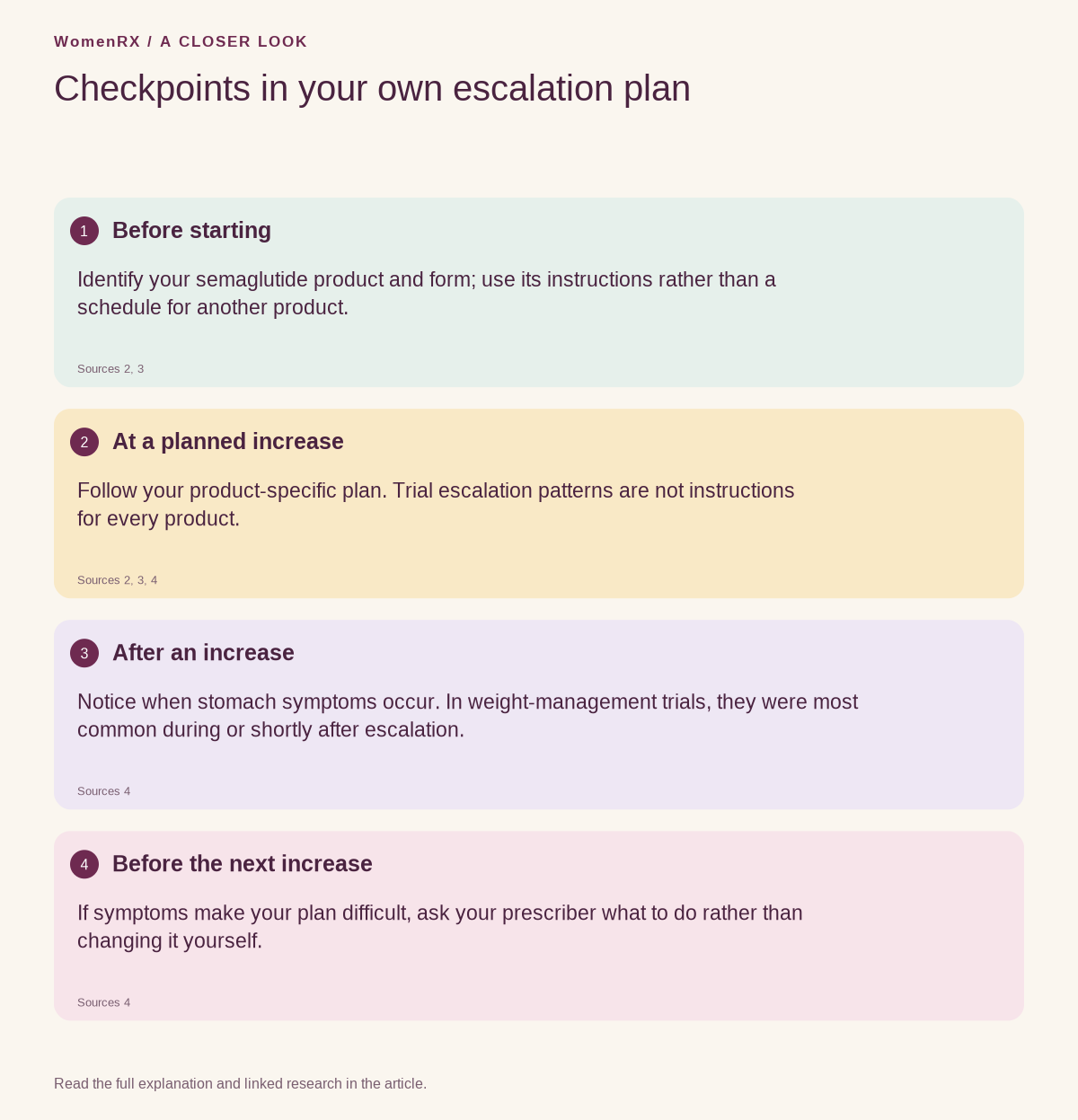
Checkpoints in your own escalation plan
Before starting: Identify your semaglutide product and form; use its instructions rather than a schedule for another product.23
At a planned increase: Follow your product-specific plan. Trial escalation patterns are not instructions for every product.234
After an increase: Notice when stomach symptoms occur. In weight-management trials, they were most common during or shortly after escalation.4
Before the next increase: If symptoms make your plan difficult, ask your prescriber what to do rather than changing it yourself.4
Read the figure as text
This sequence shows where product instructions and symptom review fit. It is not a dosing timetable.- Before starting: Identify your semaglutide product and form; use its instructions rather than a schedule for another product.23
- At a planned increase: Follow your product-specific plan. Trial escalation patterns are not instructions for every product.234
- After an increase: Notice when stomach symptoms occur. In weight-management trials, they were most common during or shortly after escalation.4
- Before the next increase: If symptoms make your plan difficult, ask your prescriber what to do rather than changing it yourself.4
More questions, answered
Do side effects mean semaglutide is working?
No. In the pooled STEP 1-3 analysis, gastrointestinal symptoms contributed less than one percentage point of the additional weight loss attributed to semaglutide compared with placebo. Feeling nauseated isn’t a measure of whether treatment is working. 4
Sources you can check
- Nausea | Vomiting | MedlinePlusAccessed 2026-09-25Return to first citation
- OZEMPIC (ORAL SEMAGLUTIDE) TABLET RYBELSUS (ORAL SEMAGLUTIDE) TABLET [NOVO NORDISK PHARMACEUTICAL INDUSTRIES, LP] | US prescribing information and patient instructionsAccessed 2026-09-25Return to first citation
- WEGOVY (SEMAGLUTIDE) INJECTION, SOLUTION WEGOVY (SEMAGLUTIDE) TABLET [NOVO NORDISK PHARMACEUTICAL INDUSTRIES, LP] | US prescribing information and patient instructionsAccessed 2026-09-25Return to first citation
- Gastrointestinal tolerability of once-weekly semaglutide 2.4 mg in adults with overweight or obesity, and the relationship between gastrointestinal adverse events and weight loss.Wharton S, Calanna S, Davies M, Dicker D, Goldman B, Lingvay I, Mosenzon O, Rubino DM, Thomsen M, Wadden TA, Pedersen SD. · Diabetes, obesity & metabolism · 2022Return to first citation
- A Phase 2, Randomized, Dose-Finding Study of the Novel Once-Weekly Human GLP-1 Analog, Semaglutide, Compared With Placebo and Open-Label Liraglutide in Patients With Type 2 Diabetes.Nauck MA, Petrie JR, Sesti G, Mannucci E, Courrèges JP, Lindegaard ML, Jensen CB, Atkin SL, Study 1821 Investigators. · Diabetes care · 2016Return to first citation