Which Medicines Can Interact With Birth Control Pills?
Rifampin, some seizure medicines, and St. John’s wort deserve a closer look, but most common antibiotics don’t appear to weaken the pill.
Rifampin can lower contraceptive hormone levels and may make combined birth control pills less effective. Certain seizure medicines and St. John’s wort also have documented pill interactions, but they need product-specific checks rather than one blanket rule. Most common antibiotics are different. An interaction can run the other way, too: a combined pill can lower levels of the seizure medicine lamotrigine. 25679
A new prescription can raise a practical question: do you need to change how you prevent pregnancy while taking it? The answer depends on the specific medicine and pill, not simply whether the prescription is an antibiotic, a seizure treatment, or a supplement. Pills may contain estrogen and progestin together, or progestin alone; much of the interaction research concerns combined pills. 15
The main concern: faster hormone breakdown
Your body uses enzymes to process contraceptive hormones. Some medicines increase that enzyme activity, leaving less hormone circulating. That can reduce pill effectiveness. The prescribing information for one combined pill, Lo Loestrin Fe, advises additional contraception or a different method when a person takes a drug or herbal product that induces enzymes involved in hormone metabolism. That warning identifies a mechanism, not a rule that every medicine or herb has the same effect. 2
Rifampin, also called rifampicin, is the antibiotic to recognize by name. A systematic review found that studies of rifampin with combined pills showed lower estrogen and/or progestin exposure in five studies and more frequent ovulation in two of four studies that assessed it. None of the studies measured pregnancy rates, so those findings don’t provide a precise chance of pregnancy. The review found smaller hormone-level changes with rifabutin than with rifampin. 5
Other documented interactions need attention, but shouldn’t all be assigned the same mechanism. Some medicines used for seizures warrant a product-specific plan. A systematic review identified interactions involving combined pills and carbamazepine, phenobarbital, phenytoin, and topiramate, among other anticonvulsants. These medicines aren’t interchangeable, and an interaction reported for a combined pill shouldn’t automatically be applied to every progestin-only pill. If one of these treatments is being started or changed, ask the prescriber or pharmacist to check your exact pill and whether additional or alternative contraception is needed. 6
St. John’s wort belongs on the interaction-check list even though it’s sold as an herbal product. The National Center for Complementary and Integrative Health specifically names birth control pills among the medicines whose effects St. John’s wort can weaken. Share the names of any other supplements you take, too, but don’t assume they all have this interaction. 94
Not every antibiotic needs the same response
Rifampin’s effect is why the blanket claim that antibiotics cancel out the pill is misleading. A review of six clinical trials and three observational studies found that most common, non-enzyme-inducing antibiotics did not compromise combined-pill effectiveness. It also described conflicting observational findings, which are harder to interpret as proof that the antibiotic itself caused contraceptive failure. The useful question at the pharmacy is, “Is this antibiotic an enzyme inducer?” rather than “Is it an antibiotic?” 7
There’s another distinction if you’re ill: vomiting or diarrhea can interfere with a pill you take by mouth, separate from a drug interaction. Follow the instructions for your particular pill and ask promptly if you’re unsure how an episode affects protection. 2
Sometimes the pill changes the other medicine
Interaction checks should go both ways. Combined pills containing ethinyl estradiol can lower blood levels of lamotrigine, a medicine used for epilepsy, potentially reducing seizure control. This is not the same as saying lamotrigine makes the combined pill fail. Starting or stopping either medicine calls for a coordinated review rather than an unsupervised change. 2
A change in bleeding isn’t, by itself, proof that contraception has failed. For example, the US prescribing information for Qsymia, a weight-management medicine containing phentermine and topiramate, reports lower ethinyl estradiol exposure but higher norethindrone exposure when it was studied with a particular combined pill in otherwise healthy volunteers with obesity. The label says this interaction is not anticipated to increase pregnancy risk, although spotting may occur more often. That product-specific finding shouldn’t be treated as the answer for every topiramate treatment or every pill. 3
Make the check before a treatment change
When a medicine is prescribed, bring the name of your birth control pill and the names of everything else you take, including herbs and over-the-counter products. Ask whether the new treatment could lower contraceptive effectiveness, whether the pill could affect the treatment, and whether you need additional or alternative contraception. If the answer is yes, get a plan that covers starting and stopping the interacting medicine, rather than guessing when protection returns. Hormone-level changes alone do not provide a precise estimate of pregnancy risk. 28
This review is especially useful when chronic-condition treatment changes, when you’re planning a pregnancy, or when you’re choosing contraception after giving birth. If you’ve already had sex while taking a medicine that may reduce pill effectiveness, ask promptly about your options; emergency contraceptive pills are intended to be taken as soon as possible after unprotected sex. 12
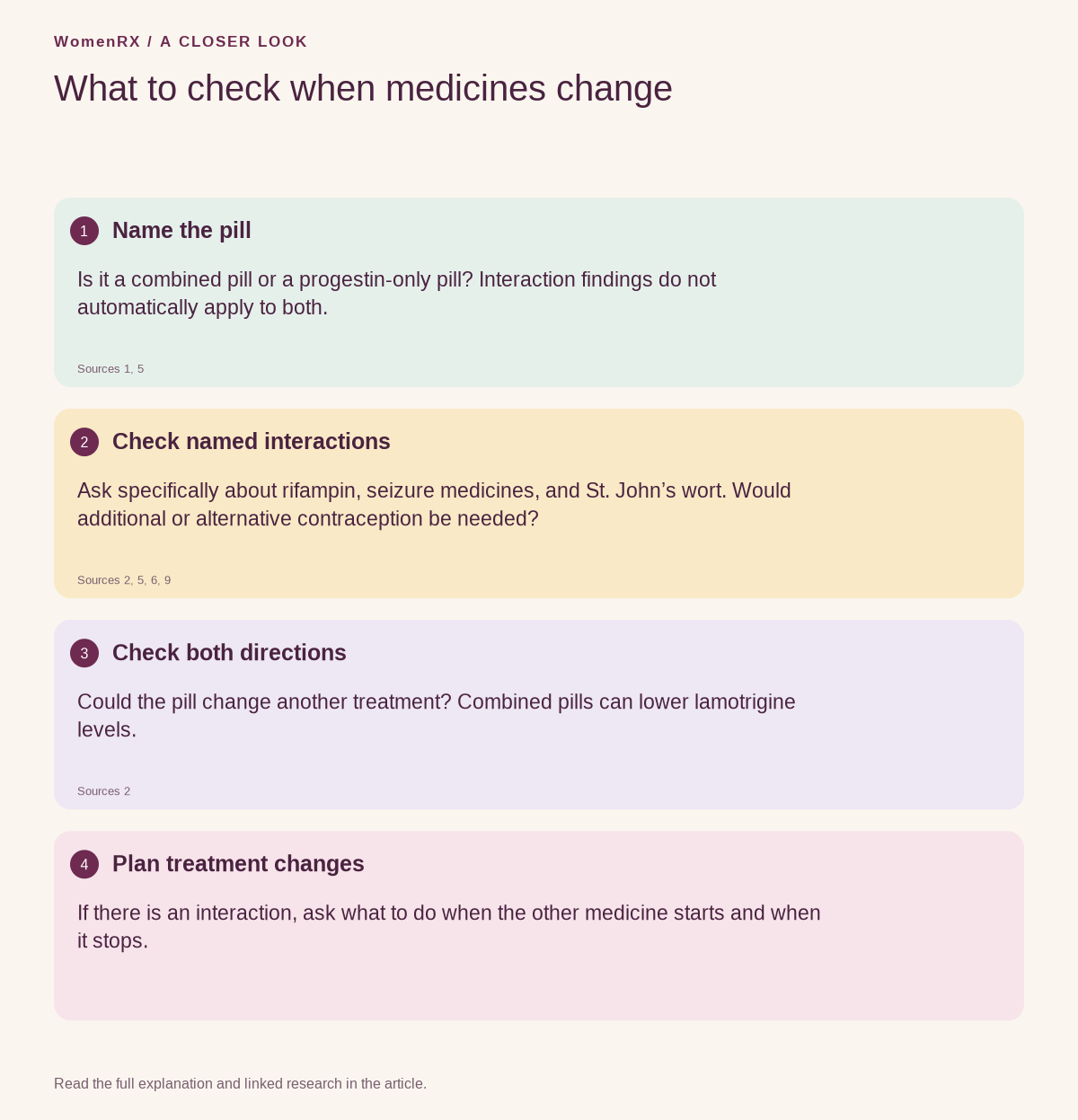
What to check when medicines change
Name the pill: Is it a combined pill or a progestin-only pill? Interaction findings do not automatically apply to both.15
Check named interactions: Ask specifically about rifampin, seizure medicines, and St. John’s wort. Would additional or alternative contraception be needed?2569
Check both directions: Could the pill change another treatment? Combined pills can lower lamotrigine levels.2
Plan treatment changes: If there is an interaction, ask what to do when the other medicine starts and when it stops.
Read the figure as text
Use these four prompts with the names of your exact pill and other products; this is a medication-review aid, not a test of contraceptive protection.- Name the pill: Is it a combined pill or a progestin-only pill? Interaction findings do not automatically apply to both.15
- Check named interactions: Ask specifically about rifampin, seizure medicines, and St. John’s wort. Would additional or alternative contraception be needed?2569
- Check both directions: Could the pill change another treatment? Combined pills can lower lamotrigine levels.2
- Plan treatment changes: If there is an interaction, ask what to do when the other medicine starts and when it stops.
More questions, answered
Does spotting mean my medicine made the pill stop working?
Not necessarily. Enzyme-inducing medicines can cause breakthrough bleeding, but spotting alone doesn’t tell you whether contraceptive protection has changed. Qsymia’s label, for example, anticipates more spotting with a studied combined pill without anticipating a higher pregnancy risk. Check the specific medicine and pill instead of using bleeding as a test. 23
Sources you can check
- Birth Control | Contraception | Contraceptives | MedlinePlusAccessed 2026-09-25Return to first citation
- LO LOESTRIN FE (NORETHINDRONE ACETATE AND ETHINYL ESTRADIOL, ETHINYL ESTRADIOL AND FERROUS FUMARATE) KIT [ALLERGAN, INC.] | US prescribing information and patient instructionsAccessed 2026-09-25Return to first citation
- QSYMIA (PHENTERMINE AND TOPIRAMATE) CAPSULE, EXTENDED RELEASE [VIVUS LLC] | US prescribing information and patient instructionsAccessed 2026-09-25Return to first citation
- Over-the-Counter Medicines: MedlinePlusAccessed 2026-09-25Return to first citation
- Drug interactions between rifamycin antibiotics and hormonal contraception: a systematic review.Simmons KB, Haddad LB, Nanda K, Curtis KM. · BJOG : an international journal of obstetrics and gynaecology · 2018Return to first citation
- The use of hormonal contraception among women taking anticonvulsant therapy.Gaffield ME, Culwell KR, Lee CR. · Contraception · 2011Return to first citation
- Exploring Antibiotic-Mediated Disruption of Enterohepatic Circulation and Combined Oral Contraceptive Efficacy: A Systematic Review.Elkhoury D, Reddy N, Venkatraman D, Patel P, Montalbano M. · Women's health reports (New Rochelle, N.Y.) · 2025Return to first citation
- Establishing a Quantitative Framework for Combined Oral Contraceptives: Evaluating the Impact of Drug-Drug Interactions on Exposure and Clinical (Surrogate) Efficacy Endpoints.Chun D, Chen H, Cicali B, Guzy S, Hoechel J, Jiao T, Vozmediano V, Schmidt S. · Journal of clinical pharmacology · 2025Return to first citation
- St. Johnâs Wort: Usefulness and Safety | NCCIHAccessed 2026-09-25Return to first citation