Slynd Interactions: What to Check Before a Medication Change
Some medicines can make Slynd less reliable, while others may raise potassium concerns, so the name of what you’re taking matters.
If you take Slynd, check new prescriptions, over-the-counter medicines, and supplements for two main concerns: reduced contraceptive effectiveness and higher potassium levels. Certain seizure medicines, rifampin, and St. John’s wort are examples in the first group; potassium supplements and some blood-pressure medicines are in the second. Tirzepatide has a separate warning for oral contraceptives when it’s started or its dose increases.23
Slynd is a progestin-only birth control pill containing drospirenone. Its interaction questions aren’t all the same. One medicine might make the pill less reliable by lowering hormone exposure. Another might add to drospirenone’s potential to raise blood potassium. Knowing which concern applies makes it easier to get a useful answer before you start, stop, or change something.2
First question: Could this make Slynd less reliable?
Some medicines and herbal products speed up the enzymes that process contraceptive hormones. Slynd’s labeling says they may lower hormone levels, potentially reducing contraceptive effectiveness or causing breakthrough bleeding. Examples include the seizure medicines carbamazepine, phenytoin, oxcarbazepine, and rufinamide; the antibiotics rifampin and rifabutin; and products containing St. John’s wort. The label also names other medicines, so this is not an exhaustive list.2
If one of these applies to you, don’t assume that taking the medicines at different times of day solves the problem. Ask about a non-hormonal contraceptive method or backup before making the change. Slynd’s label advises alternative non-hormonal contraception or a backup method while an enzyme inducer is used, and continued non-hormonal backup for 28 days after it is stopped. That afterward period is worth asking about if you’re finishing a course of treatment or changing a long-term medicine.2
Tirzepatide is a different kind of check. Mounjaro’s labeling says it delays stomach emptying and may reduce the effectiveness of oral hormonal contraceptives. It advises switching to a non-oral method or adding a barrier method for four weeks after starting Mounjaro and for four weeks after each dose increase. If you take Slynd and are starting or increasing tirzepatide, tell the prescriber it’s an oral pill rather than assuming this is covered by the same advice as other medication interactions.3
Second question: Could this raise my potassium?
Drospirenone has a potassium-sparing effect. Slynd’s label identifies a potential increase in blood potassium when it’s taken with medicines that can also raise potassium, including ACE inhibitors, angiotensin-II receptor blockers (ARBs), potassium-sparing diuretics, aldosterone antagonists, heparin, and nonsteroidal anti-inflammatory drugs (NSAIDs). Potassium supplements belong on the list too. These are reasons to check your particular combination, not a claim that everyone who takes one of these medicines will develop high potassium.2
The pattern of use matters. For someone receiving daily, long-term treatment for a chronic condition with a medicine that may increase potassium, Slynd’s label calls for a potassium blood test before starting Slynd and during its first treatment cycle. It also says to monitor people who later develop a condition or start a medicine that increases their risk. If you already take Slynd and are being prescribed a new blood-pressure medicine, for example, ask whether your potassium needs checking rather than applying the starting-Slynd schedule to yourself.2
Check the ingredients in products you buy without a prescription. NIH notes that potassium can be present in supplements and in salt substitutes; a supplement’s Supplement Facts panel lists its amount of elemental potassium. A product containing potassium is worth naming when you ask about Slynd, but that does not make every vitamin or supplement an interaction.4 St. John’s wort belongs in a different category because Slynd’s label names it as a product that may reduce contraceptive effectiveness.2
There’s one more potassium-related distinction: strong CYP3A4 inhibitors can increase drospirenone exposure. Slynd’s label says to consider potassium monitoring for people at increased risk who take one of these medicines long-term alongside Slynd. Examples include ketoconazole, itraconazole, voriconazole, and clarithromycin. This is not the same interaction as the enzyme-inducing medicines that may make contraception less reliable.2
Make the medication check specific
When a medicine or supplement changes, bring the product name or a photo of its label to a pharmacist or prescriber. Include prescription medicines, occasional over-the-counter products, vitamins, herbal products, potassium supplements, and salt substitutes. Slynd’s patient information recommends keeping a medicine list to show when you receive a new prescription; the National Center for Complementary and Integrative Health also recommends sharing supplement use because supplements can change how medicines work.21
You can make the conversation shorter by asking: Could this affect how well Slynd prevents pregnancy, raise my potassium, or neither? If contraception could be affected, ask what backup applies and when you can stop using it. If potassium is the concern, ask whether a blood test makes sense for your medicines and health conditions. Kidney, liver, and adrenal conditions also matter to Slynd’s potassium risk, so mention any new diagnosis rather than checking the medication name alone.2
Medication lists can change during pregnancy planning or postpartum care. If you’re planning to become pregnant, say so when you discuss stopping Slynd and reviewing your other medicines. If you’re breastfeeding, tell the person checking interactions: Slynd’s label addresses its use during lactation, but that does not answer whether a new medicine or supplement is suitable for you or your baby.2
If you develop palpitations or an irregular heartbeat, chest pain, or shortness of breath while taking Slynd, seek urgent medical help. Slynd’s patient information lists these among symptoms that need prompt attention in the context of possible high potassium.2
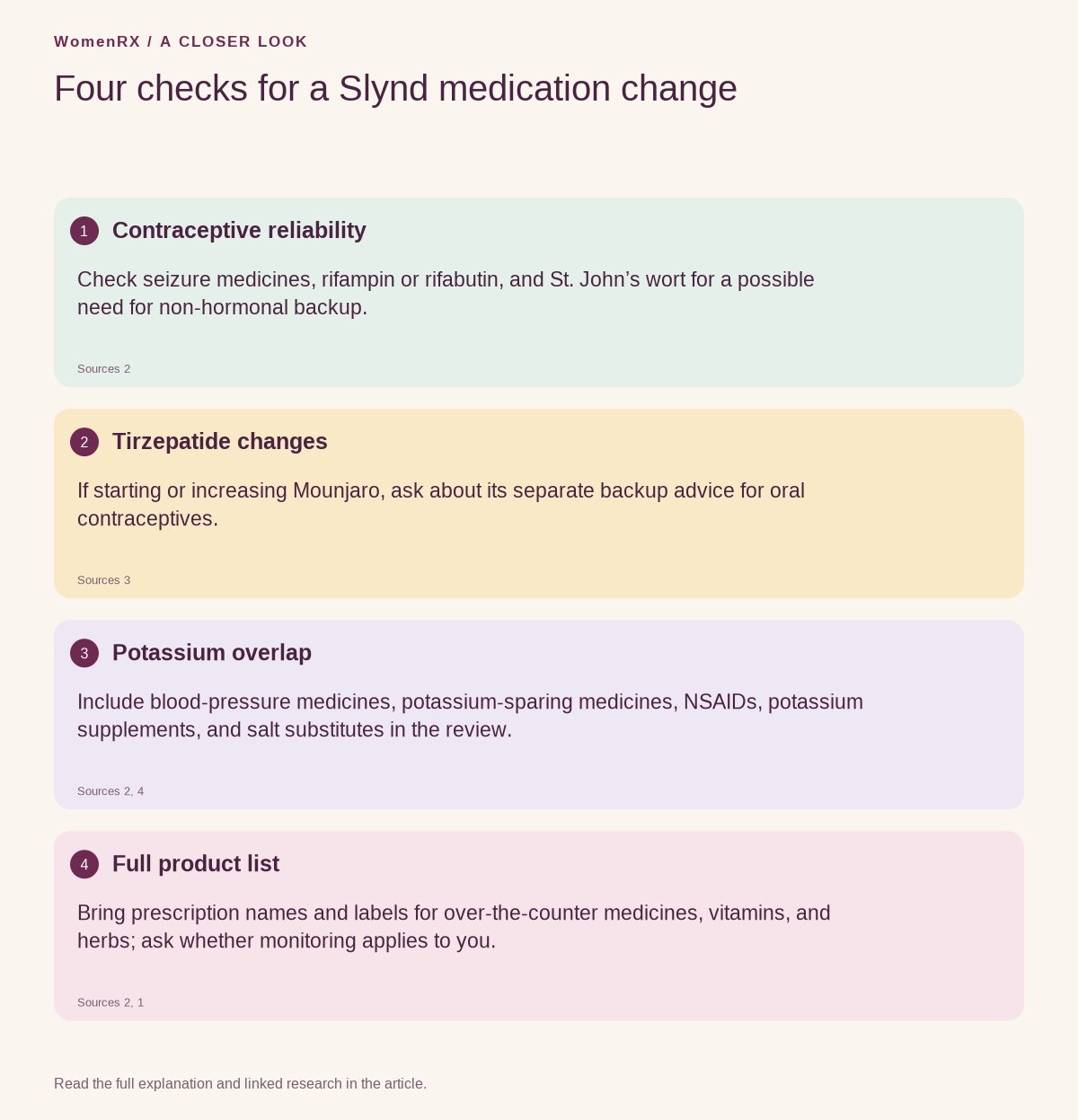
Four checks for a Slynd medication change
Contraceptive reliability: Check seizure medicines, rifampin or rifabutin, and St. John’s wort for a possible need for non-hormonal backup.2
Tirzepatide changes: If starting or increasing Mounjaro, ask about its separate backup advice for oral contraceptives.3
Potassium overlap: Include blood-pressure medicines, potassium-sparing medicines, NSAIDs, potassium supplements, and salt substitutes in the review.24
Full product list: Bring prescription names and labels for over-the-counter medicines, vitamins, and herbs; ask whether monitoring applies to you.21
Read the figure as text
Use these prompts with the exact names and labels of products you take; they are not a test for whether a combination is safe.- Contraceptive reliability: Check seizure medicines, rifampin or rifabutin, and St. John’s wort for a possible need for non-hormonal backup.2
- Tirzepatide changes: If starting or increasing Mounjaro, ask about its separate backup advice for oral contraceptives.3
- Potassium overlap: Include blood-pressure medicines, potassium-sparing medicines, NSAIDs, potassium supplements, and salt substitutes in the review.24
- Full product list: Bring prescription names and labels for over-the-counter medicines, vitamins, and herbs; ask whether monitoring applies to you.21
More questions, answered
Do all antibiotics interfere with Slynd?
No. Slynd’s interaction list specifically names rifampin and rifabutin as medicines that may reduce contraceptive effectiveness. It names clarithromycin under a different concern: as a strong CYP3A4 inhibitor that may increase drospirenone exposure and warrant consideration of potassium monitoring in people at increased risk. Check the exact antibiotic, not just the fact that it’s an antibiotic.2
Is every supplement a problem with Slynd?
No. The specific products to flag here are St. John’s wort, which may reduce contraceptive effectiveness, and supplements containing potassium, which may add to a potassium concern. Share the actual product name and ingredients so the check reflects what you take.24
Sources you can check
- How Medications and Supplements Can Interact | NCCIHAccessed 2026-09-25Return to first citation
- SLYND drospirenone tablets, ExeltisAccessed 2026-09-25Return to first citation
- MOUNJARO (TIRZEPATIDE) INJECTION, SOLUTION [A-S MEDICATION SOLUTIONS] | US prescribing information and patient instructionsAccessed 2026-09-25Return to first citation
- Potassium - Health Professional Fact SheetAccessed 2026-09-25Return to first citation