When to Review Whether Flibanserin Is Helping
The current U.S. prescribing information calls for an eight-week decision if symptoms haven’t improved, even though the main trials measured results at 24 weeks.
You don’t need to wait for a six-month trial endpoint to decide whether flibanserin is helping. The current U.S. prescribing information says to discontinue it after eight weeks if you report no improvement in your low-desire symptoms. Before that review, notice whether desire feels different, whether low desire bothers you less, and whether side effects change the balance. Make the decision with your prescriber. 1
Start with the change you’re hoping for
Flibanserin, sold as Addyi, is prescribed for acquired, generalized hypoactive sexual desire disorder (HSDD) in women under 65. That means low desire developed after a time when desire wasn’t a problem, occurs across situations, and causes marked distress or difficulty. It isn’t intended to improve sexual performance or to treat low desire caused by another medical condition, a medication, or a relationship problem. 1
That definition gives you a useful starting point for assessing treatment: What about low desire is troubling you now? For example, you might care most about feeling sexual interest again, or about feeling less bothered by its absence. You can note those things before treatment and describe any change in your own words. A count of sexual encounters alone may miss the part of the problem you most want to change. In the trials, researchers measured desire and distress as well as satisfying sexual events. 1
Week four is a research observation, not a deadline
A later analysis of the flibanserin trials compared sexual-function scores at weeks 4, 8, 16, and 24. In the premenopausal group, differences from placebo in several scores were visible at the first assessment, week 4. In the postmenopausal group, desire and arousal scores differed at week 4, while some other sexual-function scores differed at week 8. These were group-level findings from a post-hoc analysis, not a promise that you’ll feel a change by week four. The questionnaire asked about the preceding month, so it couldn’t establish exactly when an individual response began. 3
If you notice a change early, you can bring it up. If you don’t, week four by itself isn’t the stopping rule. The U.S. prescribing information gives a different decision point: discontinue flibanserin after eight weeks if you report no improvement in HSDD symptoms. Its patient instructions also say to tell your doctor if symptoms haven’t improved after eight weeks. 1
At eight weeks, weigh benefit against the experience of taking it
For the review, compare what’s happening with the concern you identified at the start. Has your interest changed? Is low desire less troubling? If sexual activity has changed, does that feel like a benefit to you? These are prompts for a conversation, not a score you have to reach. Researchers’ measures included satisfying sexual events, desire scores, and how often women felt bothered by low desire; they don’t replace your assessment of whether treatment is helping. 14
Side effects belong in that conversation too. Dizziness, nausea, tiredness, sleep problems, and dry mouth are among the effects listed in the medication guide. A systematic review of trials in premenopausal and postmenopausal women found a modest average benefit over placebo alongside higher risks of dizziness, sleepiness, nausea, and fatigue. An average treatment effect cannot tell you whether your own benefit is worth those effects. 12
You needn’t wait for week eight to raise a safety concern. Flibanserin can cause low blood pressure and fainting, and the risk increases with alcohol close to a dose, certain interacting medicines, or liver problems. If you feel lightheaded or dizzy, the medication guide says to lie down; seek emergency help if it doesn’t pass or you feel you could faint. Tell your prescriber about a fainting episode as soon as you can. Check with them before starting another medicine: the guide specifically lists interacting drugs including fluconazole and ciprofloxacin. 1
Why the trials lasted longer
The main placebo-controlled efficacy trials measured outcomes at 24 weeks. Three enrolled premenopausal women; one enrolled naturally postmenopausal women under 65. That endpoint tells researchers how groups compared over the study period. It does not mean someone with no improvement at eight weeks should continue for 24 weeks to find out. Conversely, if you do report improvement at eight weeks, that review is a chance to discuss benefit and side effects, not an automatic end date. 1
The current U.S. indication includes women under 65, rather than only premenopausal women, but response shouldn’t be assumed to be identical across life stages. The postmenopausal evidence in the prescribing information comes from one 24-week trial, compared with three premenopausal trials. Those studies do not establish a predictable day when any one woman will notice a benefit. 13
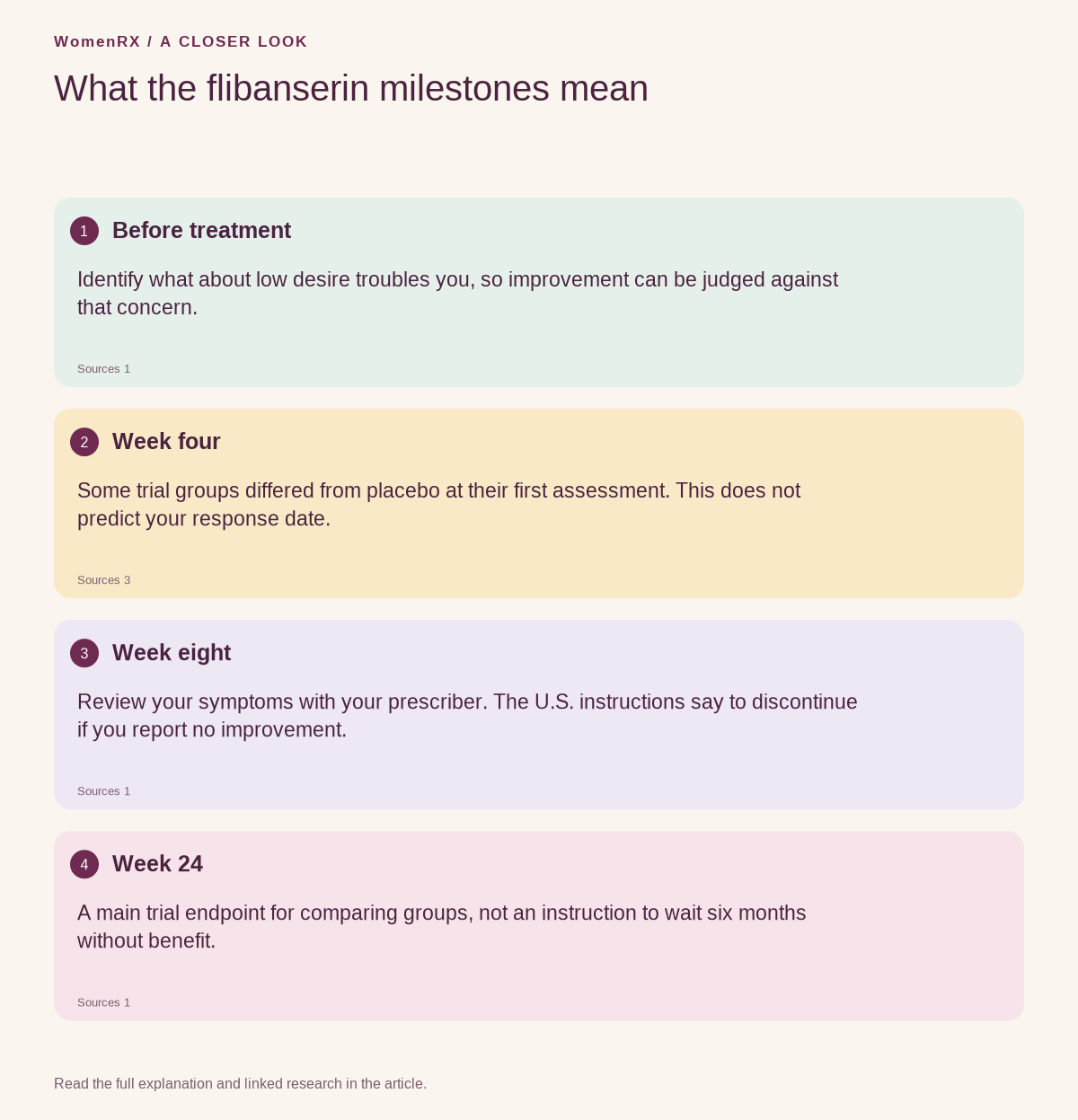
What the flibanserin milestones mean
Before treatment: Identify what about low desire troubles you, so improvement can be judged against that concern.1
Week four: Some trial groups differed from placebo at their first assessment. This does not predict your response date.3
Week eight: Review your symptoms with your prescriber. The U.S. instructions say to discontinue if you report no improvement.1
Week 24: A main trial endpoint for comparing groups, not an instruction to wait six months without benefit.1
Read the figure as text
Research assessments and the treatment decision are different kinds of milestones.- Before treatment: Identify what about low desire troubles you, so improvement can be judged against that concern.1
- Week four: Some trial groups differed from placebo at their first assessment. This does not predict your response date.3
- Week eight: Review your symptoms with your prescriber. The U.S. instructions say to discontinue if you report no improvement.1
- Week 24: A main trial endpoint for comparing groups, not an instruction to wait six months without benefit.1
Sources you can check
- ADDYI (FLIBANSERIN) TABLET, FILM COATED [SPROUT PHARMACEUTICALS, INC.] | US prescribing information and patient instructionsAccessed 2026-09-25Return to first citation
- Efficacy and Safety of Flibanserin for the Treatment of Hypoactive Sexual Desire Disorder in Women: A Systematic Review and Meta-analysis.Jaspers L, Feys F, Bramer WM, Franco OH, Leusink P, Laan ET. · JAMA internal medicine · 2016Return to first citation
- Effects of Flibanserin on Subdomain Scores of the Female Sexual Function Index in Women With Hypoactive Sexual Desire Disorder.Simon JA, Clayton AH, Goldstein I, Kingsberg SA, Shapiro M, Patel S, Kim NN. · Sexual medicine · 2022Return to first citation
- Clinically Meaningful Benefit in Women with Hypoactive Sexual Desire Disorder Treated with Flibanserin.Simon JA, Clayton AH, Kim NN, Patel S. · Sexual medicine · 2022Return to first citation