What to Confirm About Your Spironolactone Prescription
Your label tells you how to take spironolactone; a few questions can make the lab plan, interactions, and missed-dose instructions clear too.
Confirm the instructions on your own prescription label, what to do if you miss a dose, and when you’ll have potassium checks, and whether and when you need kidney-function tests. Review your medicines, supplements, and salt substitutes because some can raise potassium alongside spironolactone. If pregnancy is possible or planned, ask about that separately from the daily dosing instructions. 34

Spironolactone prescriptions aren’t all for the same reason. It may be used for conditions involving fluid buildup, blood pressure, or heart failure, and the dose and length of treatment depend on why you’re taking it. Start with the instructions printed for your prescription, not a regimen someone else was given. 3
Make the label instructions usable
Before you leave the pharmacy, check that you can answer: How much am I taking, how often, and how should I measure it if it’s a liquid? Spironolactone comes as tablets and as a liquid taken by mouth. The NHS advises using the measuring syringe or spoon supplied with liquid medicine and asking a pharmacist or prescriber if the package instructions aren’t clear. 3
Ask about missed doses while the prescription is in front of you. General NHS guidance says to take a forgotten dose when you remember unless it’s nearly time for the next one; if it is, skip the missed dose and don’t take two doses together. Have your pharmacist confirm how to apply that guidance to your label, especially if you’re unsure what counts as nearly time for your next dose. If you’ve taken more than prescribed, get medical advice rather than trying to balance it out yourself. 3
Know what the blood tests are checking
Spironolactone reduces the amount of potassium your kidneys release in urine. Potassium helps muscles and nerves work, including those involved in your heartbeat, but too much potassium in the blood can be dangerous. Kidney problems and other medicines that raise potassium increase the concern. 124
Ask: When will my potassium be checked after starting or changing the dose? Do I need kidney-function tests, and who will tell me the results? One US spironolactone tablet label calls for a potassium check within one week of starting or changing the dose, then regular checks afterward. It says checks may need to be more frequent when kidney function is impaired or other potassium-raising drugs are used. Your prescriber can tell you the plan for your prescription and reason for taking it; don’t use a general schedule as a reason to order, skip, or change treatment on your own. 4
The plan may also need revisiting when another medicine changes. For example, the US label calls for a potassium check when treatment with an ACE inhibitor or angiotensin receptor blocker is altered in someone taking spironolactone. 4
Review the combinations that matter
Bring up everything you take, including occasional medicines and products that may not look like supplements. Potassium supplements and potassium-containing salt substitutes can increase the risk of high potassium with spironolactone. So can certain blood-pressure medicines, including ACE inhibitors and angiotensin receptor blockers; the US label also identifies nonsteroidal anti-inflammatory drugs (NSAIDs), such as ibuprofen, among medicines to review. Spironolactone can reduce the kidney’s clearance of lithium, creating a separate risk of lithium toxicity. Ask which combinations affect your monitoring plan rather than stopping a prescribed medicine without a plan. 34
A salt substitute deserves a specific mention because some replace sodium with potassium chloride. That’s different from assuming you must avoid every food that contains potassium. Ask whether your kidney function, test results, and other medicines call for any changes to what you eat or use. 14
Keep pregnancy plans and warning signs in the conversation
If you’re pregnant, might become pregnant, or are planning pregnancy, tell your prescriber and ask whether spironolactone is appropriate and what contraception discussion applies to you. This isn’t a question your dosing label alone can settle. US prescribing information describes a potential concern for fetal sex development based on spironolactone’s antiandrogen effects and animal findings; those findings shouldn’t be presented as a measured risk in human pregnancies. 4
Finally, ask what should prompt a call and what needs urgent care. High potassium may cause no noticeable symptoms, so feeling well doesn’t replace planned blood tests. Severe muscle weakness or a racing or irregular heartbeat warrants urgent medical assessment; tell the care team that you take spironolactone. Those symptoms can have other causes, but severe high potassium can affect muscles and heart rhythm. 1
You don’t need to memorize a universal set of rules. You need a label you understand, a lab plan with a named follow-up, and clear answers about the other products and pregnancy plans that apply to you.
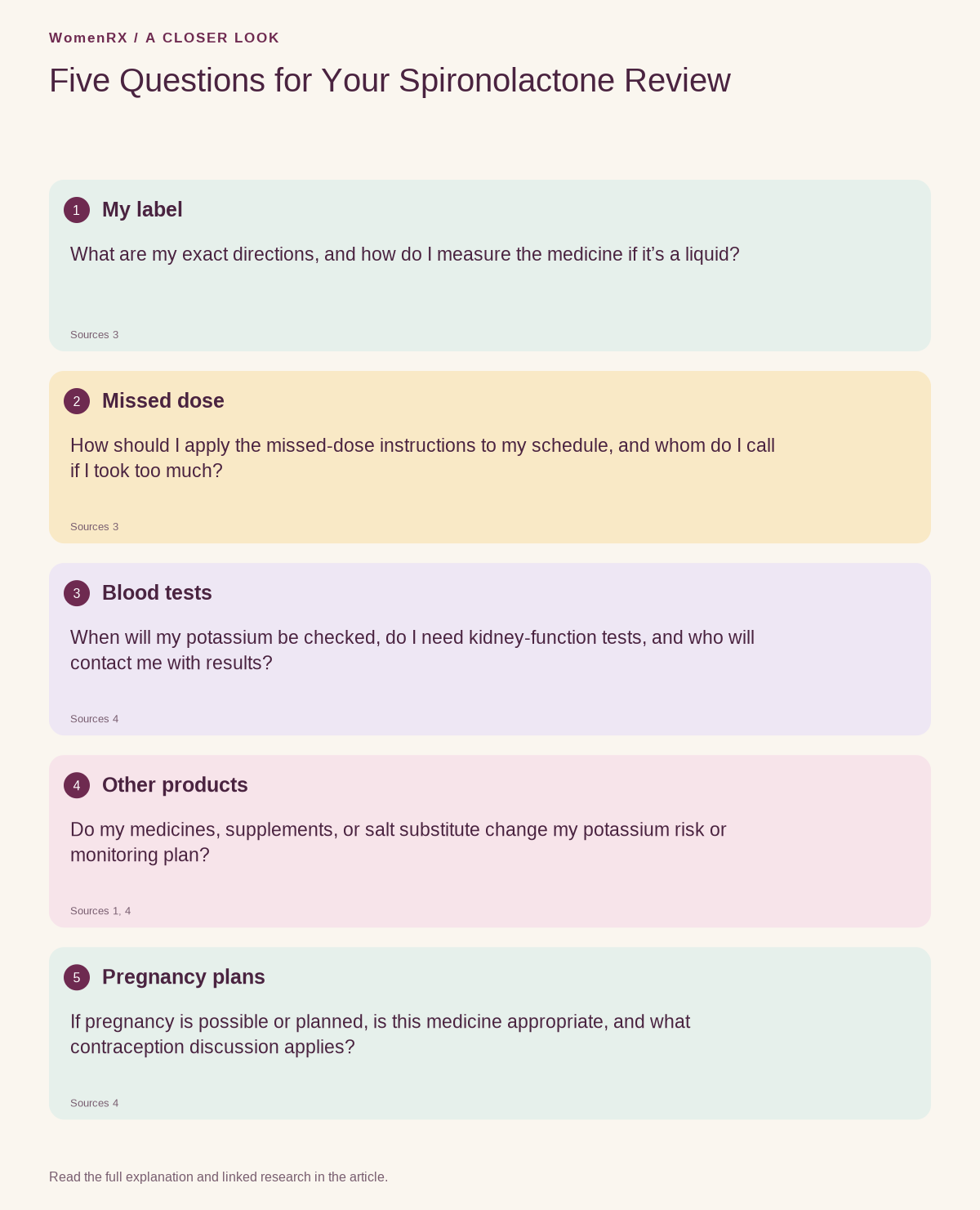
Five Questions for Your Spironolactone Review
My label: What are my exact directions, and how do I measure the medicine if it’s a liquid?3
Missed dose: How should I apply the missed-dose instructions to my schedule, and whom do I call if I took too much?3
Blood tests: When will my potassium be checked, do I need kidney-function tests, and who will contact me with results?4
Other products: Do my medicines, supplements, or salt substitute change my potassium risk or monitoring plan?14
Pregnancy plans: If pregnancy is possible or planned, is this medicine appropriate, and what contraception discussion applies?4
Read the figure as text
Use these prompts with your prescription in hand; they aren’t a dosing or diagnostic checklist.- My label: What are my exact directions, and how do I measure the medicine if it’s a liquid?3
- Missed dose: How should I apply the missed-dose instructions to my schedule, and whom do I call if I took too much?3
- Blood tests: When will my potassium be checked, do I need kidney-function tests, and who will contact me with results?4
- Other products: Do my medicines, supplements, or salt substitute change my potassium risk or monitoring plan?14
- Pregnancy plans: If pregnancy is possible or planned, is this medicine appropriate, and what contraception discussion applies?4
More questions, answered
Do I need to stop eating foods with potassium?
Not automatically. Potassium is present in many everyday foods, while spironolactone and kidney function can change how your body handles it. Ask whether your test results and other medicines call for dietary changes, and mention any potassium-containing salt substitute you use. 14
Sources you can check
- Potassium - Health Professional Fact SheetAccessed 2026-09-25Return to first citation
- Potassium | Dietary Potassium | MedlinePlusAccessed 2026-09-25Return to first citation
- Spironolactone - NHSAccessed 2026-09-25Return to first citation
- SPIRONOLACTONE TABLET, FILM COATED [REMEDYREPACK INC.] | US prescribing information and patient instructionsAccessed 2026-09-25Return to first citation