What Carrots Bring to a Snack or Meal
Carrots bring fiber and vitamin A precursors to the plate; a protein-containing dip can make them part of a more substantial snack.
A cup of raw grated carrots provides about 3.1 grams of fiber, 1 gram of protein, and 45 calories. Carrots also supply carotenoids that your body can convert to vitamin A.71 For a more substantial snack, pair them with a bean-based or yogurt dip for protein. The amount depends on the dip and portion you choose.38
What’s in a serving of carrots?
If you’re adding carrots to lunch or setting out a snack, their main contributions aren’t protein or calories. USDA reference data for one cup of raw grated carrots (110 grams) estimates about 3.1 grams of fiber, 1 gram of protein, 10.5 grams of carbohydrate, and 45 calories. These are estimates for that specific raw, grated portion, not every handful of carrot sticks.7
Carrots also provide alpha- and beta-carotene, plant pigments the body can convert into vitamin A.14 In a separate reference serving, ½ cup of raw carrots supplies 459 micrograms of retinol activity equivalents (RAE) of vitamin A. RAE accounts for the fact that carotenoids from food don’t have the same vitamin A activity, gram for gram, as preformed vitamin A.1 The two serving descriptions aren’t interchangeable, so don’t combine those figures as though they describe the same measured cup.
Vitamin A supports normal vision and other body functions. Deficiency can cause difficulty seeing in low light and is uncommon in the United States.1
Whole carrots, juice, and cooking do different things
Whole carrots keep the vegetable’s fiber in the snack. That fiber adds bulk to food and can help with fullness and regularity.72 The grated-carrot estimates above do not tell you how much fiber or other nutrients are in a glass of juice. For packaged juice, check the label for listed nutrients per serving and compare its serving size with how much you plan to drink.78
There is one interesting tradeoff that doesn’t fit a simple “whole is always better” rule. In a small crossover study, 16 healthy adults had a greater rise in blood beta-carotene over 24 hours after fresh carrot juice than after raw carrots. Researchers matched the beta-carotene provided and served both preparations with canola oil. They used large research portions, not an ordinary snack, and did not report a separate result for women.5 Greater short-term beta-carotene absorption doesn’t establish that juice delivers a better overall snack or improves health outcomes.
Cooking can also change what your body gets from carrots. Heat treatment may make beta-carotene more available for absorption, while the amount of carotene remaining in the food can fall with some cooking methods.16 Raw carrots for crunch and cooked carrots in a meal are both reasonable choices; there’s no need to treat one preparation as the only nutritious one.
Let the pairing supply what carrots don’t
Because a cup of grated carrots contains only about 1 gram of protein, carrots alone may not be the snack you want when you need something more substantial.7 Try carrot sticks with a bean-based dip, or add carrots to a plate with a yogurt dip. Beans and dairy foods are protein sources; how much protein the pairing adds depends on the ingredients and how much you serve.3
That’s where a packaged-food label is more useful than a blanket claim that every dip is “high protein.” Compare the protein per serving, then look at the serving size you’re likely to eat. The label can also show how much fiber or added sugar a prepared dip contributes.8 If you’re making a dip at home, the ingredients still tell you its role: beans or yogurt contribute protein, while the carrots contribute crunch, fiber, and carotenoids.371
The same idea works at a meal. For example, grated carrots can add texture to a bean bowl, or cooked carrots can sit alongside an egg or another protein-containing food. You don’t need carrots to provide every nutrient on the plate.37
Does the answer change during pregnancy?
The carrot itself doesn’t have a special effect because you’re a woman. Vitamin A needs do change during pregnancy and lactation: the recommended intake is 700 micrograms RAE daily for women ages 19-50, 770 during pregnancy, and 1,300 during lactation.1 Those are daily needs, not targets to meet with carrots alone.
There’s also a meaningful distinction between carrots and high-dose vitamin A supplements. Carrots provide provitamin A carotenoids; excess preformed vitamin A from supplements or animal sources can pose risks during pregnancy, while beta-carotene is not known to cause birth defects.1 That’s a reason not to confuse the vitamin A activity listed for a food with a dose of preformed vitamin A.
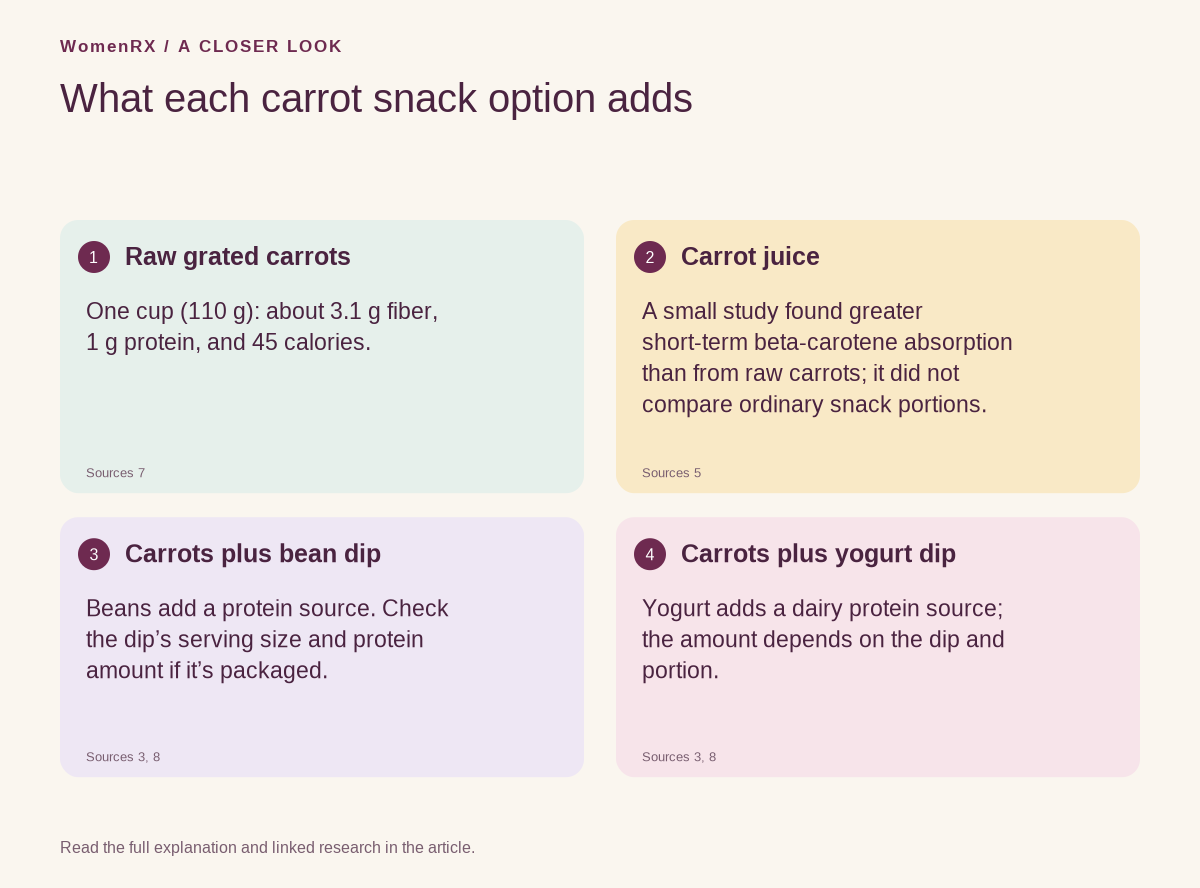
What each carrot snack option adds
Raw grated carrots: One cup (110 g): about 3.1 g fiber, 1 g protein, and 45 calories.7
Carrot juice: A small study found greater short-term beta-carotene absorption than from raw carrots; it did not compare ordinary snack portions.5
Carrots plus bean dip: Beans add a protein source. Check the dip’s serving size and protein amount if it’s packaged.38
Carrots plus yogurt dip: Yogurt adds a dairy protein source; the amount depends on the dip and portion.38
Read the figure as text
The measured carrot portion and the practical pairing choices answer different nutrition questions. For packaged juice or dip, the label lists nutrients per serving.8- Raw grated carrots: One cup (110 g): about 3.1 g fiber, 1 g protein, and 45 calories.7
- Carrot juice: A small study found greater short-term beta-carotene absorption than from raw carrots; it did not compare ordinary snack portions.5
- Carrots plus bean dip: Beans add a protein source. Check the dip’s serving size and protein amount if it’s packaged.38
- Carrots plus yogurt dip: Yogurt adds a dairy protein source; the amount depends on the dip and portion.38
Sources you can check
- Vitamin A and Carotenoids - Health Professional Fact SheetAccessed 2026-09-25Return to first citation
- Dietary Fiber: MedlinePlusAccessed 2026-09-25Return to first citation
- Dietary Proteins: MedlinePlusAccessed 2026-09-25Return to first citation
- Carrot2006Return to first citation
- Comparative bioavailability of β-carotene from raw carrots and fresh carrot juice in humans: a crossover study.Choi M, Baek J, Park E. · Nutrition research and practice · 2025Return to first citation
- Effect of hydrothermal processing on carrot carotenoids changes and interactions with dietary fiber.Borowska J, Kowalska M, Czaplicki S, Zadernowski R. · Die Nahrung · 2003Return to first citation
- USDA SR Legacy: Carrots, raw (FDC 170393)Accessed 2026-09-25Return to first citation
- Food Labeling: MedlinePlusAccessed 2026-09-25Return to first citation