What an Online Tretinoin Consultation Should Cover
A useful visit should clarify your skin concern, the exact product, pregnancy and breastfeeding considerations, and how you’ll handle irritation.
Before tretinoin is prescribed, the clinician should understand what you’re treating, review your medications and skincare, and confirm the exact formulation and instructions. Tell them if you’re pregnant, planning pregnancy, or breastfeeding; the topical cream’s patient information says to discuss pregnancy or nursing before use. Agree on what to do if irritation develops, how follow-up will work, and what you’ll pay for the visit and medication. 2
Start with the skin concern, not the prescription
Explain what you want treated, where it appears, how long it has been happening, and what you’ve already tried. Tretinoin cream has product-specific instructions for acne, and its patient leaflet says to use it only as directed, not on other areas or growths. If your goal is something other than acne, ask whether the exact product being considered has been evaluated for that use. 2
An online visit should also make room for uncertainty. Ask whether the clinician has enough information to assess your concern remotely, what they can’t determine from the information you’ve shared, and whether they might recommend an in-person skin examination instead. The visit should leave you with a clear plan, not just a prescription decision.
Share the full picture of your skin routine
List prescription creams and gels, over-the-counter acne treatments, cleansers, exfoliants, and cosmetics you use on the area. Don’t leave out products just because they seem gentle or aren’t sold as medicine. The tretinoin cream information cautions that other topical medications and drying or abrasive products can add to irritation. It specifically calls for caution with products containing sulfur, resorcinol, or salicylic acid. 2
Also mention skin that is already irritated, very dry, or affected by eczema, and say whether you spend substantial time in sun, wind, or cold. The product information warns that tretinoin can cause local redness and peeling, that eczema-prone skin may be especially irritated, and that sun exposure and weather extremes can aggravate treated skin. 2
A practical question is: “Which of my current products should I keep using, pause, or change, and what should I do if my skin becomes irritated?” Get an answer specific to your routine rather than guessing which products can be combined.
Make pregnancy and feeding plans part of the conversation
Tell the clinician if you’re pregnant, might be pregnant, trying to become pregnant, or breastfeeding. Ask them to check the current guidance for the exact topical product and how you would use it. The patient information for one tretinoin acne cream says people who are pregnant, think they may be pregnant, or are nursing should consult their physician before using it. It also says human studies have not established safety in pregnancy. 2
That uncertainty shouldn’t be confused with the much stronger warnings for oral tretinoin capsules, which are used for a specific leukemia treatment. Capsule instructions and risks are not instructions for acne cream. Confirm the formulation rather than relying on the drug name alone. 12
Research summaries describe limited or uncertain pregnancy-outcome evidence for topical retinoids, including tretinoin. That does not establish that topical tretinoin is safe in pregnancy, nor does it tell you what to do with every formulation or situation. Your clinician should explain the product-specific recommendation, including if you’re planning pregnancy or breastfeeding. 34
Leave with instructions you can follow
Before the visit ends, make sure you know:
- The exact medication name and whether it is a cream, gel, or combination product.
- Where to apply it, how much to use, and when to use it. The product information for the cited acne cream says it is applied to acne-affected skin, but your own instructions should match your prescription. 2
- What to do about other acne products and skincare, and what sun-protection steps are recommended. The cream information advises minimizing sun exposure and using sunscreen and protective clothing when exposure can’t be avoided. 2
- What level of redness, peeling, or discomfort the clinician expects, and when to pause treatment or contact them. The cream information says irritation may warrant using it less often, temporarily stopping, or stopping altogether. 2
- When and how you’ll check whether treatment is working, and whom to contact if the plan isn’t manageable.
A reaction that needs a change isn’t something you have to interpret alone. Tretinoin can cause significant local irritation, and the product information allows for changing frequency or temporarily stopping when irritation warrants it. Ask your prescriber how that applies to your plan rather than changing the schedule on your own. 2
Check the cost before you agree
Ask what the online visit costs, whether follow-up has a separate charge, and whether the medication price includes shipping or tax. Keep those amounts separate: a pharmacy’s tube price is not the price of the consultation or the whole treatment plan.
For one concrete example, on September 25, 2026, Cost Plus Drugs listed one 20 g tube of 0.025% tretinoin cream at $14.17, with $5.25 standard shipping listed separately. Taxes and the final total varied by location. This was a prescription-required medication listing, not a monthly treatment cost or a guarantee that you’ll receive a prescription. 5
A quick check before you log off
You should be able to say, in your own words, what you’re treating, which exact product you’ve been prescribed, how to use it, what to do with your other skincare, and how pregnancy or breastfeeding affects the decision. If any of those answers are missing, ask before starting.
What to cover before starting
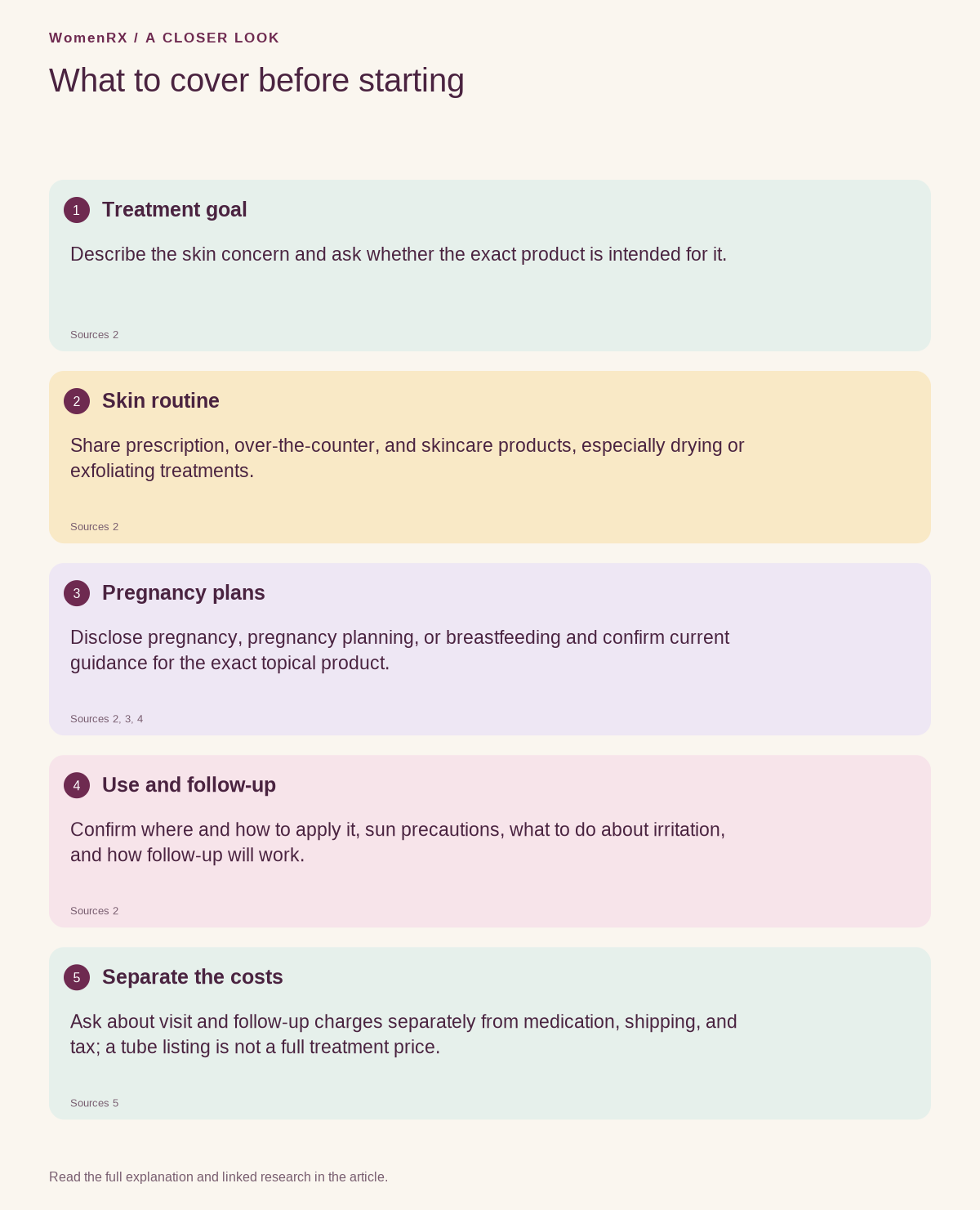
Treatment goal: Describe the skin concern and ask whether the exact product is intended for it.2
Skin routine: Share prescription, over-the-counter, and skincare products, especially drying or exfoliating treatments.2
Pregnancy plans: Disclose pregnancy, pregnancy planning, or breastfeeding and confirm current guidance for the exact topical product.234
Use and follow-up: Confirm where and how to apply it, sun precautions, what to do about irritation, and how follow-up will work.2
Separate the costs: Ask about visit and follow-up charges separately from medication, shipping, and tax; a tube listing is not a full treatment price.5
Read the figure as text
Use these five checkpoints to cover the treatment decision, instructions, and costs during an online visit.- Treatment goal: Describe the skin concern and ask whether the exact product is intended for it.2
- Skin routine: Share prescription, over-the-counter, and skincare products, especially drying or exfoliating treatments.2
- Pregnancy plans: Disclose pregnancy, pregnancy planning, or breastfeeding and confirm current guidance for the exact topical product.234
- Use and follow-up: Confirm where and how to apply it, sun precautions, what to do about irritation, and how follow-up will work.2
- Separate the costs: Ask about visit and follow-up charges separately from medication, shipping, and tax; a tube listing is not a full treatment price.5
Sources you can check
- TRETINOIN CAPSULE [PAR HEALTH USA, LLC] | US prescribing information and patient instructionsAccessed 2026-09-25Return to first citation
- TRETINOIN CREAM [REDPHARM DRUG] | US prescribing information and patient instructionsAccessed 2026-09-25Return to first citation
- Use of Topical Tazarotene for the Treatment of Acne Vulgaris in Pregnancy: A Literature Review.Han G, Wu JJ, Del Rosso JQ. · The Journal of clinical and aesthetic dermatology · 2020Return to first citation
- Safety of skin care products during pregnancy.Bozzo P, Chua-Gocheco A, Einarson A. · Canadian family physician Medecin de famille canadien · 2011Return to first citation
- Cost Plus Drugs: Tretinoin exact package priceAccessed 2026-09-25Return to first citation