Vyleesi Side Effects: What to Expect and When to Get Help
Nausea often starts soon after a Vyleesi dose, but severe symptoms and heart-health concerns call for a different response.
Nausea is Vyleesi’s most common side effect; flushing, headache, and injection-site reactions also occur. Nausea often starts within an hour and lasts about two hours. Contact your prescriber about severe or persistent nausea. Seek prompt medical assessment for a severe headache with vomiting, rather than assuming it’s a routine reaction. Vyleesi also temporarily raises blood pressure. 1 2
What you might notice after a dose
Nausea is the side effect most likely to shape your experience. In placebo-controlled trials, it was reported by 40% of women receiving Vyleesi, compared with 1.3% receiving placebo. The median onset was within an hour of the dose, and it lasted about two hours. Nausea was most common after the first dose and became less frequent with later doses, but that pattern won’t predict how you’ll feel. 1
Other reported reactions included flushing (20.3% with Vyleesi versus 0.3% with placebo), injection-site reactions (13.2% versus 8.4%), and headache (11.3% versus 1.9%). Vomiting was reported by 4.8% versus 0.2%. These are trial figures, not a prediction for any one dose or person; most reported reactions were mild to moderate and temporary. 1
For nausea that is bothersome, severe, or keeps returning, contact your prescriber before deciding what to do about another dose. The prescribing information says persistent or severe nausea may warrant stopping treatment; your prescriber can discuss whether treatment is right for you. 1
When not to wait for the next dose
A severe headache with vomiting deserves prompt medical assessment, not an assumption that both symptoms will pass because they followed an injection. In the phase 3 trials, one participant was hospitalized overnight for vomiting and an intractable headache considered related to bremelanotide. That case doesn’t mean every headache or episode of vomiting is an emergency, but it shows why the severity of symptoms matters. 2
Before another dose: check the bigger picture
In the phase 3 trials, average blood-pressure increases were small and temporary, with readings returning to baseline within 8-10 hours. That average doesn’t tell you what will happen for you. Vyleesi must not be used if you have uncontrolled high blood pressure or known cardiovascular disease. If you have high blood pressure or heart-health concerns, discuss them with your prescriber before using it. 1 2
The prescribing information says not to take more than one dose within 24 hours and does not recommend more than eight doses a month. Doses taken close together may add to blood-pressure effects; more frequent use also increases the risk of focal skin darkening. 1
Focal darkening can affect areas including the face, gums, and breasts. It was reported in 1% of Vyleesi-treated participants receiving up to eight doses a month in the placebo-controlled trials, compared with none receiving placebo. It was more common with consecutive daily dosing and in people with darker skin, and it may not completely fade after stopping treatment. Tell your prescriber if you notice a change. 1
Vyleesi isn’t for every kind of low desire
Vyleesi is approved for premenopausal women with acquired, generalized hypoactive sexual desire disorder (HSDD): low desire that developed after previously having no desire problem, occurs across situations, and causes distress or interpersonal difficulty. Its approved use does not include low desire due to a medical or mental health condition, a relationship problem, or a medication or other drug. It is not indicated after menopause or to improve sexual performance. The side-effect figures here come from trials in premenopausal women with HSDD and shouldn’t be assumed to apply equally to other groups. 1 2
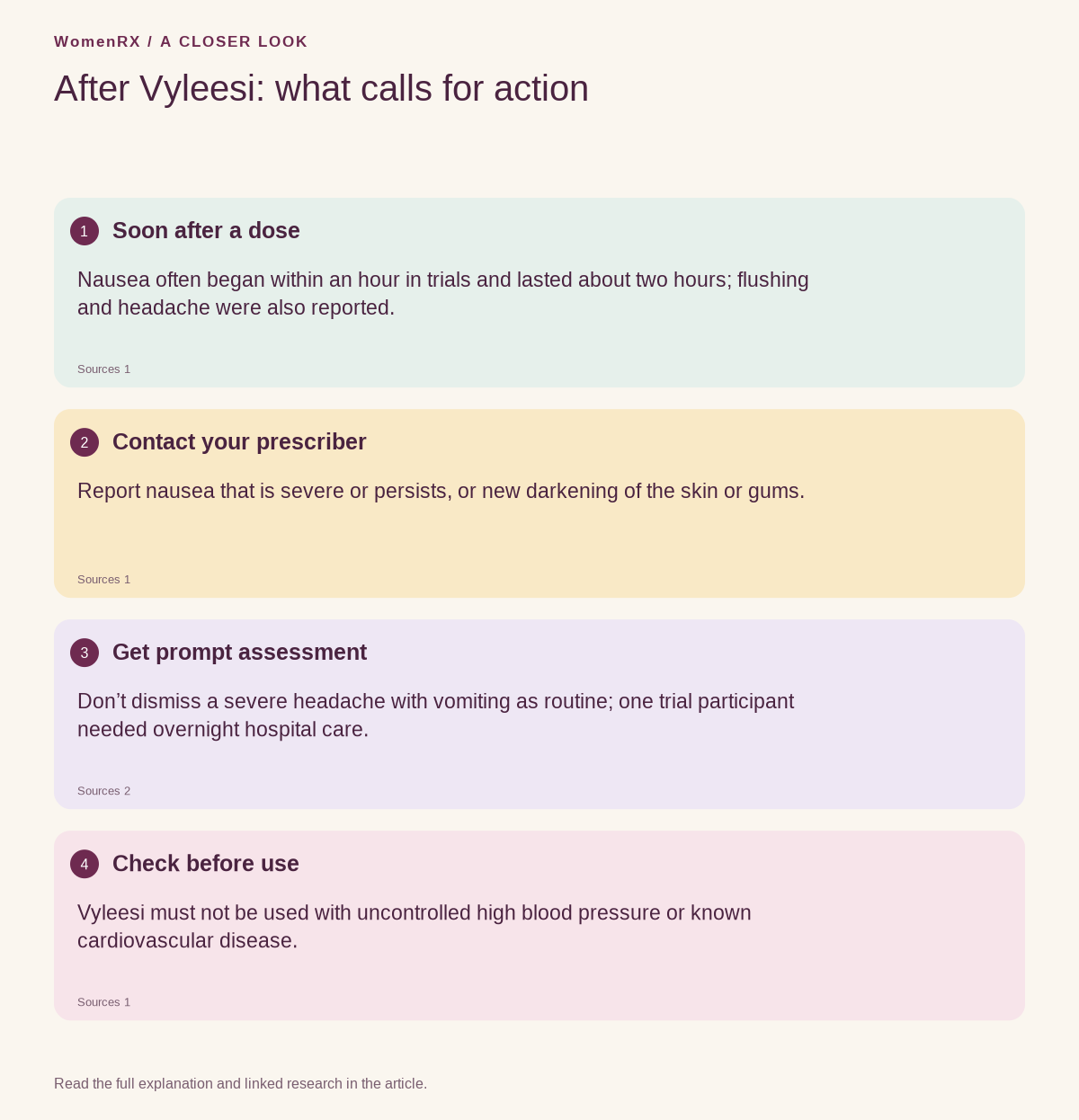
After Vyleesi: what calls for action
Soon after a dose: Nausea often began within an hour in trials and lasted about two hours; flushing and headache were also reported.1
Contact your prescriber: Report nausea that is severe or persists, or new darkening of the skin or gums.1
Get prompt assessment: Don’t dismiss a severe headache with vomiting as routine; one trial participant needed overnight hospital care.2
Check before use: Vyleesi must not be used with uncontrolled high blood pressure or known cardiovascular disease.1
Read the figure as text
A response guide, not a test for whether Vyleesi caused a symptom.- Soon after a dose: Nausea often began within an hour in trials and lasted about two hours; flushing and headache were also reported.1
- Contact your prescriber: Report nausea that is severe or persists, or new darkening of the skin or gums.1
- Get prompt assessment: Don’t dismiss a severe headache with vomiting as routine; one trial participant needed overnight hospital care.2
- Check before use: Vyleesi must not be used with uncontrolled high blood pressure or known cardiovascular disease.1
More questions, answered
Does nausea usually happen after every Vyleesi dose?
No. In the trials, nausea was most frequent after the first dose and less frequent after later doses. That’s a group pattern, not a guarantee; contact your prescriber if it is severe or persistent. 1
Can I take another dose within 24 hours?
The prescribing information says not to take more than one dose within 24 hours. Doses taken close together may add to blood-pressure effects. 1
Sources you can check
- VYLEESI (BREMELANOTIDE) INJECTION [COSETTE PHARMACEUTICALS, INC.] | US prescribing information and patient instructionsAccessed 2026-09-25Return to first citation
- Bremelanotide for the Treatment of Hypoactive Sexual Desire Disorder: Two Randomized Phase 3 Trials.Kingsberg SA, Clayton AH, Portman D, Williams LA, Krop J, Jordan R, Lucas J, Simon JA. · Obstetrics and gynecology · 2019Return to first citation