Flibanserin Side Effects: What to Watch For and When to Get Help
Sleepiness, dizziness, nausea, and fatigue are among the side effects to watch for; fainting calls for prompt medical attention.
Flibanserin can cause sleepiness or sedation, dizziness, nausea, and fatigue. In trials of premenopausal women, sleepiness, sedation, or fatigue occurred in 21% taking flibanserin and 8% taking placebo. Seek prompt medical attention if you faint. Contact your prescriber about severe or persistent dizziness, other disruptive symptoms, alcohol, or a new medication. 1 4
Start with the symptoms that change what you do
Sleepiness or sedation, dizziness, nausea, and fatigue are among the side effects reported with flibanserin. A systematic review of randomized trials in women found higher risks of dizziness, sleepiness, nausea, and fatigue with flibanserin than with placebo. These symptoms don’t affect everyone, but they’re worth noticing, especially if they interfere with driving, work, or your usual activities. 4
In five 24-week trials of premenopausal women, 21% of those taking flibanserin had somnolence, sedation, or fatigue, compared with 8% taking placebo. That figure combines three symptoms; it doesn’t tell you the rate for each one separately. 1
Use symptoms to guide your next step
If you feel sleepy or sedated: Flibanserin can cause central nervous system depression, and its prescribing information says the risk increases if it’s taken during waking hours or with alcohol, other central nervous system depressants, or medicines that raise flibanserin levels. If sleepiness disrupts your day, tell your prescriber. Ask your prescriber or pharmacist to check before you combine it with alcohol or another medicine. 1
If you feel dizzy: Contact your prescriber if dizziness is severe or doesn’t settle. If you faint, seek prompt medical attention. Flibanserin can cause severe low blood pressure and fainting in certain situations, including with medicines called moderate or strong CYP3A4 inhibitors. 1
If nausea or fatigue is affecting your day: Let your prescriber know if the symptom persists, feels difficult to manage, or makes you consider stopping treatment. A review can help determine whether the symptom may be related to flibanserin, another medicine, or something else, and whether continuing still makes sense for you. Don’t change how you take flibanserin without discussing it with your prescriber. Nausea and fatigue were among the adverse effects evaluated in trials, but the evidence doesn’t predict how any one person will feel. 4
Fainting and medication interactions deserve extra attention
Fainting needs prompt medical attention. Flibanserin can cause severe hypotension, meaning very low blood pressure, and syncope, meaning fainting. Its prescribing information says the risk of these effects can rise when flibanserin is taken with a moderate or strong CYP3A4 inhibitor. Taking it with these medicines is contraindicated. 1
Flibanserin is also contraindicated in people with hepatic impairment. Before starting it, and whenever a new medicine is prescribed, ask your prescriber or pharmacist to review your medication list. Don’t guess whether a specific prescription, over-the-counter drug, or supplement is safe to combine. 1
Alcohol deserves a specific check, too. The label states that alcohol can increase the risk of central nervous system depression. Small controlled studies in healthy premenopausal women assessed flibanserin with alcohol, but their results don’t establish that combining them is safe for everyone or replace the product’s instructions. Follow your current label and ask your prescriber or pharmacist about your situation. 1 2 3 5
Pregnancy and breastfeeding call for an individual discussion
If you’re pregnant, planning pregnancy, or breastfeeding, bring that up with your prescriber before taking flibanserin. The label says it’s not recommended while breastfeeding because it’s unknown whether the medicine enters human milk or affects a breastfed baby, and sedation could be a serious concern for an infant. 1
A practical way to prepare for a tolerability review is to note what you felt, when it happened, how much it disrupted your day, and any alcohol or new medicines involved. That gives your prescriber a clearer starting point without requiring you to decide on your own whether a symptom is harmless or whether to stop treatment.
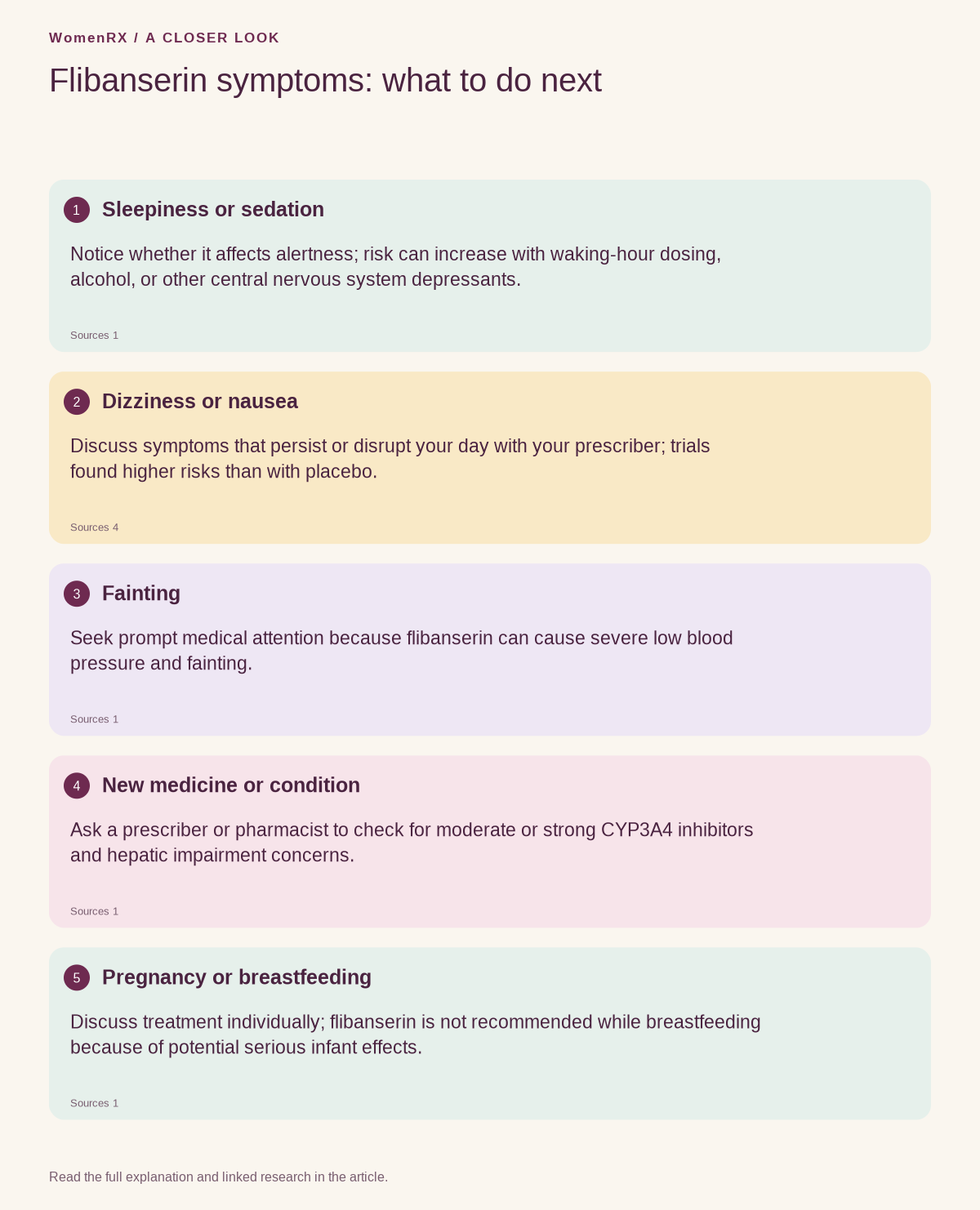
Flibanserin symptoms: what to do next
Sleepiness or sedation: Notice whether it affects alertness; risk can increase with waking-hour dosing, alcohol, or other central nervous system depressants.1
Dizziness or nausea: Discuss symptoms that persist or disrupt your day with your prescriber; trials found higher risks than with placebo.4
Fainting: Seek prompt medical attention because flibanserin can cause severe low blood pressure and fainting.1
New medicine or condition: Ask a prescriber or pharmacist to check for moderate or strong CYP3A4 inhibitors and hepatic impairment concerns.1
Pregnancy or breastfeeding: Discuss treatment individually; flibanserin is not recommended while breastfeeding because of potential serious infant effects.1
Read the figure as text
Use the symptom and situation to choose a sensible next step; fainting is not a symptom to simply track at home.- Sleepiness or sedation: Notice whether it affects alertness; risk can increase with waking-hour dosing, alcohol, or other central nervous system depressants.1
- Dizziness or nausea: Discuss symptoms that persist or disrupt your day with your prescriber; trials found higher risks than with placebo.4
- Fainting: Seek prompt medical attention because flibanserin can cause severe low blood pressure and fainting.1
- New medicine or condition: Ask a prescriber or pharmacist to check for moderate or strong CYP3A4 inhibitors and hepatic impairment concerns.1
- Pregnancy or breastfeeding: Discuss treatment individually; flibanserin is not recommended while breastfeeding because of potential serious infant effects.1
More questions, answered
Should I stop taking flibanserin if I feel sleepy?
If sleepiness is persistent, severe, or affecting activities that require alertness, contact your prescriber to review it. The label notes that taking flibanserin during waking hours, or with alcohol or other central nervous system depressants, can increase the risk of central nervous system depression. Don’t change how you take it without discussing that with your prescriber. 1
What should I do if I faint while taking flibanserin?
Seek prompt medical attention. Fainting can be a sign of severe low blood pressure, a recognized safety concern with flibanserin, particularly with certain interacting medicines. 1
Sources you can check
- ADDYI (FLIBANSERIN) TABLET, FILM COATED [SPROUT PHARMACEUTICALS, INC.] | US prescribing information and patient instructionsAccessed 2026-09-25Return to first citation
- Effects of Timing of Flibanserin Administration Relative to Alcohol Intake in Healthy Premenopausal Women: A Randomized, Double-Blind, Crossover Study.Simon JA, Clayton AH, Kingsberg SA, Parish SJ, Kim NN, Millheiser L. · The journal of sexual medicine · 2019Return to first citation
- Effects of Alcohol Administered With Flibanserin in Healthy Premenopausal Women: A Randomized, Double-Blind, Single-Dose Crossover Study.Simon JA, Clayton AH, Parish SJ, Apfel SC, Millheiser L. · The journal of sexual medicine · 2020Return to first citation
- Efficacy and Safety of Flibanserin for the Treatment of Hypoactive Sexual Desire Disorder in Women: A Systematic Review and Meta-analysis.Jaspers L, Feys F, Bramer WM, Franco OH, Leusink P, Laan ET. · JAMA internal medicine · 2016Return to first citation
- Safety and Tolerability of Evening Ethanol Consumption and Bedtime Administration of Flibanserin in Healthy Premenopausal Female Subjects.Millheiser L, Clayton AH, Parish SJ, Kingsberg SA, Kim NN, Simon JA. · Sexual medicine · 2019Return to first citation