Metformin for PCOS: Side Effects and What to Watch For
Stomach and bowel symptoms are the main tolerability issue; serious warning symptoms call for prompt attention.
With metformin for PCOS, the side effects most often discussed are digestive: diarrhea, nausea, bloating, and constipation. These effects can be mild and may settle, but they can make treatment hard to continue. 35 Ask about your specific tablet and dose changes if symptoms are troublesome. Unusual breathing, muscle pain, or marked sleepiness needs prompt attention because it can signal a serious reaction. 12
What you might notice at first
The side effects most closely tied to metformin are gastrointestinal. In PCOS research, reported problems include diarrhea, nausea, constipation, and bloating. A systematic review comparing metformin with inositol described these effects as typically mild and self-limited, though that doesn’t mean they’ll feel minor to you. 35
One small, single-center trial gives a sense of how variable the experience can be: over 12 weeks, 12 of 40 women assigned to metformin reported gastrointestinal adverse events. That’s a result from this particular study, not a prediction of your own chances; it doesn’t establish how often symptoms occur across all people with PCOS or with different treatment regimens. 4
If symptoms are disrupting meals, work, or daily routines, tell your prescriber rather than simply putting up with them. Ask whether the instructions for your particular tablet include taking it with food, and whether a change in how treatment is introduced might help. One US label for a product combining metformin with another medicine says meals may reduce digestive symptoms; another combination-product label describes gradual dose escalation to reduce gastrointestinal reactions. Directions vary by product. 12
Separate everyday discomfort from serious symptoms
Digestive symptoms are not the only safety question. Metformin-containing product labels warn about lactic acidosis, a serious condition. Symptoms listed in a US label include unexplained rapid or deep breathing, muscle pain, unusual tiredness or sleepiness, dizziness, and feeling unusually cold. If these occur, seek prompt medical attention rather than assuming they’re ordinary stomach side effects. 12
Kidney function is one useful topic to raise when discussing individual safety: a US metformin-containing product label notes that reduced kidney function can raise metformin levels. Ask whether your kidney health affects your treatment or monitoring plan. This is a question to individualize, not a reason to change a prescription on your own. 1
Also mention new or worsening digestive symptoms that begin after you’ve been stable on treatment. Product labeling says later symptoms should be evaluated rather than automatically blamed on metformin, since another serious illness could be responsible. 12
Keep the PCOS goal in view
Metformin may be used for different PCOS goals, including metabolic measures and menstrual outcomes. In one 12-week trial of women with PCOS and insulin resistance, both the metformin group and a digital lifestyle-intervention group had improved menstrual frequency; the study was small and wasn’t designed to answer every question about longer-term treatment. 4
If pregnancy is part of your near-term plan, bring that up before starting or changing treatment. Your treatment goal matters. Don’t alter a prescribed treatment based on side effects or a change in plans without discussing it with your prescriber.
A helpful conversation can be specific: Which symptoms are expected with my product? What should I do if they interfere with daily life? Does my kidney health affect the plan? Which symptoms mean I should seek prompt help? Those questions separate routine tolerability from safety concerns without treating every stomach upset as an emergency.
Metformin: tolerability and safety questions
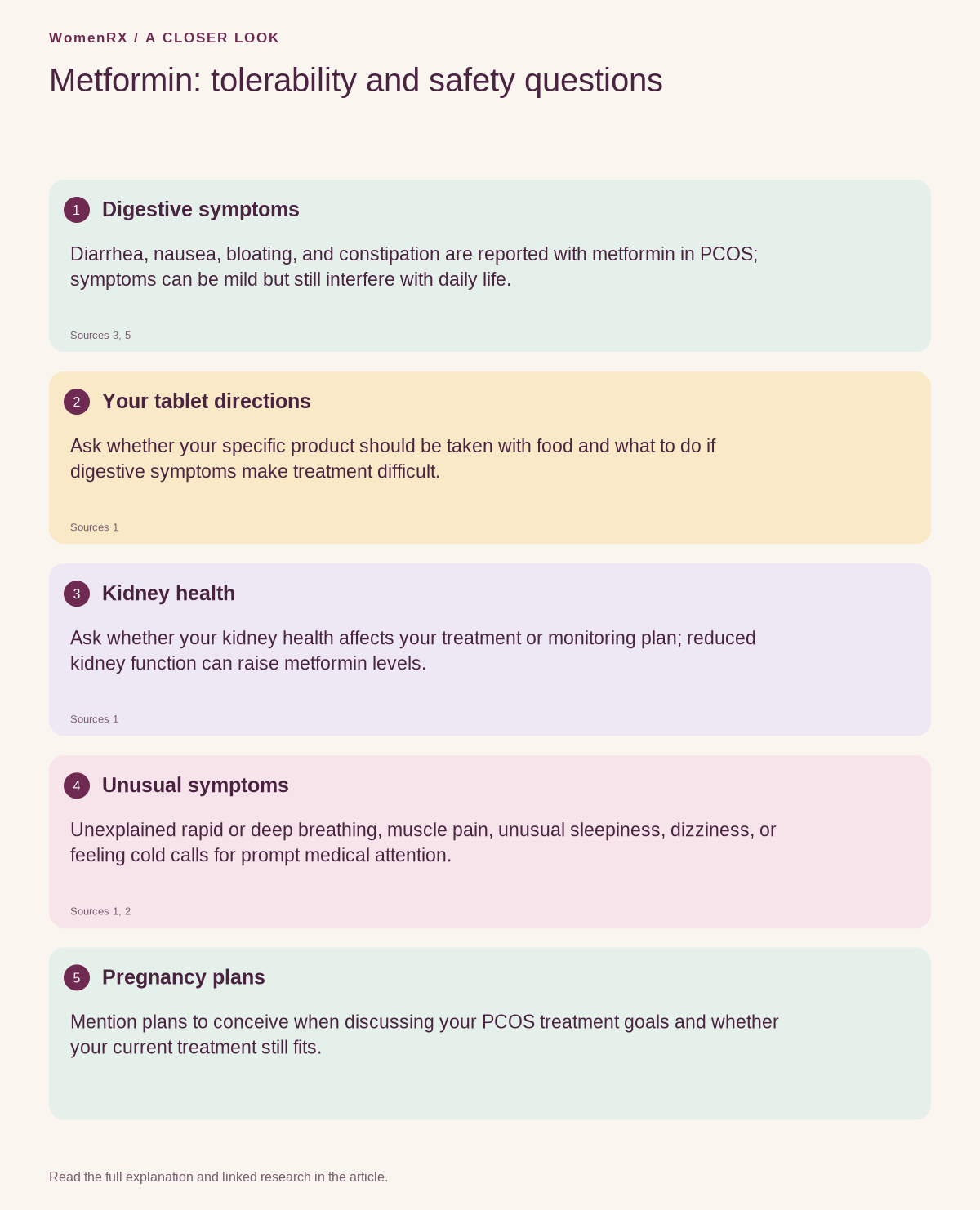
Digestive symptoms: Diarrhea, nausea, bloating, and constipation are reported with metformin in PCOS; symptoms can be mild but still interfere with daily life.35
Your tablet directions: Ask whether your specific product should be taken with food and what to do if digestive symptoms make treatment difficult.1
Kidney health: Ask whether your kidney health affects your treatment or monitoring plan; reduced kidney function can raise metformin levels.1
Unusual symptoms: Unexplained rapid or deep breathing, muscle pain, unusual sleepiness, dizziness, or feeling cold calls for prompt medical attention.12
Pregnancy plans: Mention plans to conceive when discussing your PCOS treatment goals and whether your current treatment still fits.
Read the figure as text
Use these distinctions to decide what to raise with your prescriber and which symptoms need prompt attention.- Digestive symptoms: Diarrhea, nausea, bloating, and constipation are reported with metformin in PCOS; symptoms can be mild but still interfere with daily life.35
- Your tablet directions: Ask whether your specific product should be taken with food and what to do if digestive symptoms make treatment difficult.1
- Kidney health: Ask whether your kidney health affects your treatment or monitoring plan; reduced kidney function can raise metformin levels.1
- Unusual symptoms: Unexplained rapid or deep breathing, muscle pain, unusual sleepiness, dizziness, or feeling cold calls for prompt medical attention.12
- Pregnancy plans: Mention plans to conceive when discussing your PCOS treatment goals and whether your current treatment still fits.
Sources you can check
- GLIPIZIDE AND METFORMIN HYDROCHLORIDE TABLET, FILM COATED [REMEDYREPACK INC.] | US prescribing information and patient instructionsAccessed 2026-09-25Return to first citation
- DAPAGLIFLOZIN AND METFORMIN HYDROCHLORIDE TABLET, FILM COATED, EXTENDED RELEASE [SUN PHARMACEUTICAL INDUSTRIES, INC.] | US prescribing information and patient instructionsAccessed 2026-09-25Return to first citation
- Effects of probiotic and metformin co-administration versus metformin monotherapy on anthropometric measurements, hormones, and glucolipid profile in women with polycystic ovary syndrome: a systematic review and meta-analysis.Hamsho M, Shkorfu W, Bensaoua M, Martins CEC, Hacıbayram H, Fadel A, Ranneh Y. · Frontiers in endocrinology · 2026Return to first citation
- Efficacy of WeChat-Based Digital Intervention Versus Metformin in Women With Polycystic Ovary Syndrome: Randomized Controlled Trial.Dilimulati D, Shao X, Wang L, Cai M, Zhang Y, Lu J, Wang Y, Liu H, Kuang M, Chen H, Zhang M, Qu S. · Journal of medical Internet research · 2024Return to first citation
- Inositol for Polycystic Ovary Syndrome: A Systematic Review and Meta-analysis to Inform the 2023 Update of the International Evidence-based PCOS Guidelines.Fitz V, Graca S, Mahalingaiah S, Liu J, Lai L, Butt A, Armour M, Rao V, Naidoo D, Maunder A, Yang G, Vaddiparthi V, Witchel SF, Pena A, Spritzer PM, Li R, Tay C, Mousa A, Teede H, ... · The Journal of clinical endocrinology and metabolism · 2024Return to first citation