Spironolactone Side Effects: What to Track and When to Call
Menstrual and breast changes deserve a medication review; an irregular heartbeat, blistering rash, or trouble breathing needs faster attention.
Record new menstrual or breast changes and discuss effects that bother you or don’t go away. Ask your prescriber whether potassium and kidney-function checks are appropriate for you, especially if you take medicines that raise potassium. Seek urgent assessment for an irregular heartbeat, muscle weakness, or a blistering rash. Trouble breathing or swelling of the throat or tongue also needs urgent medical attention. Discuss possible pregnancy promptly. 1 2 3
Start with what changed
A new symptom can be unsettling, but it doesn’t automatically mean spironolactone caused it. Make a short note of what you noticed, when it began, whether it comes and goes, and whether it affects daily activities. If you menstruate, include where you are in your cycle and whether your bleeding pattern has changed. Note any recent dose change and other medicines, supplements, or potassium-containing salt substitutes you use. This gives your prescriber a clearer picture without asking you to diagnose the cause.
Make a note of hormonal and breast changes
Changes to discuss include irregular or missed periods and breast tenderness, pain, or enlargement. Bleeding after menopause is also listed among reported adverse reactions and warrants a medication review rather than being assumed to be an expected period change. Spironolactone has hormonal effects beyond its action on the kidneys, which may help explain reproductive and breast symptoms. A symptom that happens while you take the medicine is not proof that the medicine caused it. 1 2
In five randomized, placebo-controlled trials in women with acne, involving 563 participants, a 2025 review found no statistically significant difference between spironolactone and placebo for menstrual irregularities or breast enlargement. That result does not establish that these effects never occur. The trials were about acne, and the review noted that potassium-related outcomes were not adequately reported, so it cannot settle every safety question for every person taking spironolactone. 3
Record when a change began and how it affects you so you can describe it to your prescriber. If it bothers you or doesn’t go away, contact your prescriber or pharmacist for advice rather than waiting silently for the next visit. Don’t adjust or stop your medicine on your own; ask the prescriber what to do. 1
Potassium risk is not something to judge by feel
Spironolactone helps the body release sodium and water while retaining potassium. US prescribing information recommends potassium blood tests, while dermatology guidance discussed in a review of acne trials does not call for routine testing in otherwise healthy people taking spironolactone for acne without risk factors. Risk is higher with impaired kidney function and with potassium supplements, potassium-containing salt substitutes, or medicines such as ACE inhibitors and ARBs. Nonsteroidal anti-inflammatory drugs (NSAIDs), including ibuprofen, are another interaction to raise with your prescriber or pharmacist. US prescribing information recommends checking potassium within a week of starting or changing the dose, then regularly; more frequent checks may be needed with kidney impairment or medicines that raise potassium. Your monitoring plan depends on why you take spironolactone and your other risks. 1 2 3
If you’re unsure whether a planned blood test happened, or you’ve started an interacting medicine or potassium product, ask your prescriber to review your monitoring plan. This is not a reason to change a prescription or cut out particular foods without advice. The NHS guidance also cautions that some high-potassium foods and salt substitutes can add to potassium levels. 1 2
Don’t wait for a routine follow-up if you develop muscle weakness, numbness, or an irregular heartbeat. These can be signs of high potassium and warrant urgent medical assessment. Tiredness can occur for several reasons, including as a reported side effect, so it cannot tell you whether your potassium is normal. 1 2
Pregnancy plans call for a medication review
If you are pregnant, think you might be pregnant, or are planning a pregnancy, contact your prescriber promptly to review spironolactone. US prescribing information advises avoiding it during pregnancy or discussing potential risk to a male fetus, based mainly on its anti-androgenic action and animal findings. Limited published case reports and case series did not show an association with major birth defects or other adverse pregnancy outcomes, but that evidence is limited. Ask for a plan before changing the medicine yourself. 2
Know when a symptom changes the timeline
Dizziness, nausea, leg cramps, and low energy are listed side effects. If you feel dizzy or have problems with your vision after taking spironolactone, wait until those effects pass before driving or using machinery. Contact your prescriber or pharmacist if an effect bothers you or doesn’t go away. 1
Some symptoms need faster attention. Seek urgent medical assessment for an irregular heartbeat, muscle weakness or numbness, yellowing of the eyes or skin, or a new rash with blistering, particularly around the lips. These can signal serious potassium, liver, or skin reactions. New breathlessness with vomiting or marked tiredness also needs prompt medical advice because kidney problems are among the possible serious effects. If your throat or tongue swells or you have trouble breathing, seek urgent medical advice right away: these are signs of a possible severe allergic reaction. Serious reactions are uncommon, but they aren’t symptoms to simply log for a future appointment. 1 2
For an effect that isn’t urgent, a useful message can be brief: “I started noticing [symptom] on [date]. It is [getting better, staying the same, or worsening], and it affects [daily activity]. I also take [relevant medicines or supplements]. Does this need a medication or blood-test review?”
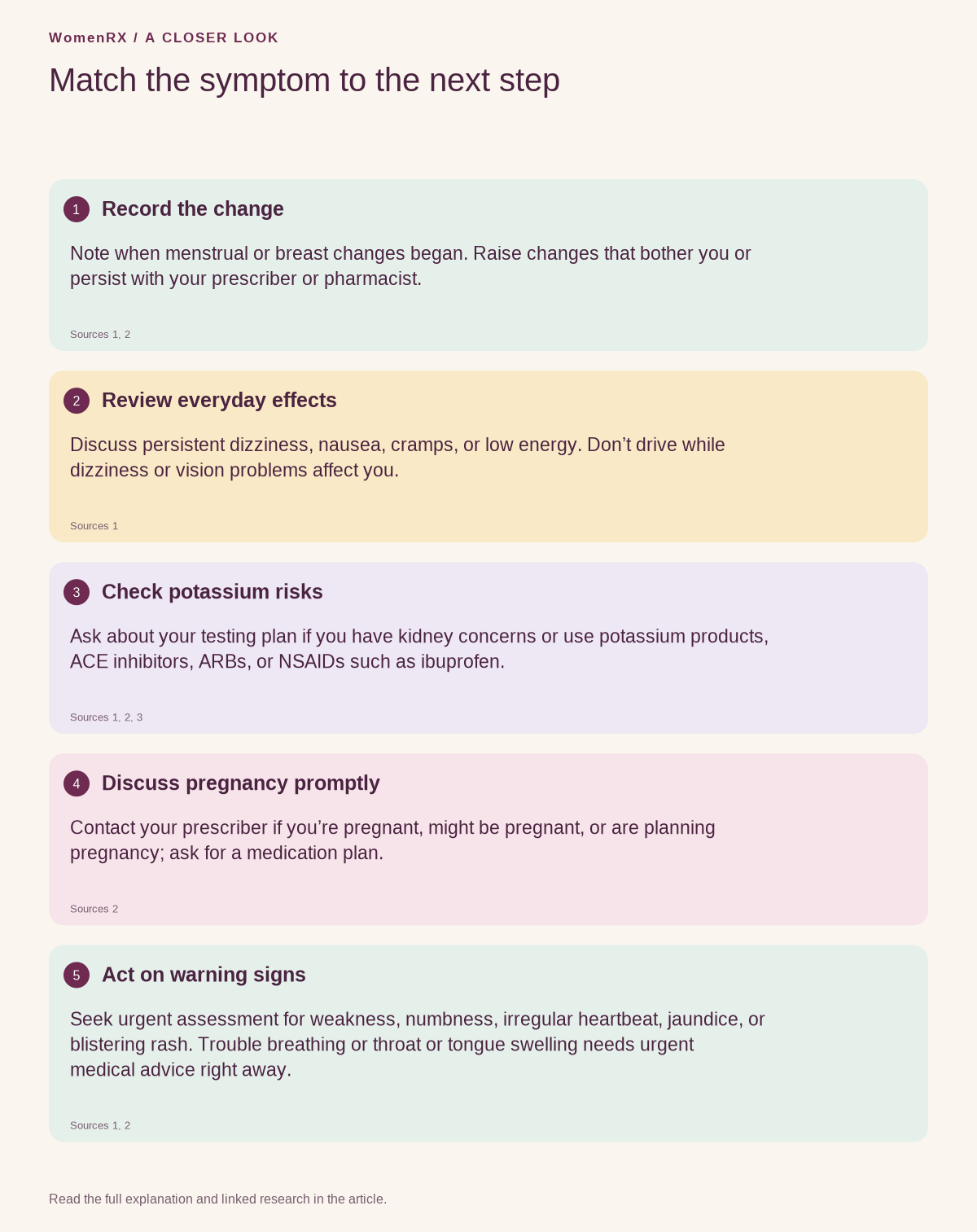
Match the symptom to the next step
Record the change: Note when menstrual or breast changes began. Raise changes that bother you or persist with your prescriber or pharmacist.12
Review everyday effects: Discuss persistent dizziness, nausea, cramps, or low energy. Don’t drive while dizziness or vision problems affect you.1
Check potassium risks: Ask about your testing plan if you have kidney concerns or use potassium products, ACE inhibitors, ARBs, or NSAIDs such as ibuprofen.123
Discuss pregnancy promptly: Contact your prescriber if you’re pregnant, might be pregnant, or are planning pregnancy; ask for a medication plan.2
Act on warning signs: Seek urgent assessment for weakness, numbness, irregular heartbeat, jaundice, or blistering rash. Trouble breathing or throat or tongue swelling needs urgent medical advice right away.12
Read the figure as text
Use these distinctions to decide what to record, what to raise for review, and what should not wait.- Record the change: Note when menstrual or breast changes began. Raise changes that bother you or persist with your prescriber or pharmacist.12
- Review everyday effects: Discuss persistent dizziness, nausea, cramps, or low energy. Don’t drive while dizziness or vision problems affect you.1
- Check potassium risks: Ask about your testing plan if you have kidney concerns or use potassium products, ACE inhibitors, ARBs, or NSAIDs such as ibuprofen.123
- Discuss pregnancy promptly: Contact your prescriber if you’re pregnant, might be pregnant, or are planning pregnancy; ask for a medication plan.2
- Act on warning signs: Seek urgent assessment for weakness, numbness, irregular heartbeat, jaundice, or blistering rash. Trouble breathing or throat or tongue swelling needs urgent medical advice right away.12
More questions, answered
Should I wait for symptoms before asking about potassium tests?
No. Whether you need potassium monitoring depends on individual risks, including kidney function and other medicines or potassium products. US prescribing information recommends testing, while dermatology guidance discussed in a review of acne trials does not call for routine testing in otherwise healthy people without risk factors. Ask your prescriber what plan applies to you, including after a dose change. 2 3
What if I’m planning a pregnancy?
Ask your prescriber to review spironolactone before making a change. US prescribing information advises avoiding it during pregnancy or discussing potential risk to a male fetus, while noting that human pregnancy information is limited. 2
Sources you can check
- Spironolactone - NHSAccessed 2026-09-25Return to first citation
- SPIRONOLACTONE TABLET, FILM COATED [REMEDYREPACK INC.] | US prescribing information and patient instructionsAccessed 2026-09-25Return to first citation
- Efficacy and Safety of Oral Spironolactone for Women With Acne Vulgaris: A Systematic Review and Meta-Analysis of Randomized Placebo-Controlled Trials With Trial Sequential Analysis.Ghanem L, Kirmani N, De León Fernández N, Palacios-Ortiz MP, Rodríguez-Parra JD, Rusu CA. · Journal of cosmetic dermatology · 2025Return to first citation