Constipation on Mounjaro: What to Track and When to Call
Constipation is a reported Mounjaro side effect; note how your bowel habits change, and seek urgent help for sudden, sharp abdominal pain or if you can’t move your bowels, especially with vomiting.
In Mounjaro trials in adults with type 2 diabetes, constipation was reported by 6% of people taking 5 or 10 mg and 7% taking 15 mg, compared with 1% taking placebo. Note changes from your usual bowel pattern and tell your prescriber. Seek urgent help for sudden, sharp abdominal pain or if you can’t move your bowels, especially with vomiting. 1 2 3
First, notice what’s different for you
Constipation doesn’t have to mean a bowel movement every day. Fewer than three bowel movements a week, hard or dry stool, or painful passing can be signs of constipation, but your usual pattern matters too. 3
A useful note is simple: when the change began, how often you’re having bowel movements compared with usual, whether stool is hard or painful to pass, and whether you also have abdominal pain, nausea, or vomiting. Include when you started Mounjaro or had a dose change if that applies. This gives your prescriber a clearer picture than a count alone.
Why Mounjaro may be part of the picture
Constipation is a recognized side effect of Mounjaro. In pooled placebo-controlled trials in adults with type 2 diabetes, it was reported by 6% of participants taking 5 mg, 6% taking 10 mg, and 7% taking 15 mg, compared with 1% taking placebo. Those figures count people who reported at least one occurrence; they don’t predict what will happen to you. 1
Tirzepatide-based treatments can affect digestive movement, and gastrointestinal effects are commonly reported. A consensus review describes reduced gastrointestinal motility among the effects of GLP-1-based therapies, while also noting that much of its practical management advice relies on indirect evidence and expert consensus. This helps explain why bowel changes can occur, but it doesn’t show that every case of constipation has the same cause. 4
When to contact your prescriber
Tell your prescriber if your bowel habits change. Your usual pattern and accompanying symptoms matter; you don’t need to wait a set number of days or bowel movements before checking in. Don’t start a laxative unless your healthcare provider says it’s appropriate. 3
Mounjaro’s prescribing information also lists severe constipation, including fecal impaction, as well as ileus and intestinal obstruction among reported gastrointestinal reactions. That information identifies serious problems that can occur, but it does not mean ordinary constipation is an obstruction or tell you to diagnose one yourself. 1
When symptoms need urgent attention
Get medical help immediately for sudden, sharp abdominal pain, a stiff, hard, tender abdomen, or being unable to move your bowels, especially if you’re also vomiting. These signs don’t prove there is an obstruction, but they warrant urgent assessment rather than trying to manage constipation at home. 2
If you have these warning signs, don’t try fiber, extra fluids, or laxatives instead of seeking care.
What the trial numbers can’t tell you
The percentages above describe adults with type 2 diabetes, not a women-specific estimate. They don’t tell you whether pregnancy or the postpartum period changes your chance of constipation on Mounjaro. If either applies, mention it when you report a bowel change, without assuming the medication is the cause. 1
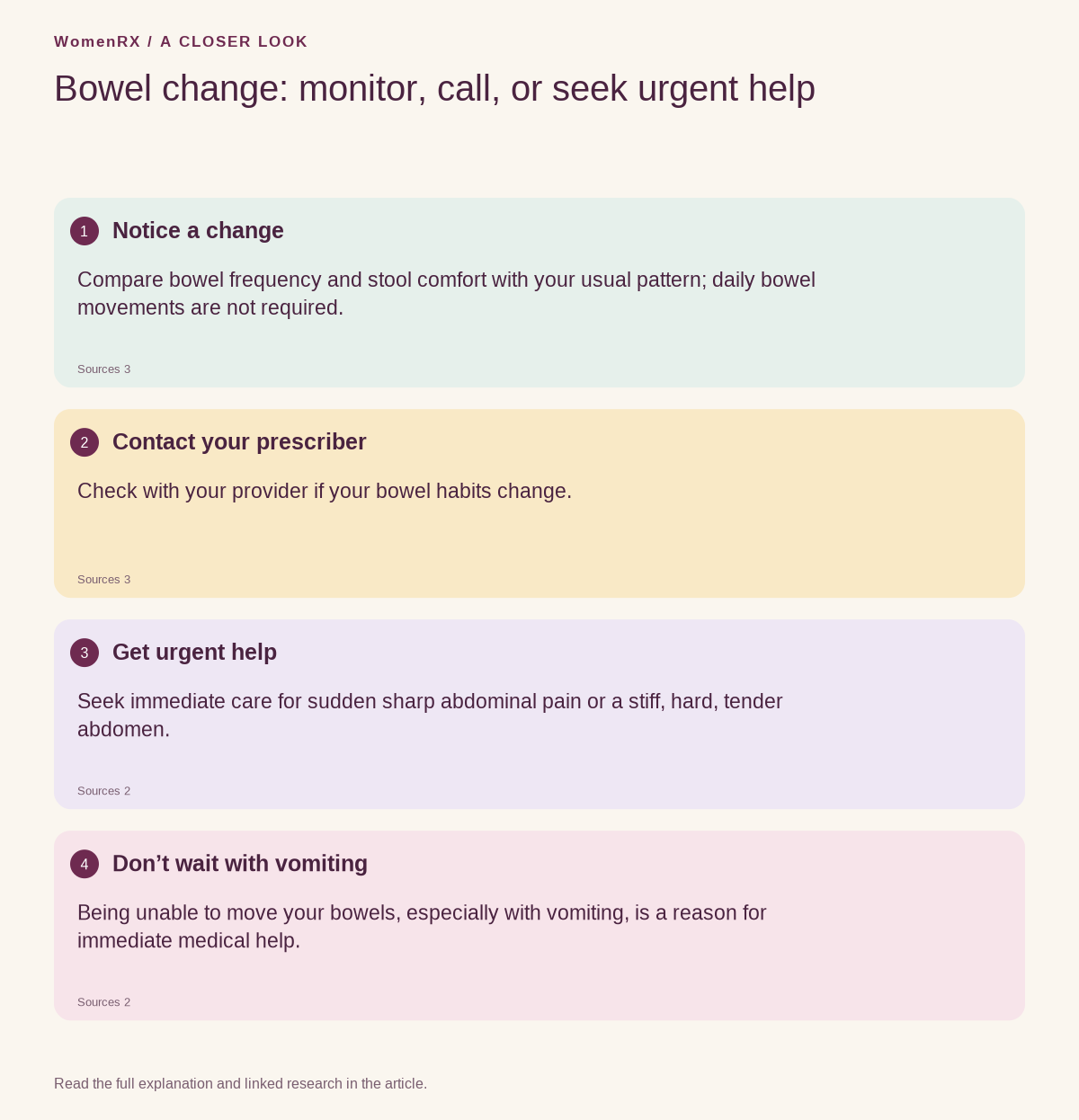
Bowel change: monitor, call, or seek urgent help
Notice a change: Compare bowel frequency and stool comfort with your usual pattern; daily bowel movements are not required.3
Contact your prescriber: Check with your provider if your bowel habits change.3
Get urgent help: Seek immediate care for sudden sharp abdominal pain or a stiff, hard, tender abdomen.2
Don’t wait with vomiting: Being unable to move your bowels, especially with vomiting, is a reason for immediate medical help.2
Read the figure as text
Use the symptom pattern to distinguish a change worth reporting from signs that need immediate assessment. The warning signs prompt care; they do not diagnose an obstruction.- Notice a change: Compare bowel frequency and stool comfort with your usual pattern; daily bowel movements are not required.3
- Contact your prescriber: Check with your provider if your bowel habits change.3
- Get urgent help: Seek immediate care for sudden sharp abdominal pain or a stiff, hard, tender abdomen.2
- Don’t wait with vomiting: Being unable to move your bowels, especially with vomiting, is a reason for immediate medical help.2
More questions, answered
Does constipation mean I need to have a bowel movement every day?
No. MedlinePlus says it isn’t important to have a bowel movement every day. A change from your usual habits is still worth checking with your provider. 3
Can I tell from symptoms alone whether I have an obstruction?
No. Symptoms such as sudden sharp abdominal pain or being unable to move your bowels with vomiting warrant urgent medical help, but they don’t establish a diagnosis on their own. 2
Sources you can check
- MOUNJARO (TIRZEPATIDE) INJECTION, SOLUTION MOUNJARO KWIKPEN (TIRZEPATIDE) INJECTION, SOLUTION [ELI LILLY AND COMPANY] | US prescribing information and patient instructionsAccessed 2026-09-25Return to first citation
- Abdominal Pain | MedlinePlusAccessed 2026-09-25Return to first citation
- Constipation | MedlinePlusAccessed 2026-09-25Return to first citation
- Nutritional and lifestyle supportive care recommendations for management of obesity with GLP-1 - based therapies: An expert consensus statement using a modified Delphi approach.Sievenpiper JL, Ard J, Blüher M, Chen W, Dixon JB, Fitch A, Gigliotti L, Khunti K, Lecube A, Lean MEJ, Mittendorfer B, Pfeiffer AFH, Ryan DH, Vilsbøll T, Van Gaal LF. · Obesity pillars · 2026Return to first citation