Lo Loestrin Fe: What’s in the Pack and What to Check
Lo Loestrin Fe has active pills in two colors, and its low estrogen dose doesn’t make health-history checks optional.
Lo Loestrin Fe is a combined birth control pill that prevents pregnancy primarily by suppressing ovulation. Its 28-day pack has 24 blue pills containing norethindrone acetate and ethinyl estradiol, two white pills containing ethinyl estradiol, and two nonhormonal brown pills. Take the pills in pack order; before starting, review blood pressure, migraine symptoms, clot history, smoking, and any recent delivery or breastfeeding.145
The colors tell you what each pill does
Lo Loestrin Fe combines a progestin, norethindrone acetate, with an estrogen, ethinyl estradiol. Like other combined hormonal contraceptives, it prevents pregnancy primarily by suppressing ovulation.1
The order inside the pack matters. Each of the first 24 blue pills contains 1 mg norethindrone acetate and 10 micrograms ethinyl estradiol. The next two white pills contain 10 micrograms ethinyl estradiol without norethindrone acetate. The final two brown pills contain no contraceptive hormones. They contain ferrous fumarate, but the product information says they serve no therapeutic purpose, so they aren’t iron treatment.1
That’s a different pattern from a pack with a full week of nonhormonal pills. Lo Loestrin Fe has two estrogen-only days followed by two nonhormonal days. Don’t use instructions remembered from another pill pack to decide which Lo Loestrin Fe tablets you can skip.1
Make the daily routine work for you
The product instructions call for one tablet at the same time every day, following the blister-pack order for all 28 days. Tablets can be taken with or without food. For a first-day-of-period start, the first blue tablet is taken on the first day of menstrual bleeding. If you start on another day, the product instructions call for nonhormonal backup contraception during the first seven days.1
If you’re changing methods, the handoff depends on what you use now. The product instructions give different starting points for someone switching from another combined pill, a ring or patch, or a progestin-only method. Switching from an IUD needs particular attention because backup contraception may be needed around its removal. Settle the changeover plan before you stop your current method, rather than guessing from the new pack’s start date.14
A missed pill also calls for a color-specific response. The product instructions distinguish one missed blue pill, multiple missed blue or white pills, and a missed brown pill. For example, the instructions say to take one missed blue pill as soon as possible and continue the pack; a missed brown pill is discarded. Missing multiple active pills can mean starting a new pack and using backup contraception, depending on when it happened. If you vomit or have diarrhea within three to four hours after a blue or white pill, the product directs you to its missed-dose instructions. Keep those instructions handy rather than applying a rule from a different combined pill.1
Bleeding may not look like your usual period
Spotting between expected bleeds is common enough to plan for, particularly early on. In the Lo Loestrin Fe trial, unscheduled bleeding or spotting was reported during at least one cycle by 1,257 of 1,582 participants who had a post-treatment evaluation. Some participants had no bleeding at all: the proportion without scheduled or unscheduled bleeding was 32% in the first cycle and 49% by the thirteenth. Those figures describe this product’s trial participants, not what will happen to any one person.1
No withdrawal bleed doesn’t automatically mean pregnancy. But if you missed active pills or started a pack late, the product instructions say to consider pregnancy at the first missed period. If you followed the regimen and miss two consecutive periods, pregnancy should be ruled out. Bleeding that persists or begins after previously regular cycles also warrants a check for another cause.1
In a one-year, uncontrolled trial of 1,660 women ages 18 to 45 who took at least one dose, the most commonly reported adverse reactions included nausea or vomiting and headache, each reported by 7%, as well as breast tenderness, weight fluctuation, acne, and mood symptoms. An uncontrolled trial can describe reported effects, but it can’t tell you whether this pill causes each symptom in every person who experiences it.1
Low estrogen still means estrogen-related decisions
The 10-microgram estrogen amount doesn’t remove the clot, stroke, or other cardiovascular concerns associated with combined hormonal contraception. Before starting, blood pressure should be measured. The most useful history to bring up includes any blood clot or clotting disorder; migraine with aura, such as flashing lights or zigzag lines before or during a migraine; high blood pressure; smoking, especially at age 35 or older; and diabetes with vascular disease. The product also lists a current or past breast cancer diagnosis, liver disease, and unexplained abnormal uterine bleeding among reasons not to use it. Eligibility depends on the details, not simply on your age or on the pill’s estrogen amount.1245
Mention your medicines too, particularly if you’re being treated for hepatitis C: Lo Loestrin Fe must not be used with combinations containing ombitasvir, paritaprevir, and ritonavir, with or without dasabuvir, because of a liver-enzyme concern. If you take thyroid hormone replacement, the product information notes that combined pills can change thyroid-binding proteins and that a dose adjustment may be needed.1
If you’ve recently given birth, timing is a separate question. The product instructions say that someone who isn’t breastfeeding should start no earlier than four weeks after delivery, with nonhormonal backup for the first seven days. Combined hormonal contraception also needs a postpartum clot-risk assessment. If you’re breastfeeding, combined hormonal contraceptives can reduce milk production, including after feeding is established. Discuss when you gave birth, how feeding is going, and whether a non-estrogen method would suit you better.15
Perimenopause isn’t an automatic reason to stop thinking about contraception: pregnancy remains possible until menopause. It also isn’t a reason to overlook newly developed high blood pressure, migraine with aura, or other risk factors when deciding whether to continue an estrogen-containing pill.35
Lo Loestrin Fe prevents pregnancy, not sexually transmitted infections. If STI protection is part of what you need, condoms serve a different purpose alongside your contraceptive choice.5
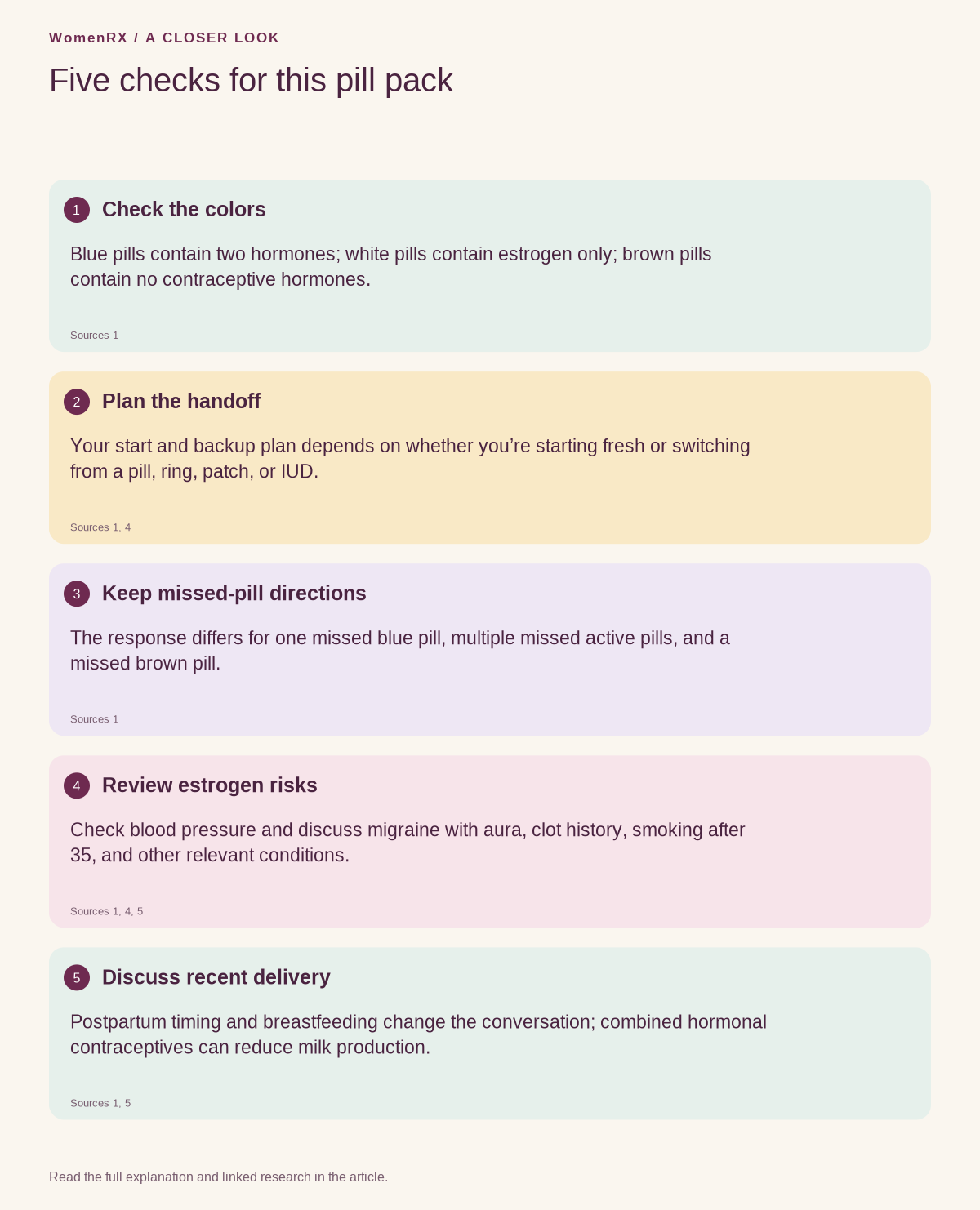
Five checks for this pill pack
Check the colors: Blue pills contain two hormones; white pills contain estrogen only; brown pills contain no contraceptive hormones.1
Plan the handoff: Your start and backup plan depends on whether you’re starting fresh or switching from a pill, ring, patch, or IUD.14
Keep missed-pill directions: The response differs for one missed blue pill, multiple missed active pills, and a missed brown pill.1
Review estrogen risks: Check blood pressure and discuss migraine with aura, clot history, smoking after 35, and other relevant conditions.145
Discuss recent delivery: Postpartum timing and breastfeeding change the conversation; combined hormonal contraceptives can reduce milk production.15
Read the figure as text
Use these distinctions to check the pack and settle the questions that change how you start or continue it.- Check the colors: Blue pills contain two hormones; white pills contain estrogen only; brown pills contain no contraceptive hormones.1
- Plan the handoff: Your start and backup plan depends on whether you’re starting fresh or switching from a pill, ring, patch, or IUD.14
- Keep missed-pill directions: The response differs for one missed blue pill, multiple missed active pills, and a missed brown pill.1
- Review estrogen risks: Check blood pressure and discuss migraine with aura, clot history, smoking after 35, and other relevant conditions.145
- Discuss recent delivery: Postpartum timing and breastfeeding change the conversation; combined hormonal contraceptives can reduce milk production.15
More questions, answered
Do the brown pills treat low iron?
No. They contain ferrous fumarate, but Lo Loestrin Fe’s product information calls them nonhormonal placebo pills and says they serve no therapeutic purpose. They’re part of the pack routine, not treatment for iron deficiency.1
Sources you can check
- LO LOESTRIN FE (NORETHINDRONE ACETATE AND ETHINYL ESTRADIOL, ETHINYL ESTRADIOL AND FERROUS FUMARATE) KIT [ALLERGAN, INC.] | US prescribing information and patient instructionsAccessed 2026-09-25Return to first citation
- Migraine | MedlinePlusAccessed 2026-09-25Return to first citation
- Contraception and hormonal management in the perimenopause.Long ME, Faubion SS, MacLaughlin KL, Pruthi S, Casey PM. · Journal of women's health (2002) · 2015Return to first citation
- Combined Hormonal Contraceptives | Contraception | CDCAccessed 2026-09-25Return to first citation
- Appendix A: Summary of Classifications for U.S. Medical Eligibility Criteria for Contraceptive Use, 2024 | Contraception | CDCAccessed 2026-09-25Return to first citation