Hummus Nutrition: Protein, Portions and How to Use It
Hummus offers plant protein and fiber, but its nutrition depends on the recipe and how much you serve.
Hummus can add chickpeas, fiber and some protein to a meal, but it isn’t a concentrated protein food. One review describes four tablespoons of traditional hummus as about 100 calories. Using its nutrition table, that amount works out to roughly 5 grams of protein; about 60 grams of cooked chickpeas provides a similar 100 calories and roughly 5 grams of protein. These are approximate comparisons, not universal product values. 2
Hummus can be a satisfying dip or spread, but it works best when you treat it as one part of a snack or meal, not as a stand-in for a larger serving of protein. Chickpeas bring fiber and protein; tahini and oil also shape the mix of nutrients and calories. The amounts vary by recipe and brand, so serving size and the label matter. 2
How much protein does hummus provide?
A USDA-based nutrient table reproduced in a review lists hummus at 7.9 grams of protein per 100 grams, alongside 6 grams of fiber and 166 calories. That gives you a useful reference point, not a universal value for every tub or homemade recipe. 2
For a same-weight comparison, cooked chickpeas in that table provide 8.86 grams of protein, 7.6 grams of fiber and 164 calories per 100 grams. Hummus has less protein and fiber in this comparison, with similar calories. It also has more fat: 9.6 grams per 100 grams, compared with 2.59 grams for cooked chickpeas. Traditional hummus includes tahini and olive oil, so it isn’t nutritionally identical to plain chickpeas. 2
A useful portion comparison
The review describes four tablespoons of traditional hummus as about 100 calories. Using the table’s nutrient values, that 100-calorie amount works out to roughly 4.8 grams of protein. The calculation assumes the portion has the same nutrient composition as the table’s hummus entry, so think of it as an estimate, not a label value. 2
For a comparison at roughly the same calories, about 60 grams of cooked chickpeas also provides close to 100 calories and about 5.4 grams of protein, calculated from the same table. This is not an equal-weight comparison: the hummus amount is a household serving estimate, while the chickpea amount is a weight. Both figures are approximate and recipe or product differences can change them. 2
If you eat hummus by the spoonful, spread it in a sandwich, or use a generous scoop for dipping, the total changes. Check the serving size on the package and compare products using the same amount. Recipes differ, too: a study of selected hummus products found variation in both energy and protein, but those products were from the Polish market and shouldn’t be treated as a survey of US brands. 3
Make the pairing match your hunger
For a snack, hummus with vegetables is an easy way to include vegetables alongside a chickpea-based dip. It can also go with whole-grain bread or crackers as part of a more substantial snack. A review of hummus nutrition describes pairing it with vegetables or whole grains as one way to add it to meals. 2
If you want the meal to contain more protein, add a separate protein food rather than expecting a small amount of hummus to do that job. Dairy foods, beans and nuts are among the protein sources described by MedlinePlus; choose what fits the meal and your preferences. 1 For example, you might serve hummus and vegetables with a bean salad, or put a dairy food alongside the dip. These pairings add variety, but their protein amounts depend on the specific food and portion.
What hummus can and can’t tell you about weight
Hummus contains fiber and protein, but that doesn’t prove a particular portion will keep you full or lead to weight loss. A review describes weight-management benefits as an area of emerging research, not a guaranteed effect. It also reports that hummus consumers had higher diet-quality scores in observational comparisons; that kind of association doesn’t show that hummus itself caused the difference. 2
The nutrition evidence summarized here doesn’t establish a special weight-loss benefit or a different serving target for women. The basic choice is practical: look at the amount you actually eat, what you pair it with, and whether the whole snack or meal suits your appetite and needs. A nutrition table alone can’t predict how filling it will feel for you.
Hummus portions and protein in context
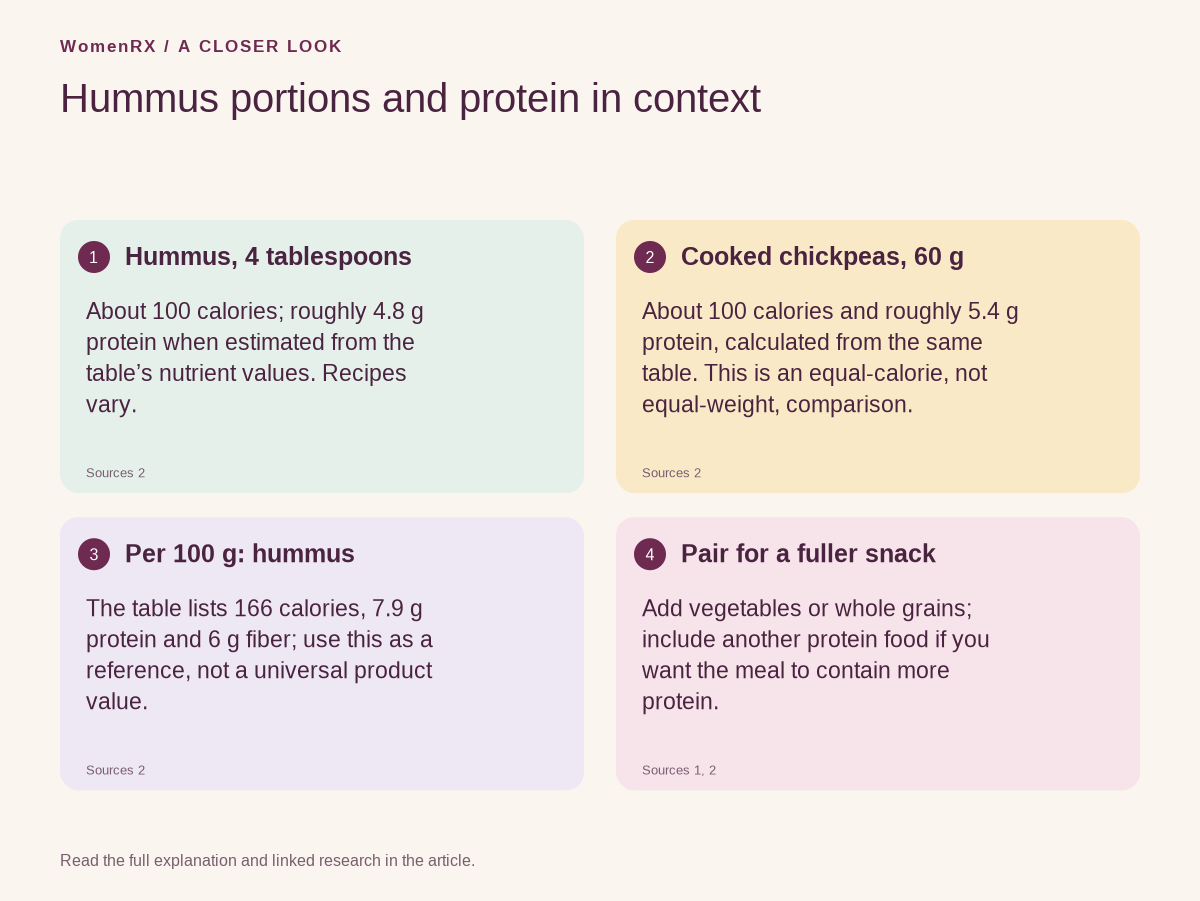
Hummus, 4 tablespoons: About 100 calories; roughly 4.8 g protein when estimated from the table’s nutrient values. Recipes vary.2
Cooked chickpeas, 60 g: About 100 calories and roughly 5.4 g protein, calculated from the same table. This is an equal-calorie, not equal-weight, comparison.2
Per 100 g: hummus: The table lists 166 calories, 7.9 g protein and 6 g fiber; use this as a reference, not a universal product value.2
Pair for a fuller snack: Add vegetables or whole grains; include another protein food if you want the meal to contain more protein.12
Read the figure as text
The serving estimate and cooked-chickpea comparison are approximately equal in calories, while the per-100-gram figures are an equal-weight comparison. Calculated values are estimates.- Hummus, 4 tablespoons: About 100 calories; roughly 4.8 g protein when estimated from the table’s nutrient values. Recipes vary.2
- Cooked chickpeas, 60 g: About 100 calories and roughly 5.4 g protein, calculated from the same table. This is an equal-calorie, not equal-weight, comparison.2
- Per 100 g: hummus: The table lists 166 calories, 7.9 g protein and 6 g fiber; use this as a reference, not a universal product value.2
- Pair for a fuller snack: Add vegetables or whole grains; include another protein food if you want the meal to contain more protein.12
More questions, answered
Is hummus a high-protein food?
Hummus contributes plant protein, but it’s more useful to think of it as a dip or spread with some protein than as a concentrated protein choice. A USDA-based comparison lists 7.9 grams of protein per 100 grams of hummus. Four tablespoons is described as about 100 calories; using the table’s values, that amount works out to roughly 5 grams of protein. The estimate depends on the product and portion. 2
Does hummus cause weight loss?
No food guarantees weight loss. A review describes possible weight-management benefits of chickpeas and hummus as emerging research, while consumer diet-quality comparisons are associations rather than proof that hummus caused an outcome. 2
Sources you can check
- Dietary Proteins: MedlinePlusAccessed 2026-09-25Return to first citation
- The Nutritional Value and Health Benefits of Chickpeas and Hummus.Wallace TC, Murray R, Zelman KM. · Nutrients · 2016Return to first citation
- Analysis of the Quality of Selected Vegetarian Products Available on the Polish Market Compared to Their Homemade Equivalents.Kiciak A, Kuczka N, Barczyńska R, Staśkiewicz-Bartecka W, Białek-Dratwa A, Sapała AM, Kowalski O, Kardas M. · Foods (Basel, Switzerland) · 2025Return to first citation