Avocado Nutrition: Portions and Practical Meal Swaps
Avocado brings fiber and fat to a meal, but the amount you use matters more than whether it earns a “healthy” label.
A half cup of cubed raw avocado, about 75 grams, provides roughly 120 calories, 11 grams of fat, 5 grams of fiber, and 1.5 grams of protein. It’s useful for adding richness and fiber, not for anchoring a meal’s protein. If you’re watching portions, think about what the avocado replaces, such as some of a sandwich spread, rather than treating it as a free extra. 7
What’s in the portion on your plate?
Much of avocado’s energy comes from fat. It also provides fiber. USDA food-composition data for raw avocado list one cup, cubed (150 grams) at 240 calories, 22.1 grams of fat, 10.1 grams of fiber, and 3 grams of protein. Half that amount, ½ cup (75 grams), works out to about 120 calories, 11 grams of fat, 5 grams of fiber, and 1.5 grams of protein. These are estimates for the edible avocado, not a promise about the size of any particular fruit. 7
Avocado’s fat includes monounsaturated fat, but the composition figures above report total fat, not a monounsaturated-fat amount for each portion. Avocado is also a source of fiber, which helps with digestion and can make a meal feel more filling. If you’re adding substantially more fiber to your usual diet, increase it gradually to avoid gas or bloating. 41
Protein is the easy nutrient to overestimate. Even a full cup of cubed avocado has about 3 grams. If you’re making a meal, pair it with a food you’re using for protein, such as beans or yogurt, rather than counting the avocado as the protein component. 72
Make room for it, rather than just adding it
The most useful portion question is often, “What else is going into this meal?” For example, on a sandwich you could use avocado in place of some of the creamy spread you’d otherwise use. On a bowl, you could choose avocado for richness instead of adding both avocado and your usual generous drizzle of dressing. Neither swap has a fixed calorie saving: that depends on the amounts and products you actually use. The point is to make a deliberate choice, not to assume adding avocado automatically improves the meal.
You don’t need to measure every slice. But if portions are hard to picture, ¼ cup of cubed avocado (about 37.5 grams) is roughly 60 calories and ½ cup (75 grams) is roughly 120 calories, based on USDA’s cup measure. Slices and mashed avocado may not fill a measuring cup the same way as cubes, so treat these as guides, not exact counts for a whole or half fruit. 7
That flexibility matters. A little avocado can add texture to a bean bowl; more can be the main creamy element on toast. Either can fit into a healthy eating pattern. The rest of the meal still needs to do its share, including providing enough protein and a variety of foods you enjoy and can afford. 23
What can avocado do for weight or health?
Eating avocado is not, by itself, a weight-loss strategy. In a clinical trial of 1,008 adults with increased waist circumference, eating one avocado daily for six months did not reduce visceral fat compared with continuing a habitual diet. The trial also reported improvements in some secondary measures, including diet quality and LDL cholesterol. That combination is more useful than a simple “good” or “bad” verdict: avocado can contribute to a diet without producing the weight-related effect a person might expect. 5
An earlier US survey found that adults who reported eating avocado also tended to have higher fiber intake and better overall diet quality than nonconsumers. That was an observational comparison, so it cannot tell us that avocado caused those differences. What someone eats with avocado, and what it replaces, remains part of the picture. 4
The serving numbers aren’t different because you’re a woman. One cross-sectional study of Mexican adults found an association between avocado consumption and lower odds of reported diabetes among women, but not men. It does not show that eating avocado prevents diabetes, or establish a special benefit during pregnancy, perimenopause, or postmenopause. For an everyday meal decision, portion and overall dietary pattern are sturdier guides than a women-specific avocado claim. 63
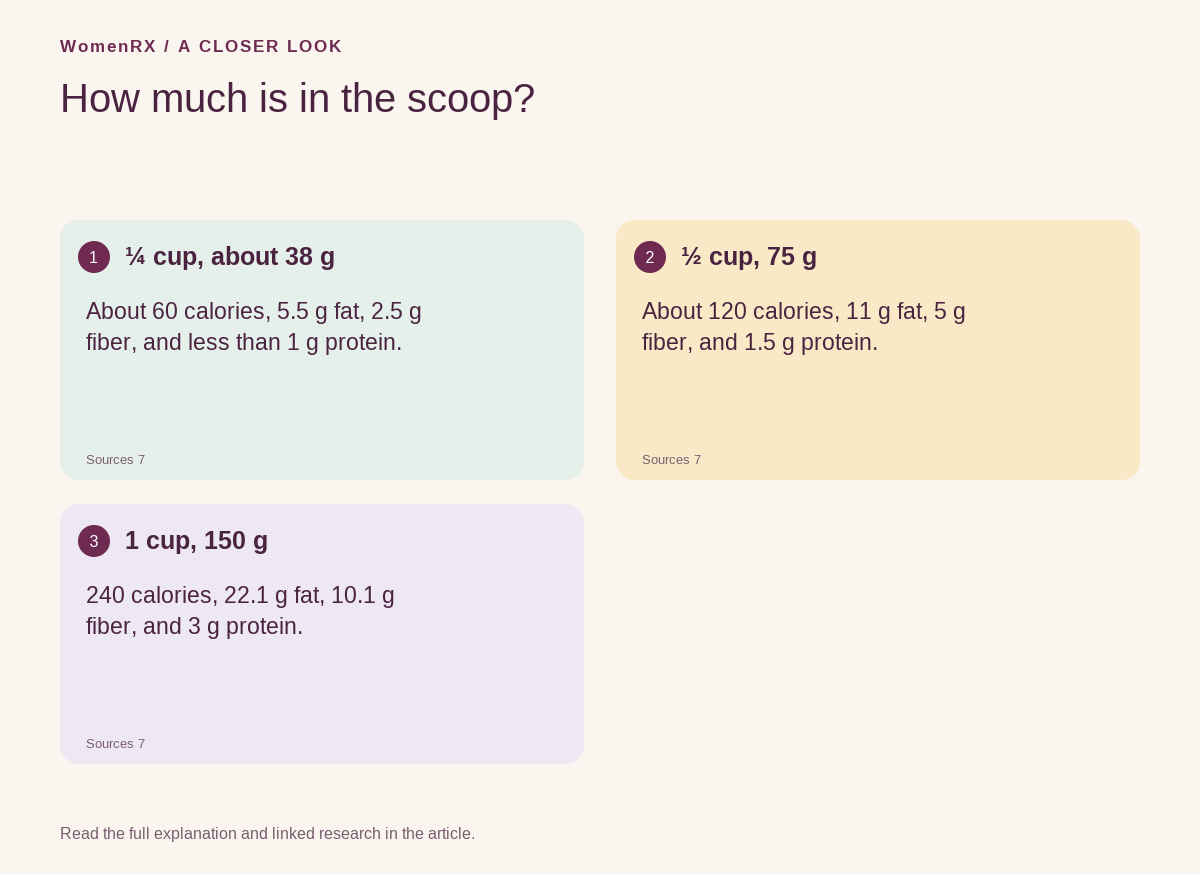
How much is in the scoop?
¼ cup, about 38 g: About 60 calories, 5.5 g fat, 2.5 g fiber, and less than 1 g protein.7
½ cup, 75 g: About 120 calories, 11 g fat, 5 g fiber, and 1.5 g protein.7
1 cup, 150 g: 240 calories, 22.1 g fat, 10.1 g fiber, and 3 g protein.7
Read the figure as text
Approximate nutrition for different amounts of cubed raw avocado, calculated from the same USDA food-composition entry.More questions, answered
Is half an avocado the same as a half-cup serving?
Not reliably. The nutrition estimate here is for ½ cup of cubed raw avocado weighing 75 grams. Fruit sizes vary, so “half an avocado” doesn’t specify the same amount. 7
Sources you can check
- Dietary Fiber: MedlinePlusAccessed 2026-09-25Return to first citation
- Dietary Proteins: MedlinePlusAccessed 2026-09-25Return to first citation
- Nutrition: MedlinePlusAccessed 2026-09-25Return to first citation
- Avocado consumption is associated with better diet quality and nutrient intake, and lower metabolic syndrome risk in US adults: results from the National Health and Nutrition Examination Survey (NHANES) 2001-2008.Fulgoni VL, Dreher M, Davenport AJ. · Nutrition journal · 2013Return to first citation
- The Habitual Diet and Avocado Trial (HAT): A Collaborative Multicenter Model for Large-Scale, Privately Funded Nutrition Research Consortia.Kris-Etherton PM, Li Z, Matthan NR, Rajaram S, Sabaté J, Reboussin DM, Ford N, Barnes S, Petersen KS. · Current developments in nutrition · 2026Return to first citation
- Association Between Avocado Consumption and Diabetes in Mexican Adults: Results From the 2012, 2016, and 2018 Mexican National Health and Nutrition Surveys.Cheng FW, Rodríguez-Ramírez S, Shamah-Levy T, Pérez-Tepayo S, Ford NA. · Journal of the Academy of Nutrition and Dietetics · 2025Return to first citation
- USDA SR Legacy: Avocados, raw, all commercial varieties (FDC 171705)Accessed 2026-09-25Return to first citation