How to Check What Your Hormone Therapy Plan Covers
Get a clearer cost estimate by checking the prescription, the reason it’s prescribed, and each type of care separately.
There isn’t one coverage answer for “hormone therapy.” A plan’s contract determines what it pays, and the exact medicine, formulation, reason for treatment, and services can all matter. Check the medication benefit separately from clinician visits, lab tests, and other care. Ask the plan to confirm coverage and likely costs for the specific prescription and indication, ideally in writing. 1
Start with the exact treatment
“Hormone therapy” can mean different things, including treatment for menopause symptoms, contraception, gender-affirming care, or another medical reason. Don’t ask only whether your plan covers HRT. Give the plan the reason it’s prescribed and the exact medicine and formulation your prescriber has proposed. If you don’t have a prescription yet, ask what details the plan will need to check.
The details can be quite specific. Estradiol and progesterone are not one interchangeable product: for example, one US product label describes a capsule combining both hormones, while another describes oral micronized progesterone alone. Those examples show why it helps to ask about the actual prescribed product, not just a hormone name. They do not establish what any plan covers. 23
Check each billable part on its own
A health plan is a contract that pays part of certain medical expenses, so your plan documents and benefits determine your coverage. 1 For a useful estimate, separate the questions into these buckets:
- Medication: Is this exact prescription included under the plan’s drug benefit? Ask whether the prescribed formulation is covered and whether any plan conditions apply. If there’s a restriction, ask what it is and how to find the written policy.
- Clinician visits: Are the prescriber and the visit covered under the plan’s medical benefit? Ask whether the clinician is in the plan’s network and what you would owe for the visit.
- Lab tests: Ask whether each ordered test is covered, where it should be done, and what your estimated share will be. Don’t assume a test is included in the visit charge.
- Other care: If treatment involves a procedure, counseling, or another service, ask about that service separately. Coverage for one part doesn’t tell you what another part will cost.
These are questions to verify, not guarantees that your plan uses a particular rule or benefit structure. Plans differ, and the cost-sharing amount can depend on your specific plan and where you receive care. 1
A short call script
You can say: “I’m checking coverage for [medicine and formulation] prescribed for [reason for treatment]. Which benefit handles the medication? Is this exact prescription covered, and are there any restrictions or steps required before it’s paid? What would I owe? I also need to check the visits and tests separately. Who can confirm those benefits?”
Then ask for the representative’s name or reference number, the date, and where to find the plan’s written coverage information. If the answer is unclear, ask whether the pharmacy benefit or medical benefit team can review the specific item. Before agreeing to a service, ask the clinician’s office for its estimate too; the plan’s estimate and the office’s charge may address different parts of the bill.
Keep the reason for treatment in the conversation
Menopause treatment, contraception, and gender-affirming care are different reasons for treatment. Don’t assume an answer about one applies to another. State the indication when you check coverage, and ask whether the plan’s answer applies to the exact prescription and services being considered. For menopause treatment, the clinical choice itself is individualized: guidance describes differences in risks by hormone type, dose, route, timing, duration, and whether a progestogen is used. That clinical decision is separate from whether a particular plan pays for it. 4
A study of US women aged 45 to 64 found that Medicaid-insured participants reported less menopausal hormone therapy use than privately insured participants, but it was a cross-sectional study of use, not a review of individual plan benefits. It can’t tell you whether your prescription is covered or why a particular person did or didn’t use treatment. 5
Before you finish
Write down the exact drug and formulation, indication, prescriber, and any planned tests or services. For each item, record who handles the benefit, whether the plan says it is covered, any conditions you need to meet, and the estimated amount you’d pay. If the prescription or care plan changes, check again: a previous answer may not apply to a different product or service.
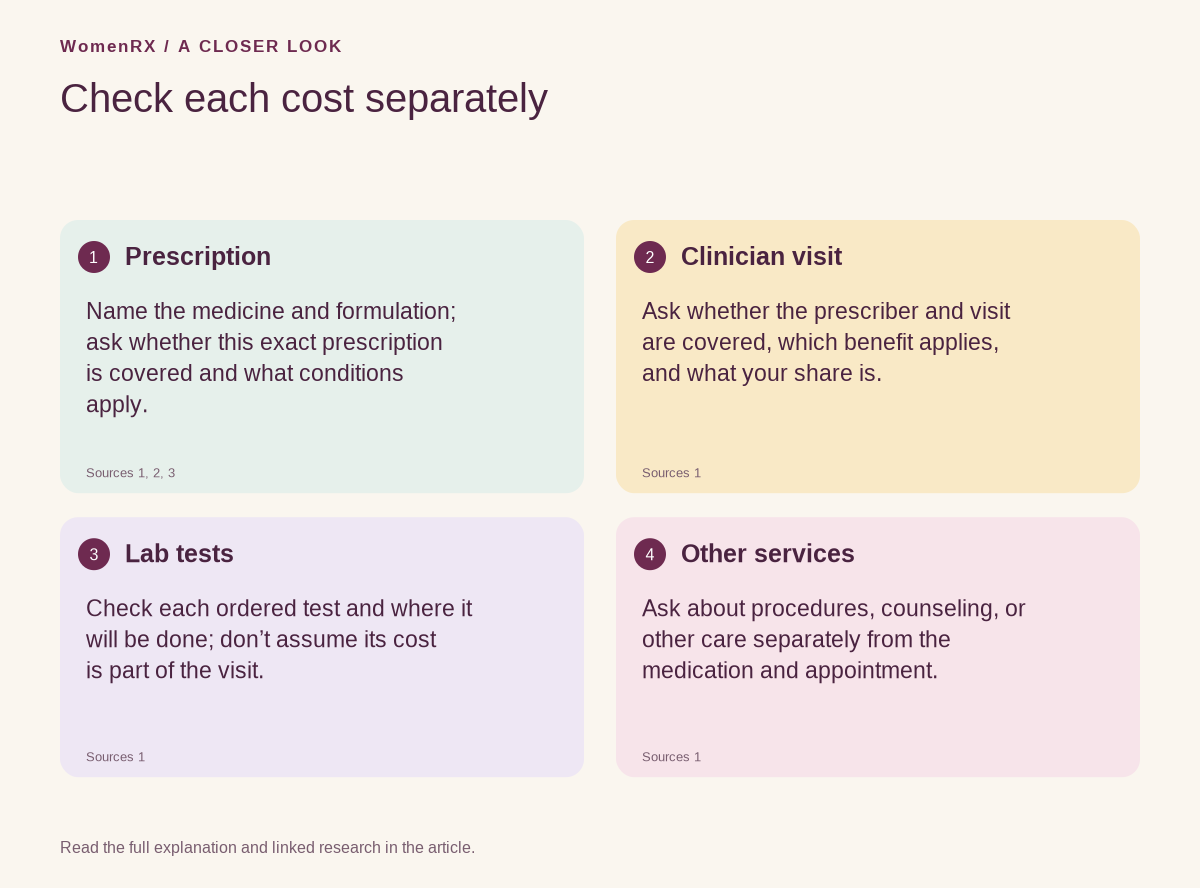
Check each cost separately
Prescription: Name the medicine and formulation; ask whether this exact prescription is covered and what conditions apply.123
Clinician visit: Ask whether the prescriber and visit are covered, which benefit applies, and what your share is.1
Lab tests: Check each ordered test and where it will be done; don’t assume its cost is part of the visit.1
Other services: Ask about procedures, counseling, or other care separately from the medication and appointment.1
Read the figure as text
Use the exact treatment details, then ask which plan benefit handles each part and what you may owe.- Prescription: Name the medicine and formulation; ask whether this exact prescription is covered and what conditions apply.123
- Clinician visit: Ask whether the prescriber and visit are covered, which benefit applies, and what your share is.1
- Lab tests: Check each ordered test and where it will be done; don’t assume its cost is part of the visit.1
- Other services: Ask about procedures, counseling, or other care separately from the medication and appointment.1
More questions, answered
Does a prescription mean my plan will pay for the medicine?
A prescription alone doesn’t establish what your plan pays. The plan is a contract for payment of covered expenses, so verify the exact medicine and formulation with the relevant benefit team. 1
Can I use one coverage answer for visits, medication, and tests?
It’s safer to check each separately. Ask which benefit handles each item and what your estimated share will be; a plan’s answer about one item doesn’t confirm the others. 1
Sources you can check
- Health Insurance: MedlinePlusAccessed 2026-09-25Return to first citation
- BIJUVA (ESTRADIOL AND PROGESTERONE) CAPSULE [MAYNE PHARMA] | US prescribing information and patient instructionsAccessed 2026-09-25Return to first citation
- PROMETRIUM (PROGESTERONE) CAPSULE [ACERTIS PHARMACEUTICALS, LLC] | US prescribing information and patient instructionsAccessed 2026-09-25Return to first citation
- The 2022 hormone therapy position statement of The North American Menopause Society.“The 2022 Hormone Therapy Position Statement of The North American Menopause Society” Advisory Panel. · Menopause (New York, N.Y.) · 2022Return to first citation
- Insurance Type and Menopausal Hormone Therapy Use Among US Women.Chesnokova A, Mumford SL, Schachter A, Hamm RF, Lorch S, Klebanoff M, Lindley S, Harness E, Williams M, Schapira MM. · JAMA network open · 2026Return to first citation