How Can You Check Whether Insurance Covers Menopause Hormone Therapy?
Check the exact prescription, the clinician visit, and the pharmacy separately before you fill it.
There isn’t one coverage answer for menopausal hormone therapy: your plan’s contract determines what it pays, and the details can depend on the specific prescription and care you need. Ask your insurer about the medication and pharmacy, then check the clinician’s fees and network status with the office. Coverage and whether a treatment is clinically appropriate are separate questions. 1 2
Check the prescription, not just the treatment name
“Does my insurance cover hormone therapy?” is a useful starting question, but it may not get you a useful estimate. A plan may handle the medication, the prescribing visit, and the pharmacy under different benefit rules. Your insurance policy is a contract, so ask about the specific prescription and service rather than assuming one answer covers every part. 1
If you already have a prescription, keep its details in front of you. Ask the prescriber’s office to confirm the medication name, strength, form, route, and quantity written on it. If you’re still discussing options, ask the office what exact prescription details the insurer would need to check. These details matter for a coverage inquiry; they aren’t a recommendation to choose one hormone or route over another. Hormone therapy decisions are individualized, and risks differ by type, dose, duration, route, timing, and whether a progestogen is used. 2
Use this script with your insurer
Call the member-services number on your insurance card, or use the plan’s member portal. You can say:
> “I’m checking coverage for a prescription for menopause-related care. The medication is [name], [strength], [form and route], for [quantity]. Can you check this exact prescription under my plan and tell me what I would pay?”
Then ask one question at a time:
- Formulary: Is this exact medication on the plan’s covered-drug list? If not, is a different version covered, and what information would you need to check it?
- Your cost: What would I pay at this pharmacy? Does the amount depend on a deductible, copay, or coinsurance? Ask for the estimated amount before and after any deductible that applies.
- Prior authorization: Is approval required before the prescription can be covered? If so, who submits the request, and how can I check its status?
- Pharmacy: Is the pharmacy I plan to use in the plan’s network? What would the cost be at another in-network pharmacy, if I’m comparing options?
- Limits or conditions: Are there quantity limits or other plan requirements for this prescription?
Ask the representative to repeat the medication details they checked. Write down the date, the name or identification number of the representative, and any call reference number. A quoted benefit is an estimate based on the details reviewed, not a promise that a claim will be paid exactly that way.
Ask about the visit separately
A medication check won’t tell you what an appointment will cost. Contact the clinician’s office and ask whether the clinician and location are in your plan’s network, what the expected charge is for the visit, and whether any separate lab or other service is planned. Then ask your insurer how that visit is covered and what your estimated share would be. Managed-care plans may contract with particular providers and facilities, so check the specific office rather than relying on the clinic name alone. 1
You can ask the office: “I’m considering menopause-related care. Can you check whether this clinician and location are in network, and tell me what the visit is expected to cost? Are any other services expected to be billed separately?” If you don’t yet know which services may be involved, ask the office to clarify before assuming they’re included in the visit fee.
Verify with the pharmacy before pickup
Even after you’ve checked with the plan, ask the pharmacy to run the prescription through your insurance before you pick it up. Confirm that the pharmacy has the same medication and prescription details you checked, and ask what you’ll owe. If the amount differs from the insurer’s estimate, ask the pharmacy what detail caused the difference and contact the plan to resolve it before deciding what to do next.
If the plan says the medication isn’t covered or needs approval, ask what alternatives or review process the plan recognizes. Share that information with the prescriber’s office. A coverage rule doesn’t determine whether a particular treatment is the right clinical choice; that decision should account for your symptoms and individual health factors. Menopause hormone therapy is used for specific symptoms, and professional guidance recommends individualizing treatment and periodically reevaluating its benefits and risks. 2
Keep the two questions separate
You’re checking two things: what your plan may pay for, and whether a particular treatment makes sense for you. Insurance can answer the first only for the details and plan rules it reviewed. Your prescriber can discuss the second. Knowing the exact prescription, visit, and pharmacy costs gives you a clearer basis for that conversation, without assuming that every plan covers the same care.
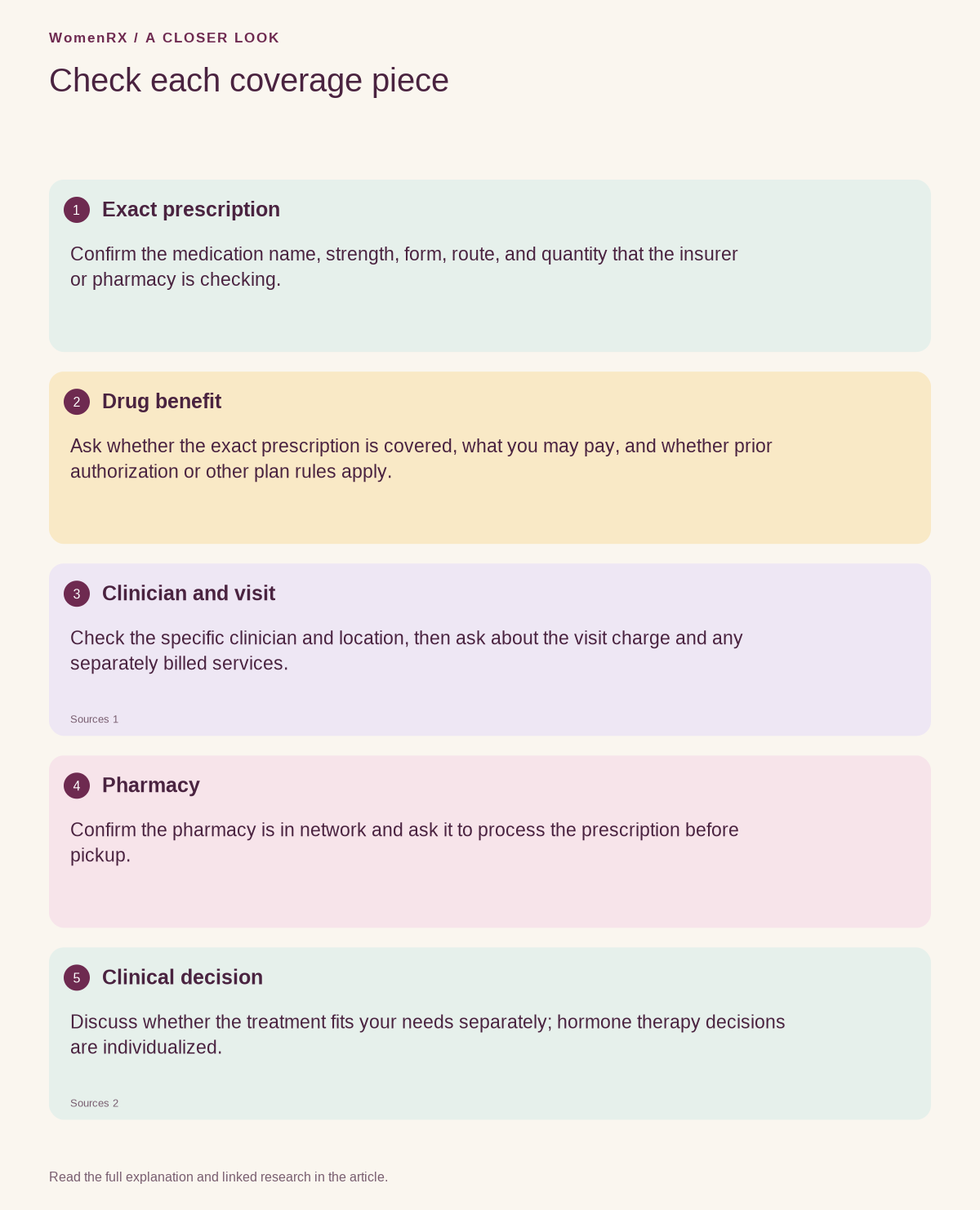
Check each coverage piece
Exact prescription: Confirm the medication name, strength, form, route, and quantity that the insurer or pharmacy is checking.
Drug benefit: Ask whether the exact prescription is covered, what you may pay, and whether prior authorization or other plan rules apply.
Clinician and visit: Check the specific clinician and location, then ask about the visit charge and any separately billed services.1
Pharmacy: Confirm the pharmacy is in network and ask it to process the prescription before pickup.
Clinical decision: Discuss whether the treatment fits your needs separately; hormone therapy decisions are individualized.2
Read the figure as text
Verify the medication, visit, and pharmacy separately so one answer doesn’t stand in for the whole cost.- Exact prescription: Confirm the medication name, strength, form, route, and quantity that the insurer or pharmacy is checking.
- Drug benefit: Ask whether the exact prescription is covered, what you may pay, and whether prior authorization or other plan rules apply.
- Clinician and visit: Check the specific clinician and location, then ask about the visit charge and any separately billed services.1
- Pharmacy: Confirm the pharmacy is in network and ask it to process the prescription before pickup.
- Clinical decision: Discuss whether the treatment fits your needs separately; hormone therapy decisions are individualized.2
Sources you can check
- Health Insurance: MedlinePlusAccessed 2026-09-25Return to first citation
- The 2022 hormone therapy position statement of The North American Menopause Society.“The 2022 Hormone Therapy Position Statement of The North American Menopause Society” Advisory Panel. · Menopause (New York, N.Y.) · 2022Return to first citation