Hair Loss and Thyroid Disease: What to Check First
Diffuse shedding can have several causes, so thyroid testing is one part of an evaluation, not a diagnosis based on hair loss alone.
Thyroid problems can contribute to hair shedding, but hair loss by itself doesn’t show that your thyroid is the cause. The pattern, timing, thyroid history, and other possible triggers help guide whether testing makes sense. In one clinic study of 500 women with telogen effluvium, thyroid results varied; another study of 108 women found no significant correlation between TSH and measured hair findings. 6 7
Start with the pattern and the timing
Hair loss is easier to assess when you can describe what you’re seeing. Clinicians distinguish diffuse shedding, which is spread across the scalp, from patterned thinning and other forms of hair loss. That distinction helps narrow the possibilities, but it doesn’t identify a cause on its own. A review of hair-loss evaluation emphasizes recognizing the pattern and looking for possible triggers before choosing tests or treatment. 5
Think about when the change began and whether something else happened beforehand. Telogen effluvium is a type of diffuse shedding; in one study’s description, it often appeared about two to three months after a triggering event. Illness and weight loss are also listed among possible causes of temporary hair loss. This timing can give a clinician a useful lead, but it can’t confirm the cause by itself. 4 7
Postpartum shedding is a particular example: it often becomes noticeable a few months after delivery and usually improves over time, with most women recovering their usual fullness by their baby’s first birthday. That pattern can help distinguish postpartum shedding from a separate problem, but it doesn’t establish whether thyroid disease is present. 1
When a thyroid check may be part of the picture
Thyroid-stimulating hormone (TSH) testing is included among possible tests in a systematic approach to hair loss. That doesn’t mean every woman with shedding needs the same blood work. The hair-loss pattern, history, and examination help determine which tests are useful. 5
Research in women with diffuse shedding points to a reason for being measured rather than assuming. In a retrospective study of 500 women diagnosed with telogen effluvium who had thyroid testing, 150 had hypothyroidism, 102 had hyperthyroidism, and 248 had normal thyroid function. The hypothyroidism group had more severe hair loss on average, but this was a clinic-based study of women already selected for evaluation. Those proportions shouldn’t be treated as the chance that any woman with hair loss has thyroid disease. 7
A separate study of 108 women with diffuse hair loss found no significant correlation between TSH and measured hair findings. Taken together, these studies support considering thyroid function as one possible part of an evaluation, not treating shedding as proof of a thyroid problem. 6 7
Keep other explanations in view
Iron deficiency can be associated with hair loss, and heavy periods and pregnancy are common causes of iron-deficiency anemia. A clinician may consider blood counts and iron studies alongside thyroid testing, depending on your history and the hair-loss pattern. Low ferritin has been discussed in research on diffuse shedding, but results don’t make one ferritin value a diagnosis of the cause. In the study of 108 women, some hair-cycle measurements differed among participants with ferritin below 40 ng/mL, while TSH did not significantly correlate with the measured hair findings. That result is not a treatment threshold. 2 5 6
Perimenopause may be part of the timing you want to mention, but timing alone can’t identify the cause. If hair changes begin around perimenopause, mention the timing, but don’t treat it as proof of thyroid disease. A useful discussion separates what you’re noticing, such as diffuse shedding or patterned thinning, from the life stage in which it began.
What to discuss before changing treatment
If you take levothyroxine, don’t change the dose just because your hair is shedding. The dose is monitored with blood tests, and the right amount depends on thyroid levels and individual factors. Tell the prescriber about the hair change and ask whether your thyroid results need review alongside other possible causes. 3
Mention vitamins and supplements too, especially biotin: it can affect thyroid test results. If you’re pregnant or breastfeeding, say so, because thyroid monitoring or medication discussions may need to account for that context. 3
A focused conversation can start with: When did the shedding begin? Is it diffuse or patterned? Was there a recent illness, weight loss, pregnancy, or postpartum period? Do I have a thyroid history or take levothyroxine, biotin, or other supplements? Given my pattern and history, would TSH, a blood count, or iron studies help? Those details give testing a purpose rather than turning it into a search for one presumed cause. 1 3 4 5
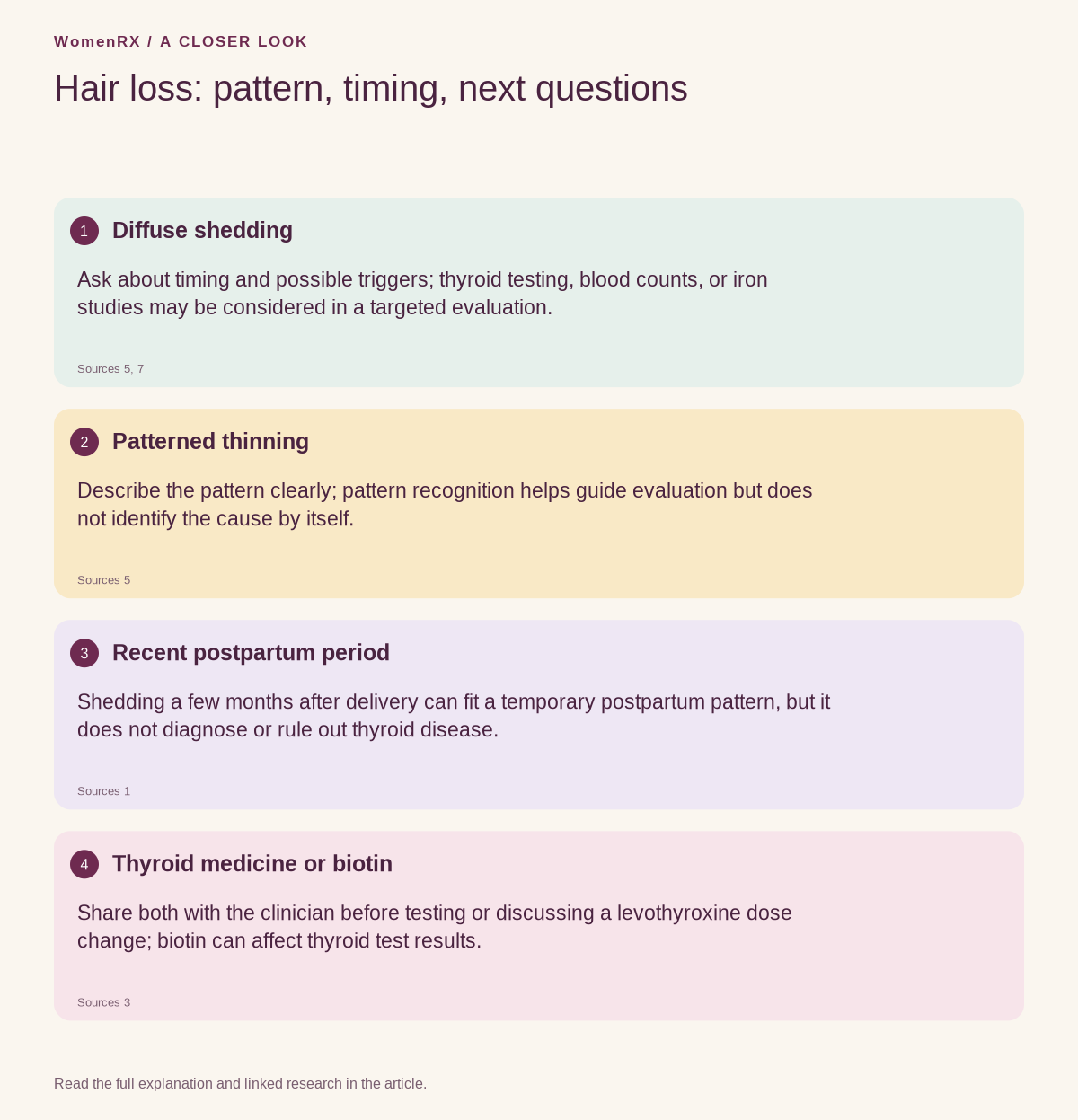
Hair loss: pattern, timing, next questions
Diffuse shedding: Ask about timing and possible triggers; thyroid testing, blood counts, or iron studies may be considered in a targeted evaluation.57
Patterned thinning: Describe the pattern clearly; pattern recognition helps guide evaluation but does not identify the cause by itself.5
Recent postpartum period: Shedding a few months after delivery can fit a temporary postpartum pattern, but it does not diagnose or rule out thyroid disease.1
Thyroid medicine or biotin: Share both with the clinician before testing or discussing a levothyroxine dose change; biotin can affect thyroid test results.3
Read the figure as text
A simple route from what you notice to a focused discussion about possible causes and tests.- Diffuse shedding: Ask about timing and possible triggers; thyroid testing, blood counts, or iron studies may be considered in a targeted evaluation.57
- Patterned thinning: Describe the pattern clearly; pattern recognition helps guide evaluation but does not identify the cause by itself.5
- Recent postpartum period: Shedding a few months after delivery can fit a temporary postpartum pattern, but it does not diagnose or rule out thyroid disease.1
- Thyroid medicine or biotin: Share both with the clinician before testing or discussing a levothyroxine dose change; biotin can affect thyroid test results.3
More questions, answered
Can postpartum shedding mean I have thyroid disease?
Not by itself. Postpartum shedding commonly begins a few months after delivery and usually improves over time. Its timing is useful context, but it does not establish thyroid disease. 1
Should I stop biotin before thyroid testing?
Biotin can affect thyroid test results, so tell the clinician ordering the test that you take it. Ask what to do before testing rather than changing supplements or treatment on your own. 3
Sources you can check
- Hair loss in new moms: Dermatologist tipsAccessed 2026-09-25Return to first citation
- Iron deficiency anaemia - NHSAccessed 2026-09-25Return to first citation
- Levothyroxine: a medicine for an underactive thyroid (hypothyroidism) - NHSAccessed 2026-09-25Return to first citation
- Hair loss - NHSAccessed 2026-09-25Return to first citation
- Hair loss: A systematic approach to evaluation, diagnosis, and management.Walker CW, Champigny D, Hartman T, Hulsey B, Hoffart C. · JAAPA : official journal of the American Academy of Physician Assistants · 2026Return to first citation
- Evaluation of the relationship of digital phototrichogram findings of patients with diffuse hair loss with blood TSH, ferritin and vitamin B12 levels.Bilik L, Kokcam I, Esen M. · Northern clinics of Istanbul · 2024Return to first citation
- Is thyroid dysfunction a common cause of telogen effluvium?: A retrospective study.Bin Dayel S, Hussein RS, Atia T, Abahussein O, Al Yahya RS, Elsayed SH. · Medicine · 2024Return to first citation