Flibanserin Interactions: What to Have Checked
The key checks are medicines that change flibanserin levels, add sedation, or raise the risk of low blood pressure or fainting.
Before starting flibanserin, or adding anything new, have a pharmacist or prescriber review every prescription, over-the-counter medicine, supplement, herb, and alcohol use. Some moderate or strong CYP3A4 inhibitors must not be combined with flibanserin; other products can add sedation or affect blood pressure. The exact product matters, so don’t rely on a category name or an assumption that natural means safe. 1 2
Start with the full list, not just prescriptions
Bring the names and labels for everything you take, including medicines used only occasionally, vitamins, teas, herbal products, and supplements. Include how often you use each one. This matters because a medicine taken for a short infection or an occasional sleep aid can still be relevant, and herbs can interact with prescription or over-the-counter drugs. 1 2
Ask the pharmacist or prescriber to check the exact product and the full combination. Flibanserin interactions can involve how the body processes the drug, how sleepy it makes you, or how it affects blood pressure. A medication review of one item at a time may miss the effect of several products used together.
Ask about medicines that change flibanserin levels
Flibanserin is processed through CYP3A4. The U.S. prescribing information says not to combine it with moderate or strong CYP3A4 inhibitors because they can raise flibanserin levels and increase the risk of low blood pressure and fainting. Listed examples include fluconazole, erythromycin, ciprofloxacin, diltiazem, and verapamil; grapefruit juice is also listed. The label’s examples are not a substitute for checking the specific medicine. 1
The reverse can matter, too. CYP3A4 inducers can substantially lower flibanserin exposure, and the label says their use with flibanserin is not recommended. Examples include carbamazepine, phenytoin, rifampin, and St. John’s wort. Ask whether a new medicine or supplement falls into this category before starting it. 1
There’s another detail worth reviewing: several weak CYP3A4 inhibitors taken together may raise flibanserin levels enough to matter. The label gives oral contraceptives, cimetidine, fluoxetine, and ginkgo as examples of weak inhibitors, and notes that ginkgo and resveratrol supplements may be relevant. That doesn’t mean every contraceptive or supplement has the same effect. It means the exact product belongs on the review list. 1
Some strong CYP2C19 inhibitors may also increase flibanserin exposure. Because a medicine can affect more than one pathway, ask the pharmacist to check its specific interaction profile rather than relying on a broad label such as antidepressant or antifungal. A flibanserin safety review also identifies antidepressants and alcohol among interaction topics for careful review. 1 3
Check for added sleepiness and falls
Flibanserin can cause sleepiness, sedation, or fatigue. Its label warns that other central nervous system depressants can add to this effect. Examples include diphenhydramine, opioids, sleep medicines, and benzodiazepines. Tell the reviewer about occasional as-needed medicines as well as daily ones, and ask what to do if a new medicine is needed. 1
Alcohol is a separate, specific check because combining it with flibanserin can increase the risk of low blood pressure, fainting, and central nervous system depression. The U.S. label says to wait at least two hours after one or two standard drinks before taking flibanserin at bedtime, or to skip that dose if you have had three or more drinks that evening. Follow the current label and ask your prescriber or pharmacist how this applies to your circumstances. 1
Include contraception and menopause care
If you use hormonal contraception, include the exact product and formulation in the review. The flibanserin label lists oral contraceptives among weak CYP3A4 inhibitors, and multiple weak inhibitors may be more consequential together. That is a reason to check your particular combination, not to assume all contraception interacts in the same way. 1
If you’re in perimenopause or postmenopause, list any menopause medicines and symptom-relief products, including nonprescription or herbal options. The label examples don’t establish that every menopause treatment interacts with flibanserin; the useful step is to have the actual product checked rather than treating all hormone therapy or menopause supplements as interchangeable. Herbal products are not automatically free of medicine interactions. 1 2
Ask about less obvious monitoring
If you take digoxin, mention it specifically. The label reports that flibanserin can increase digoxin concentrations and advises increased monitoring of narrow-therapeutic-index P-glycoprotein medicines such as digoxin. Ask who will arrange any monitoring and whether the plan changes if either medicine changes. 1
A useful final question is: If I start, stop, or change any of these products, should I contact you before changing my flibanserin routine? The label gives specific timing for switching around moderate or strong CYP3A4 inhibitors, so don’t improvise a stop-and-restart plan on your own. 1
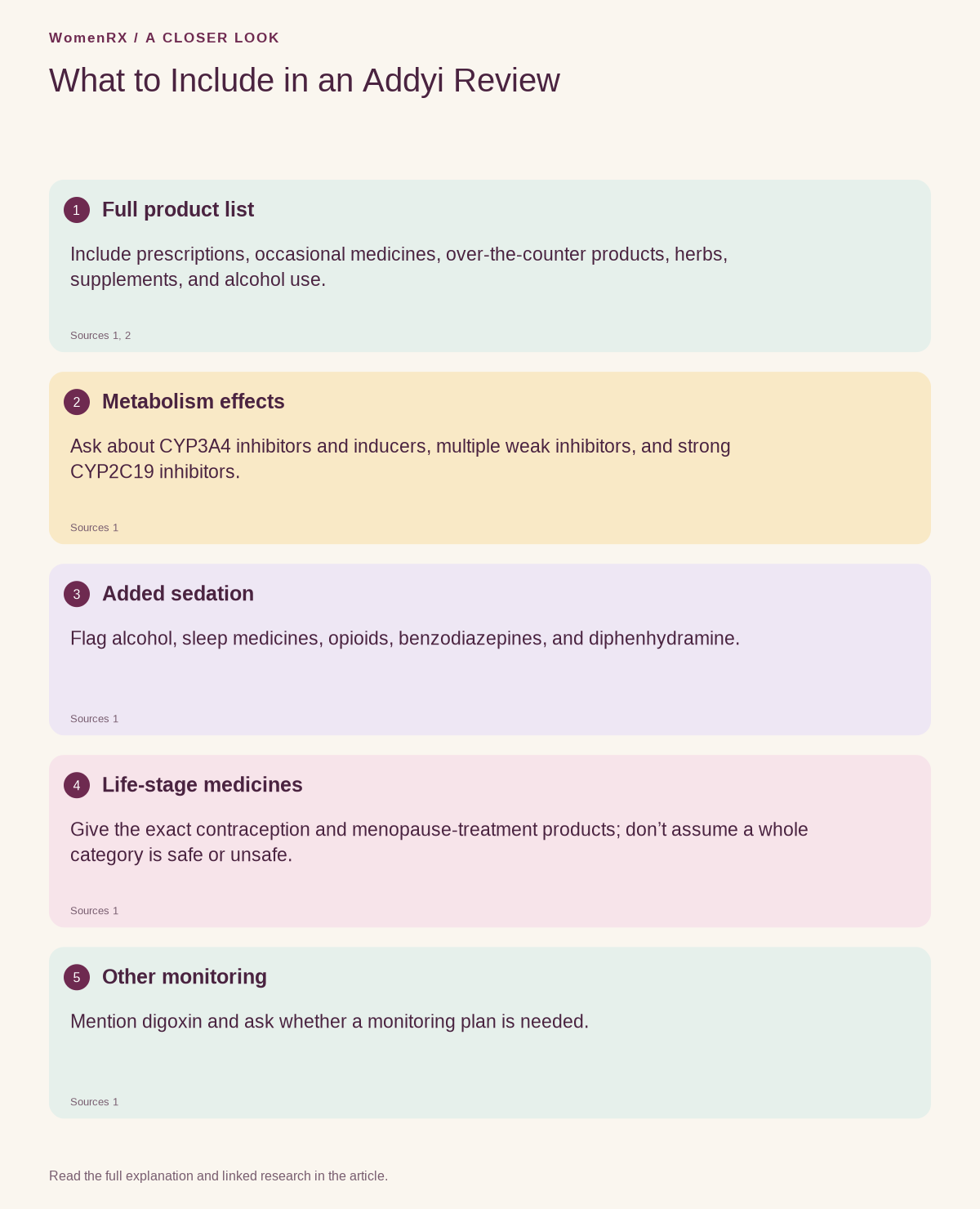
What to Include in an Addyi Review
Full product list: Include prescriptions, occasional medicines, over-the-counter products, herbs, supplements, and alcohol use.12
Metabolism effects: Ask about CYP3A4 inhibitors and inducers, multiple weak inhibitors, and strong CYP2C19 inhibitors.1
Added sedation: Flag alcohol, sleep medicines, opioids, benzodiazepines, and diphenhydramine.1
Life-stage medicines: Give the exact contraception and menopause-treatment products; don’t assume a whole category is safe or unsafe.1
Other monitoring: Mention digoxin and ask whether a monitoring plan is needed.1
Read the figure as text
Use this list to make sure the medication review covers the main interaction pathways without assuming every product in a category behaves alike.- Full product list: Include prescriptions, occasional medicines, over-the-counter products, herbs, supplements, and alcohol use.12
- Metabolism effects: Ask about CYP3A4 inhibitors and inducers, multiple weak inhibitors, and strong CYP2C19 inhibitors.1
- Added sedation: Flag alcohol, sleep medicines, opioids, benzodiazepines, and diphenhydramine.1
- Life-stage medicines: Give the exact contraception and menopause-treatment products; don’t assume a whole category is safe or unsafe.1
- Other monitoring: Mention digoxin and ask whether a monitoring plan is needed.1
More questions, answered
Should I stop a supplement before asking about it?
Don’t guess based on whether it is labeled natural. Share the product name, ingredients, and how often you take it with the pharmacist or prescriber; the label specifically flags some supplements, including ginkgo and St. John’s wort, in different interaction categories. 1 Herbal products can interact with medicines. 2
What if I’m prescribed an antibiotic or antifungal?
Ask the prescriber or pharmacist to check the exact drug before combining it with flibanserin. Some listed antibiotics and antifungals are moderate or strong CYP3A4 inhibitors, which the label says must not be combined with flibanserin. Don’t assume every drug in either category has the same interaction. 1
Sources you can check
- ADDYI (FLIBANSERIN) TABLET, FILM COATED [SPROUT PHARMACEUTICALS, INC.] | US prescribing information and patient instructionsAccessed 2026-09-25Return to first citation
- Herbal Medicine: MedlinePlusAccessed 2026-09-25Return to first citation
- Evaluation of safety for flibanserin.Clayton AH, Brown L, Kim NN. · Expert opinion on drug safety · 2020Return to first citation