EMDR Therapy: What to Expect Before You Begin
EMDR has a structured, eight-phase framework, but the pace and plan should be discussed with your therapist rather than assumed in advance.
EMDR is a structured therapy for PTSD that typically moves through history and treatment planning, preparation, work with a selected memory, and later review. During memory-focused work, you may hold part of a disturbing memory in mind while doing a second task, such as following the therapist’s fingers or listening to tones. Ask how your therapist plans to pace the work, respond if you feel overwhelmed, and review your progress. 234

The basic idea, without the jargon
Eye movement desensitization and reprocessing (EMDR) is one of the psychotherapies recommended for PTSD, alongside approaches such as cognitive processing therapy and prolonged exposure. It follows a structured, eight-phase framework, but that doesn’t mean every person’s sessions look the same or follow a fixed timetable. 24
In the memory-focused part, you pay attention to a disturbing memory while also doing a second task. That task may involve following the therapist’s moving fingers, or using taps, tones, or another activity that engages attention. The aim is not simply to tell the story from beginning to end. The treatment framework includes other phases before and after this work, including preparation, closure, and re-evaluation. 23
What the phases may involve
Assessment and planning: The therapist asks about your history and what you want treatment to address. You can ask what information they need, how you’ll decide which memories or concerns to focus on, and how progress will be reviewed. History-taking and treatment planning are part of the EMDR framework. 2
Preparation: There is a preparation phase before memory-focused work. Ask what it involves in their practice, how you can signal that you need a pause, and how the session will end if you feel unsettled. These are reasonable questions to get a clear picture of the therapist’s approach, not a test you need to pass before starting. 2
Memory-focused work: The therapist guides you through attention to a selected memory while you do a second task. Eye movements are one option, not the only one. You can ask what your therapist uses and what you should expect to do. 3
Closure and review: Closure and re-evaluation are named phases in the framework. Ask how the therapist checks in at the end of a session and how you’ll decide whether to continue, adjust the plan, or consider another approach. 2
This structure should not be mistaken for a guarantee that you will quickly feel better, or that every session will involve a detailed retelling of trauma. A research trial in people with personality disorders used a particular schedule, but that study’s schedule is not a standard timetable for everyone seeking PTSD treatment. 13
Choosing a therapist and checking fit
Ask about the therapist’s EMDR training, experience treating PTSD, and access to consultation or supervision. In a clinical trial, therapists had formal EMDR training and ongoing consultation; that shows the value placed on treatment quality in that study, but it does not establish a universal credential rule. 3
You can also ask:
- How will we decide whether EMDR fits what I’m dealing with?
- What does preparation look like in your practice?
- If I feel overwhelmed, how can I pause or change pace?
- What alternatives, such as cognitive processing therapy or prolonged exposure, might fit me, and how do they differ?
- How will we review whether treatment is helping?
You don’t need to decide that EMDR is right for you before asking these questions. PTSD guidelines include more than one therapy option, so it’s appropriate to discuss alternatives and your preferences. 4
Your circumstances belong in the plan
There isn’t one trauma history or life stage shared by all women. If pregnancy, postpartum changes, caregiving, privacy, or other circumstances affect your energy, schedule, sense of safety, or support, you can raise those practical needs when discussing the plan. The studies summarized here do not establish that EMDR works differently across women’s reproductive stages. Research reporting on sexual orientation and gender identity in PTSD treatment trials is also limited, which makes it harder to judge how well findings apply across groups. 4
The useful next step is a conversation about how the therapist would work with you, not a promise that one method will suit everyone. A clear explanation of the phases, options for adjusting pace, and a plan for reviewing progress can help you decide whether to begin.
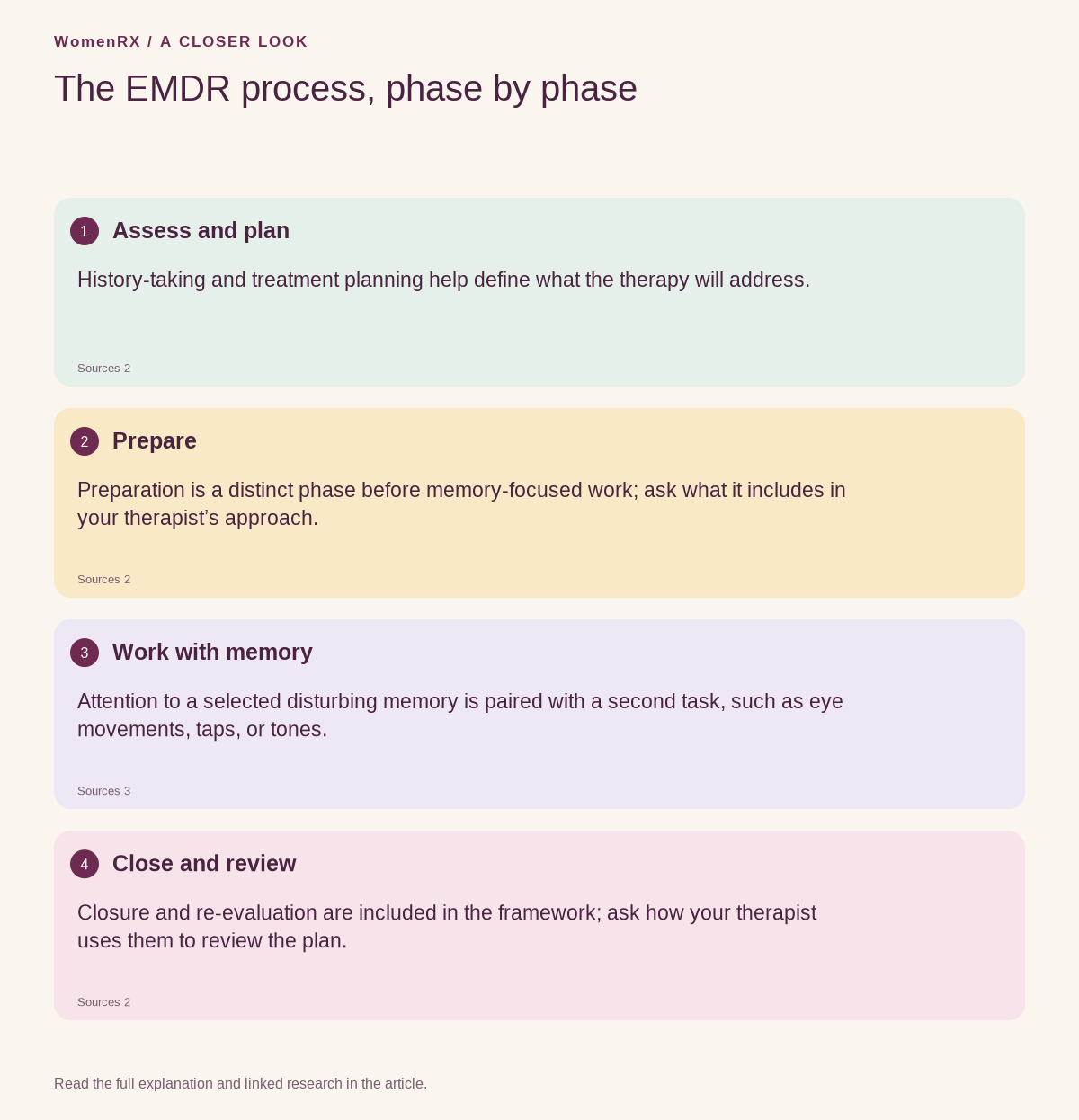
The EMDR process, phase by phase
Assess and plan: History-taking and treatment planning help define what the therapy will address.2
Prepare: Preparation is a distinct phase before memory-focused work; ask what it includes in your therapist’s approach.2
Work with memory: Attention to a selected disturbing memory is paired with a second task, such as eye movements, taps, or tones.3
Close and review: Closure and re-evaluation are included in the framework; ask how your therapist uses them to review the plan.2
Read the figure as text
A simplified map of the named phases and the memory-focused work. It shows the framework, not a required timetable.- Assess and plan: History-taking and treatment planning help define what the therapy will address.2
- Prepare: Preparation is a distinct phase before memory-focused work; ask what it includes in your therapist’s approach.2
- Work with memory: Attention to a selected disturbing memory is paired with a second task, such as eye movements, taps, or tones.3
- Close and review: Closure and re-evaluation are included in the framework; ask how your therapist uses them to review the plan.2
More questions, answered
Does EMDR use only eye movements?
No. In the described EMDR protocol, the second attention task may involve following the therapist’s fingers, taps, tones, or another task that engages working memory. Ask which approach your therapist uses. 3
Is there a set number of EMDR sessions?
The framework has eight phases, but that does not specify one session count for everyone. A study schedule for a particular patient group should not be treated as a universal timetable. Ask how your therapist will plan and review your treatment. 123
Sources you can check
- Eye Movement Desensitization and Reprocessing Therapy in Persons With Personality Disorders: A Randomized Clinical Trial.Hofman S, Hafkemeijer L, de Jongh A, Slotema CW. · JAMA network open · 2025Return to first citation
- Preliminary efficacy of eye movement desensitization and reprocessing for children aged 1.5-8 years with PTSD: a multiple baseline experimental design (N = 19).de Roos C, Offermans J, Bouwmeester S, Lindauer R, Scheper F. · European journal of psychotraumatology · 2025Return to first citation
- Trauma-focused EMDR for Personality disorders among Outpatients (TEMPO): study protocol for a multi-centre, single-blind, randomized controlled trial.Hofman S, Hafkemeijer L, de Jongh A, Starrenburg A, Slotema K. · Trials · 2022Return to first citation
- Inclusion of sexual- and gender-minoritized individuals in randomized clinical trials of first-line treatments for posttraumatic stress disorder: A systematic literature review.Warren M, Smith LJ, Pridgen SA, Held P. · Journal of traumatic stress · 2026Return to first citation