Can You Drink Alcohol While Using Testosterone Therapy?
Research on alcohol and hormone levels doesn’t establish whether drinking changes the effects or safety of prescribed testosterone in women.
There isn’t enough direct evidence here to say that alcohol has a specific interaction with prescribed testosterone in women, or to name an amount that’s safe for everyone. Studies of alcohol’s effects on hormones didn’t test women taking testosterone therapy. Your testosterone product, liver health, drinking pattern, and other medicines are useful details to review with your prescriber or pharmacist. 2 3
What the research can, and can’t, tell you
The key distinction is between alcohol’s effects on hormones and an interaction with prescribed testosterone. Those aren’t the same question. In a controlled study, healthy women and men received intravenous alcohol or saline. Alcohol-related hormone changes differed by sex: testosterone suppression occurred predominantly in men, while estradiol increases occurred predominantly in women. The study did not test women taking prescribed testosterone, so it can’t tell you whether drinking changes a woman’s treatment effect or risk. 3
Another small study followed 42 healthy adults, including 27 women, in a randomized crossover trial. Participants had a very low-alcohol beverage or a placebo for four weeks each. The researchers reported a trend toward higher serum testosterone with the low-alcohol beverage, but the result did not meet the usual threshold for statistical significance (p=0.051). This wasn’t a study of prescribed testosterone, and it doesn’t show that alcohol improves treatment or is safe to combine with it. 2
Taken together, these findings don’t support a blanket warning that alcohol interferes with every testosterone regimen, or a guarantee that drinking is harmless alongside any regimen. They also don’t establish a safe amount for women using testosterone.
Why your health and product details matter
The research here doesn’t establish an alcohol interaction for a particular testosterone formulation. For an individualized medication check, have the product name and form available, along with how much and how often you drink, any liver condition, and a complete list of medicines and supplements. A pharmacist or prescriber can check the specific product and your medication list. The studies described above don’t verify specific interactions between alcohol, testosterone, and other medicines, so it would be misleading to name one here.
Liver health is worth mentioning. A review of alcohol’s metabolic effects describes disrupted liver function with chronic alcohol consumption, but focuses largely on metabolic health and male reproductive function. That supports bringing up a known liver condition when discussing alcohol; it does not establish a specific liver interaction between alcohol and testosterone therapy in women. 1
A focused question to ask
You could ask: “Given my testosterone product, liver history, drinking pattern, and other medicines, is there a reason I should avoid alcohol or change anything about my plan?” If your prescriber has already given you advice based on your health or treatment details, that guidance is more relevant than findings from studies that didn’t include women using prescribed testosterone.
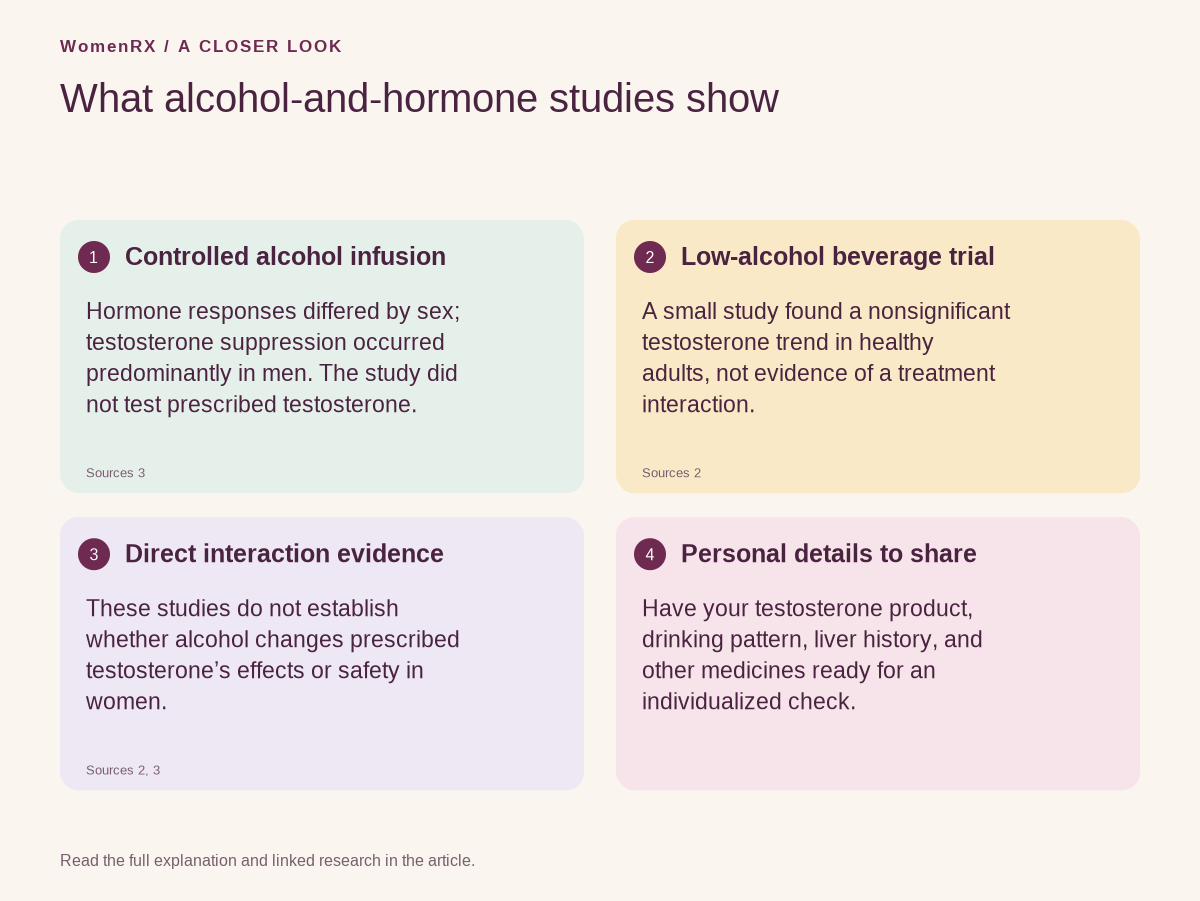
What alcohol-and-hormone studies show
Controlled alcohol infusion: Hormone responses differed by sex; testosterone suppression occurred predominantly in men. The study did not test prescribed testosterone.3
Low-alcohol beverage trial: A small study found a nonsignificant testosterone trend in healthy adults, not evidence of a treatment interaction.2
Direct interaction evidence: These studies do not establish whether alcohol changes prescribed testosterone’s effects or safety in women.23
Personal details to share: Have your testosterone product, drinking pattern, liver history, and other medicines ready for an individualized check.
Read the figure as text
These studies describe hormone responses to alcohol, but they do not test drinking alongside prescribed testosterone in women.- Controlled alcohol infusion: Hormone responses differed by sex; testosterone suppression occurred predominantly in men. The study did not test prescribed testosterone.3
- Low-alcohol beverage trial: A small study found a nonsignificant testosterone trend in healthy adults, not evidence of a treatment interaction.2
- Direct interaction evidence: These studies do not establish whether alcohol changes prescribed testosterone’s effects or safety in women.23
- Personal details to share: Have your testosterone product, drinking pattern, liver history, and other medicines ready for an individualized check.
More questions, answered
Does research show that alcohol raises or lowers testosterone in women?
Not in a way that answers this treatment question. In a controlled alcohol-infusion study, testosterone suppression occurred predominantly in men, while estradiol increases occurred predominantly in women. A separate small study found a nonsignificant trend toward higher testosterone after a low-alcohol beverage, but it did not study prescribed testosterone therapy. Neither result establishes what happens when a woman drinks while using testosterone. 2 3
Sources you can check
- Understanding the Role of Alcohol in Metabolic Dysfunction and Male Infertility.Genchi VA, Cignarelli A, Sansone A, Yannas D, Dalla Valentina L, Renda Livraghi D, Spaggiari G, Santi D. · Metabolites · 2024Return to first citation
- Effects of Regular Low-Level Alcohol Consumption in Healthy Individuals: A Randomized, Double-Blind, Placebo-Controlled Crossover Study.Oshima S, Shiiya S, Kato Y. · Healthcare (Basel, Switzerland) · 2022Return to first citation
- Pharmacodynamic effects of intravenous alcohol on hepatic and gonadal hormones: influence of age and sex.Vatsalya V, Issa JE, Hommer DW, Ramchandani VA. · Alcoholism, clinical and experimental research · 2012Return to first citation