Can You Drink Alcohol While Taking Zepbound?
The clearest concern is how you feel: alcohol may make Zepbound-related nausea or vomiting harder to manage.
NHS guidance advises avoiding alcohol while taking tirzepatide because it may increase nausea or vomiting. That’s advice about tolerability, not evidence of a direct alcohol-Zepbound interaction or a specific safe drinking amount. If you have diabetes and take insulin or certain other glucose-lowering medicines, drinking without enough food raises a separate low-blood-sugar concern. 512
The concern is tolerability, not a known drinking limit
Zepbound is the brand name for tirzepatide used for weight management. Its US prescribing information reports that nausea, vomiting and diarrhea occurred most often during dose escalation and decreased over time in two weight-reduction trials. The NHS’s tirzepatide guidance advises avoiding alcohol because it can increase side effects such as nausea and vomiting. Neither point establishes a specific amount of alcohol that is safe for you, or proves that alcohol directly interacts with tirzepatide. 15
That distinction matters on an ordinary evening. If you already feel queasy or have been vomiting, drinking is more likely to complicate how you feel than to answer anything useful about whether you can “have a drink on Zepbound.” If you’re having severe or persistent digestive symptoms, contact the clinician who prescribes it rather than assuming alcohol is the only cause. Zepbound’s prescribing information specifically calls for follow-up for severe or persistent gastrointestinal symptoms. 15
Other medicines can change the conversation
If you have diabetes, the question isn’t only whether alcohol worsens nausea. MedlinePlus identifies drinking too much alcohol without enough food as one possible cause of low blood glucose, particularly relevant to people taking insulin or medicines that prompt the pancreas to release insulin. NHS tirzepatide guidance also flags insulin as a medicine that may need attention when used with tirzepatide. These are reasons to discuss your actual medication combination and eating pattern, not evidence that a drink causes low blood glucose in everyone taking Zepbound. 25
For example, someone who takes insulin and has barely eaten because she feels sick has a different question from someone who takes no diabetes medicines and is eating normally. The first question to raise with her diabetes care team is how to handle drinking and low-blood-glucose risk with her medicines. MedlinePlus notes that low blood glucose can develop quickly and, when severe, can cause someone to pass out. 2
Pregnancy, breastfeeding and liver disease are separate questions
If you’re pregnant or planning pregnancy, don’t treat an answer about alcohol tolerability as an answer about whether to continue Zepbound. Zepbound’s US prescribing information says weight loss offers no benefit during pregnancy and may cause fetal harm; it advises discontinuing Zepbound when pregnancy is recognized. That calls for a prescribing discussion independent of any plans to drink. 1
Breastfeeding raises two separate exposures. In a small, single-dose study reported in Zepbound’s US prescribing information, tirzepatide was undetectable in most breast milk samples and detected at low levels in a few. Its effects on breastfed infants and milk production remain unknown. MedlinePlus notes that alcohol can pass into breast milk. If you’re breastfeeding, ask about the medicine and alcohol separately rather than assuming that an answer about one covers the other. 13
A diagnosed fatty liver condition can also change the answer. Joint European liver, diabetes and obesity guidelines discourage alcohol consumption in adults with metabolic dysfunction-associated steatotic liver disease, or MASLD, even while discussing tirzepatide as a possible treatment for obesity or type 2 diabetes. That’s advice about liver disease, not proof of a direct Zepbound-alcohol interaction. 4
The practical takeaway is to start with the factor that applies to you: current nausea or vomiting, diabetes medicines and missed meals, or a separate pregnancy, breastfeeding or liver-health concern. Those distinctions lead to a more useful conversation than a blanket yes or no.
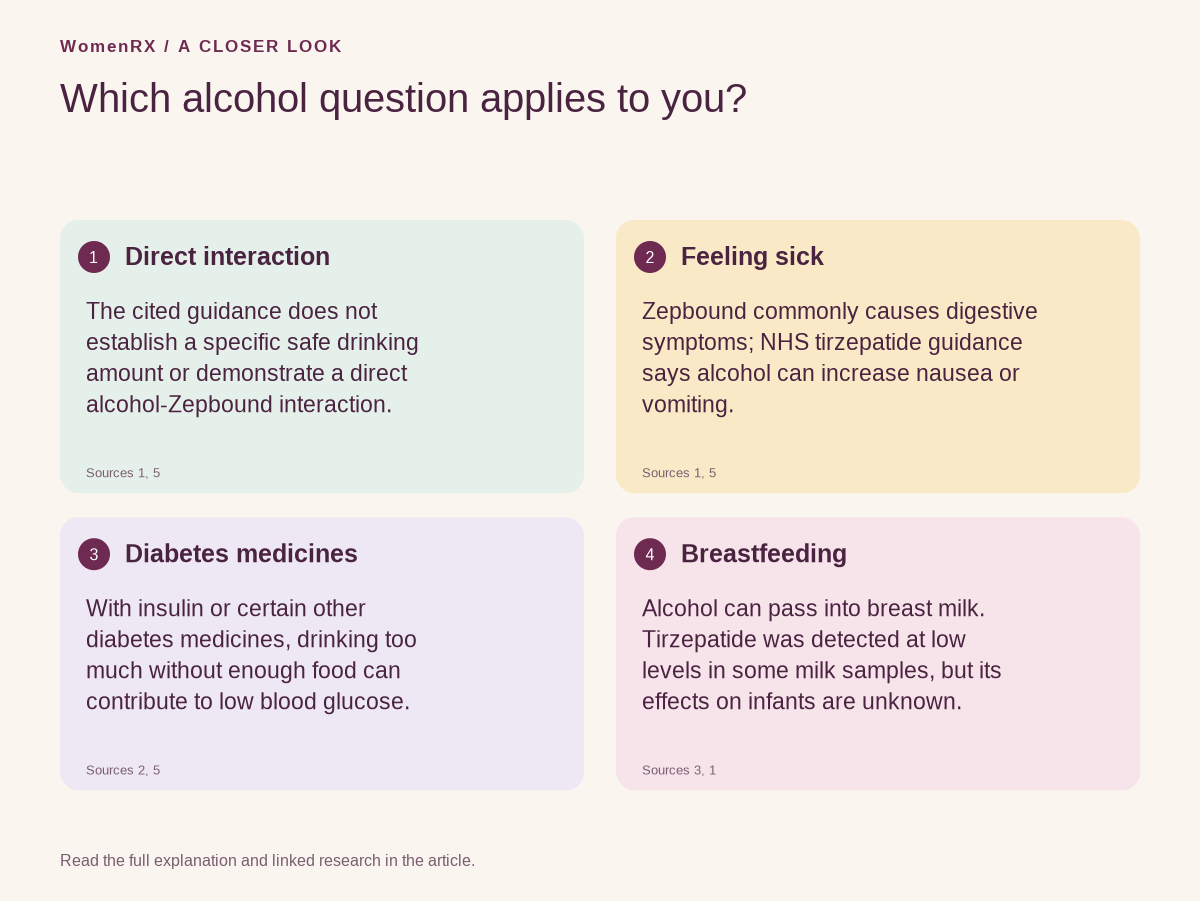
Which alcohol question applies to you?
Direct interaction: The cited guidance does not establish a specific safe drinking amount or demonstrate a direct alcohol-Zepbound interaction.15
Feeling sick: Zepbound commonly causes digestive symptoms; NHS tirzepatide guidance says alcohol can increase nausea or vomiting.15
Diabetes medicines: With insulin or certain other diabetes medicines, drinking too much without enough food can contribute to low blood glucose.25
Breastfeeding: Alcohol can pass into breast milk. Tirzepatide was detected at low levels in some milk samples, but its effects on infants are unknown.31
Read the figure as text
A quick comparison of distinct concerns that can get lumped together as an alcohol-Zepbound interaction.- Direct interaction: The cited guidance does not establish a specific safe drinking amount or demonstrate a direct alcohol-Zepbound interaction.15
- Feeling sick: Zepbound commonly causes digestive symptoms; NHS tirzepatide guidance says alcohol can increase nausea or vomiting.15
- Diabetes medicines: With insulin or certain other diabetes medicines, drinking too much without enough food can contribute to low blood glucose.25
- Breastfeeding: Alcohol can pass into breast milk. Tirzepatide was detected at low levels in some milk samples, but its effects on infants are unknown.31
More questions, answered
Should I skip a drink if Zepbound is making me nauseated?
That’s a sensible choice while you’re feeling sick: NHS tirzepatide guidance says alcohol can increase nausea or vomiting. If digestive symptoms are severe or persistent, contact your prescriber rather than simply waiting for them to pass. 51
Sources you can check
- ZEPBOUND (TIRZEPATIDE) INJECTION, SOLUTION ZEPBOUND (TIRZEPATIDE) INJECTION, SOLUTION ZEPBOUND KWIKPEN (TIRZEPATIDE) INJECTION, SOLUTION [ELI LILLY AND COMPANY] | US prescribing information and patient instructionsAccessed 2026-09-25Return to first citation
- Hypoglycemia: MedlinePlusAccessed 2026-09-25Return to first citation
- Breastfeeding | Benefits of Breastfeeding | MedlinePlusAccessed 2026-09-25Return to first citation
- EASL-EASD-EASO Clinical Practice Guidelines on the management of metabolic dysfunction-associated steatotic liver disease (MASLD): Executive Summary.European Association for the Study of the Liver, European Association for the Study of Diabetes, European Association for the Study of Obesity. · Diabetologia · 2024Return to first citation
- Tirzepatide: a medicine to manage type 2 diabetes and treat obesity - NHSAccessed 2026-09-25Return to first citation