Do You Need to Take NAC on an Empty Stomach?
An empty stomach isn’t an established rule for every NAC product, and research comparing formulations doesn’t settle whether food changes absorption.
You don’t need to assume every NAC product must be taken on an empty stomach. Check the directions for the exact product you’re using. A study tested NAC tablets under both fed and fasting conditions, but its reported result compares two tablets, not how much food changes absorption.4 Nausea was reported after an 11-g oral dose in fasting adults, but that study did not test whether food helps.5 If prescribed NAC causes stomach symptoms, ask your prescriber or pharmacist before changing its timing or stopping it.
Start with the product in your hand
NAC, short for N-acetylcysteine, comes in different oral formulations and is also used as a medicine. The useful first question isn’t “What’s the universal NAC rule?” It’s “What does this product tell me to do?” Directions for a prescribed oral medicine, an over-the-counter supplement, and a product used by another route shouldn’t be treated as interchangeable. Research in oral tablets or solutions can’t establish food instructions for an inhaled product.45
If your oral supplement’s label gives a food direction, use that as your starting point. If it doesn’t, don’t add a fasting requirement based on a general claim that NAC “absorbs better” without food. That claim needs a comparison of the same product taken with and without food. The studies most relevant here answer narrower questions.
What the absorption studies actually compared
In a randomized crossover study in healthy Chinese volunteers, researchers compared a 600-mg NAC tablet with a reference tablet under fasting conditions and under fed conditions. The abstract reports that the two tablets met the study’s bioequivalence criteria in each condition. It does not report a clear estimate of how eating changed absorption of either tablet. Bioequivalence between products when both are taken with food isn’t the same question as whether one product works better without food.4
Another study compared effervescent NAC tablets dissolved in water with an oral NAC solution. Thirty healthy adults received a single 11-g dose under fasting conditions. The formulations met the study’s bioequivalence criteria, and participants rated the effervescent version more favorably on several taste measures. Because everyone was fasting, that study can’t tell you whether eating would change absorption or settle the best timing for a supplement.5
The practical distinction: a tested fasting condition is not a fasting instruction. Researchers may control meal timing to make formulations easier to compare. That alone doesn’t show that breakfast would make your supplement ineffective.45
If your stomach objects
Nausea is worth taking seriously, but it doesn’t prove that you need to take NAC with food. In the fasting study using the 11-g oral dose, nausea, diarrhea, and gas were among the reported adverse events. That’s evidence that stomach symptoms can occur with oral NAC in that setting, not evidence that a snack prevents them or that a typical supplement will feel the same.5
If you’re using a supplement and its directions don’t address food, check the full label and ask a pharmacist about that specific formulation if symptoms make it hard to take. The dose and purpose of the prescribed treatment may be quite different from those of a supplement.5 If prescribed NAC causes stomach symptoms, ask your prescriber or pharmacist before changing its timing or stopping it.
Don’t assume every episode of nausea is caused by NAC, either. Nausea and vomiting have many possible causes. If you’re vomiting and notice a dry mouth, dark urine, or that you’re urinating less often, seek medical care promptly; those can be signs of dehydration.1
Pregnancy and breastfeeding change the question
If you’re pregnant, ask about the exact NAC product and why you’re taking it before starting it. Pregnancy guidance advises checking with a provider before taking medicines, including herbs and supplements. For a needed medicine, it advises discussing the risks and benefits rather than stopping it on your own.3 NAC’s food timing does not tell you whether taking it for a reproductive goal is useful or appropriate.
If you’re breastfeeding, check the specific product and intended use with your care team rather than assuming that supplement directions answer questions about your baby’s exposure. Some medicines can pass into breast milk, but general breastfeeding guidance doesn’t establish what happens with a particular NAC product.2
For everyday food timing, that leaves a clear next move: follow your own product’s directions, distinguish supplement questions from prescribed-treatment questions, and treat claims of a universal empty-stomach advantage as unproven by the oral comparisons described here.45
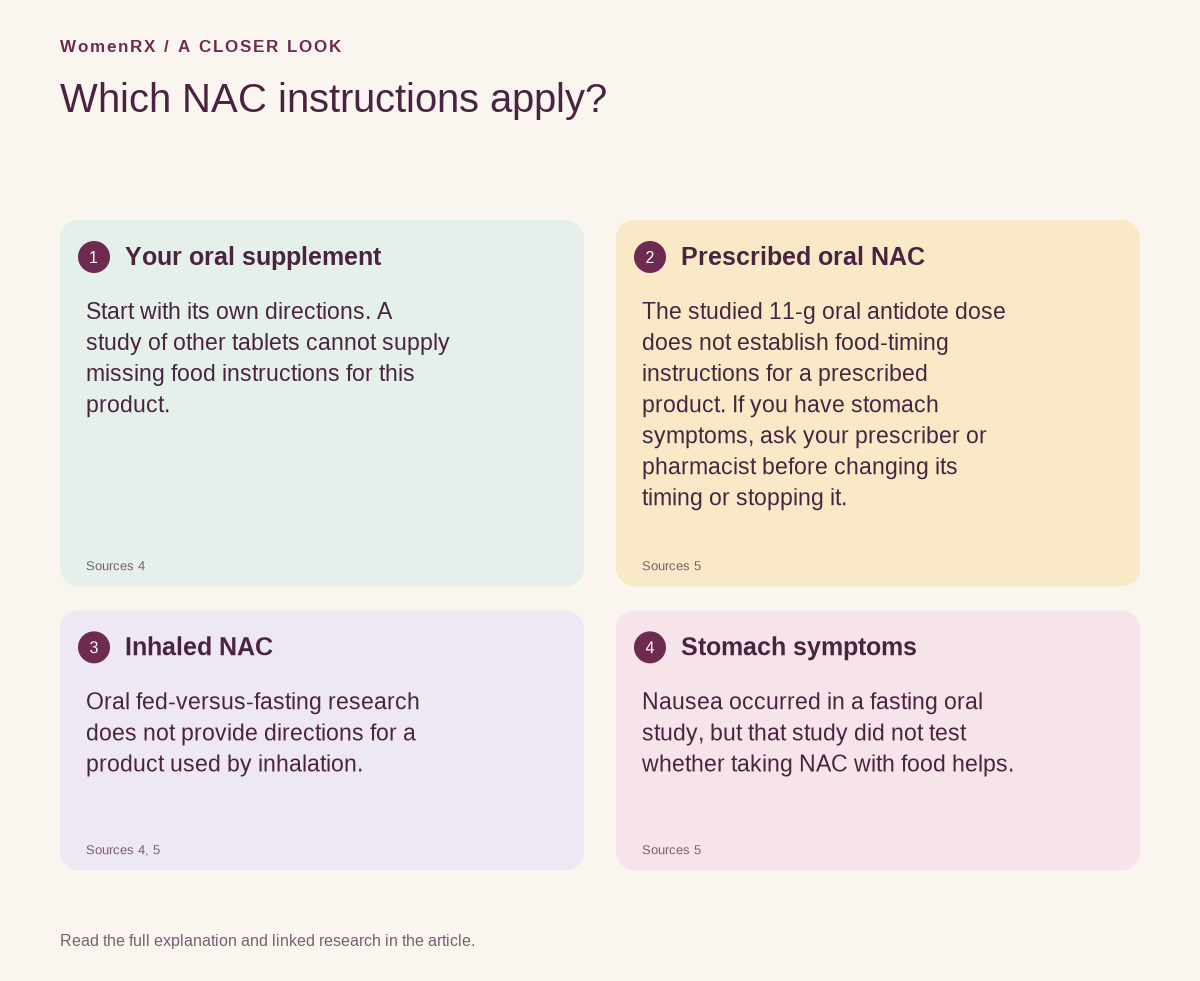
Which NAC instructions apply?
Your oral supplement: Start with its own directions. A study of other tablets cannot supply missing food instructions for this product.4
Prescribed oral NAC: The studied 11-g oral antidote dose does not establish food-timing instructions for a prescribed product. If you have stomach symptoms, ask your prescriber or pharmacist before changing its timing or stopping it.5
Inhaled NAC: Oral fed-versus-fasting research does not provide directions for a product used by inhalation.45
Stomach symptoms: Nausea occurred in a fasting oral study, but that study did not test whether taking NAC with food helps.5
Read the figure as text
Match a timing question to the product and evidence that can actually answer it.- Your oral supplement: Start with its own directions. A study of other tablets cannot supply missing food instructions for this product.4
- Prescribed oral NAC: The studied 11-g oral antidote dose does not establish food-timing instructions for a prescribed product. If you have stomach symptoms, ask your prescriber or pharmacist before changing its timing or stopping it.5
- Inhaled NAC: Oral fed-versus-fasting research does not provide directions for a product used by inhalation.45
- Stomach symptoms: Nausea occurred in a fasting oral study, but that study did not test whether taking NAC with food helps.5
Sources you can check
- Nausea | Vomiting | MedlinePlusAccessed 2026-09-25Return to first citation
- Breastfeeding | Benefits of Breastfeeding | MedlinePlusAccessed 2026-09-25Return to first citation
- Pregnancy and Medicines | MedlinePlusAccessed 2026-09-25Return to first citation
- Pharmacokinetics and bioequivalence of two N-acetylcysteine tablets in healthy Chinese volunteers under fasting and fed conditions.Yin X, Xia R, Song H, Zhang Y, Guo D, Gan F. · Clinical pharmacology in drug development · 2026Return to first citation
- Effervescent N-Acetylcysteine Tablets versus Oral Solution N-Acetylcysteine in Fasting Healthy Adults: An Open-Label, Randomized, Single-Dose, Crossover, Relative Bioavailability Study.Greene SC, Noonan PK, Sanabria C, Peacock WF. · Current therapeutic research, clinical and experimental · 2016Return to first citation