Can Zepbound Cause Acid Reflux?
Reflux was reported more often with Zepbound than with placebo, but a burning chest sensation after an injection isn’t automatically caused by the medicine.
Yes. In two weight-reduction trials, gastroesophageal reflux disease was reported by 4% to 5% of adults taking Zepbound, depending on dose, compared with 2% taking placebo.1 If symptoms start or worsen after treatment begins, note what they feel like and when they happen. That pattern can help your clinician assess reflux alongside other possible causes.24
Is it reflux or another stomach symptom?
Heartburn usually feels like burning in the middle of your chest. Acid reflux may also leave a sour taste in your mouth, and symptoms are often worse after eating or when you lie down or bend over.2 Nausea and bloating can happen with reflux, while abdominal pain is reported with Zepbound. None of these symptoms alone tells you that acid is coming up into your throat.12
That distinction matters with Zepbound because several digestive effects were reported in its weight-reduction trials. Across the three studied doses, nausea was reported by 25% to 29% of adults taking Zepbound versus 8% taking placebo; vomiting by 8% to 13% versus 2%; and gastroesophageal reflux disease by 4% to 5% versus 2%. These are reports across treatment groups, not a way to determine what’s causing one person’s symptoms.1
Why the timing is worth noticing
If burning or a sour taste began after you started Zepbound or after a dose increase, tell your prescriber. Include whether it happens after meals or when you lie down, and whether you’re also nauseated or vomiting. The sequence is useful context, not proof that the medicine is the only cause. Esophageal symptoms can reflect reflux or other conditions, and persistent symptoms sometimes need a closer assessment.24
There’s a related timing clue, with an important limit: prescribing information for Mounjaro, another tirzepatide product, says most reports of nausea, vomiting, and diarrhea in its adult trials occurred during dose escalation and decreased over time. That finding does not establish that reflux follows the same course on Zepbound.3
Pregnancy can also cause or worsen heartburn. If you’re pregnant, mention it as another possible contributor. If you recently gave birth, mention that context too, without assuming it explains the symptom. Bring up any other medicines you take so your care team can consider the full picture.2
What to do next
For occasional, mild burning, notice the pattern before your next conversation with your prescriber: what the sensation is, when it began relative to treatment changes, and whether meals or lying down bring it on. If heartburn keeps happening, a pharmacist can help you consider short-term symptom relief. Antacids and alginates may ease symptoms, but they don’t address the underlying cause and aren’t a long-term answer to recurring reflux.2
If reflux symptoms are getting worse, contact your care team rather than waiting for a routine follow-up.2 If swallowing becomes difficult, tell your clinician so that symptom can be assessed; swallowing difficulty can have causes other than reflux.4
You don’t need to decide for yourself whether Zepbound caused the reflux or change your dose to test the theory. A clear description of the symptom and its timing gives your prescriber a better starting point for deciding what to assess next.124
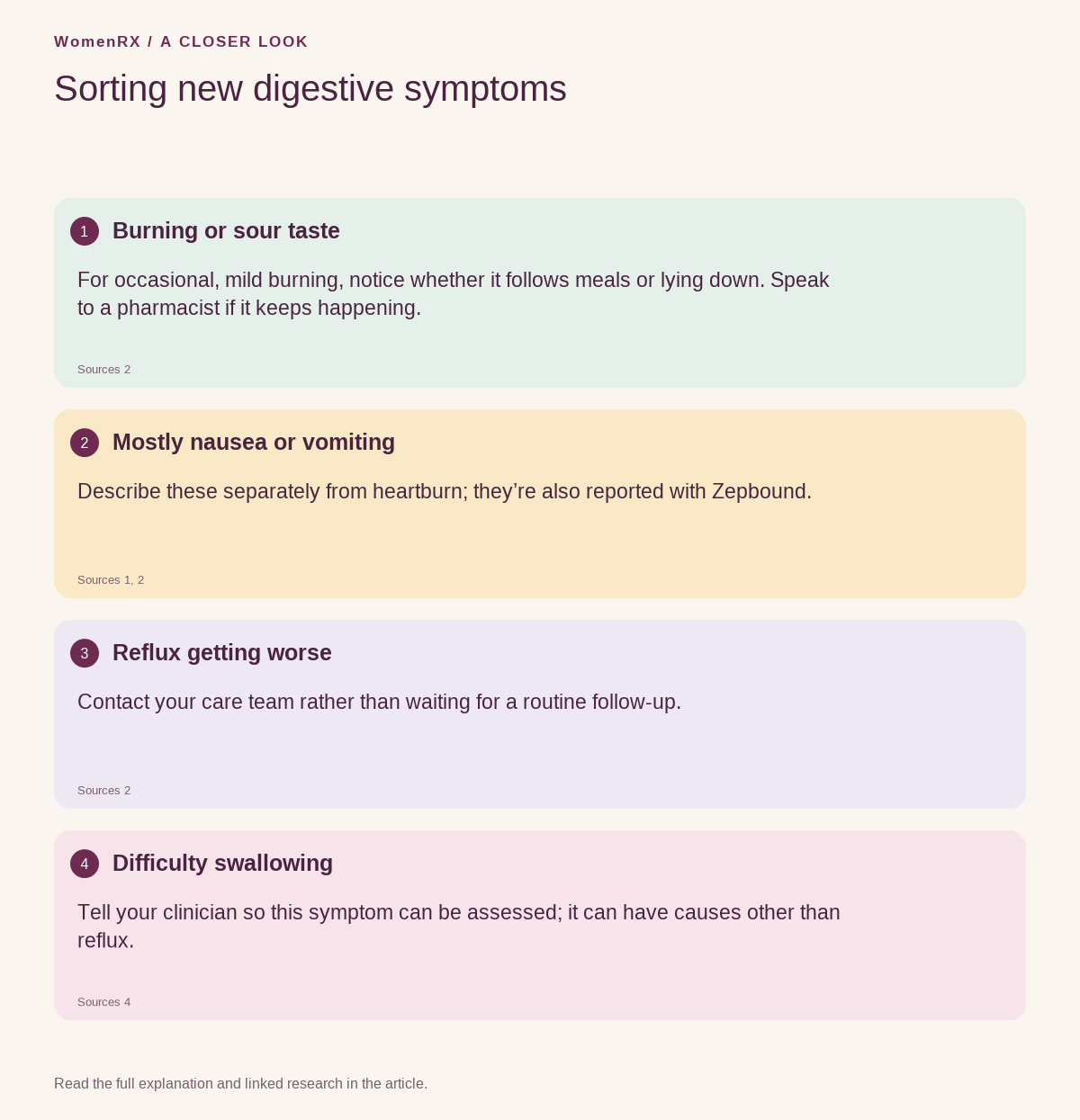
Sorting new digestive symptoms
Burning or sour taste: For occasional, mild burning, notice whether it follows meals or lying down. Speak to a pharmacist if it keeps happening.2
Mostly nausea or vomiting: Describe these separately from heartburn; they’re also reported with Zepbound.12
Reflux getting worse: Contact your care team rather than waiting for a routine follow-up.2
Difficulty swallowing: Tell your clinician so this symptom can be assessed; it can have causes other than reflux.4
Read the figure as text
Start with what the symptom feels like, then consider what to discuss and when worsening symptoms call for earlier contact.- Burning or sour taste: For occasional, mild burning, notice whether it follows meals or lying down. Speak to a pharmacist if it keeps happening.2
- Mostly nausea or vomiting: Describe these separately from heartburn; they’re also reported with Zepbound.12
- Reflux getting worse: Contact your care team rather than waiting for a routine follow-up.2
- Difficulty swallowing: Tell your clinician so this symptom can be assessed; it can have causes other than reflux.4
More questions, answered
Does heartburn after Zepbound mean I have GERD?
No. Heartburn can happen occasionally; recurring acid reflux may be called gastroesophageal reflux disease, or GERD. Symptoms alone may not settle the cause, especially if they persist despite initial care.24
Sources you can check
- ZEPBOUND (TIRZEPATIDE) INJECTION, SOLUTION ZEPBOUND (TIRZEPATIDE) INJECTION, SOLUTION ZEPBOUND KWIKPEN (TIRZEPATIDE) INJECTION, SOLUTION [ELI LILLY AND COMPANY] | US prescribing information and patient instructionsAccessed 2026-09-25Return to first citation
- Heartburn and acid reflux - NHSAccessed 2026-09-25Return to first citation
- MOUNJARO (TIRZEPATIDE) INJECTION, SOLUTION MOUNJARO KWIKPEN (TIRZEPATIDE) INJECTION, SOLUTION [ELI LILLY AND COMPANY] | US prescribing information and patient instructionsAccessed 2026-09-25Return to first citation
- ACG Clinical Guidelines: Clinical Use of Esophageal Physiologic Testing.Gyawali CP, Carlson DA, Chen JW, Patel A, Wong RJ, Yadlapati RH. · The American journal of gastroenterology · 2020Return to first citation