Can You Work Out on Ozempic? Adjusting Your Routine
You can stay active while taking Ozempic, but stomach symptoms and other diabetes medicines may change what makes sense today.
Yes, you can work out while taking Ozempic. If you feel well, your usual activity may suit you. Nausea, vomiting, or diarrhea, especially around a dose increase, may make a lighter session or rest a better choice. If you also take insulin or a sulfonylurea, include your existing blood-glucose plan when deciding how to exercise. 1 3
Start with how you feel, not the injection calendar
Ozempic doesn’t call for one particular workout schedule. The more useful question is whether today’s activity fits today’s symptoms. Nausea, vomiting, diarrhea, abdominal pain, and constipation are among its common side effects. In Ozempic trials, most reports of nausea, vomiting, or diarrhea occurred while doses were being increased. 1
For example, if you feel fine after a dose increase, you may choose the walk or strength session you had planned. If you’re nauseated and struggling to eat, that same session may feel like too much. Choosing easier movement or resting for now doesn’t mean giving up on exercise.
Before: check intake and your diabetes medicines
Ask two separate questions before you begin: Can I comfortably do this activity today? And does my diabetes treatment affect my blood-glucose plan for exercise?
If vomiting or diarrhea has made it hard to eat or drink as usual, consider postponing a demanding session. Even without those symptoms, notice whether you’ve eaten and drunk enough to feel ready for what you’ve planned. This is a comfort check, not a rule that everyone on Ozempic needs to eat at a particular time before exercise.
The blood-glucose question depends partly on your other medicines. Ozempic’s patient information says the risk of low blood sugar may be higher when it’s taken with insulin or a sulfonylurea. Exercise can also lower blood glucose. If you use either medicine, bring the glucose-monitoring and activity plan you already follow into the decision. Don’t assume everyone taking Ozempic has the same low-blood-sugar risk. 1 3
During: change course when something feels wrong
You don’t have to finish a workout just because you started it. If nausea or other symptoms make activity uncomfortable, slow down or stop. If you monitor blood glucose, use your established plan, particularly if you also take insulin or a sulfonylurea. 1 3
One symptom calls for a different response: severe stomach-area pain that won’t go away, with or without vomiting. Ozempic’s patient information says to stop using the medicine and contact your healthcare provider right away if that happens. Don’t treat it as ordinary exercise soreness or try to push through the session. 1
After: check recovery, not just the workout
Once you’ve finished, notice whether you can eat and drink comfortably and whether you feel ready for your usual daily activities. If a workout repeatedly feels harder after a dose increase, you can make the next session easier while the symptoms are present. If symptoms keep interfering with eating or drinking, tell the person managing your treatment rather than continually trying to work around them.
Give strength work a place in the plan
If you’re in perimenopause or later life, you may be thinking about strength as well as weight. That’s a useful focus: muscle-strengthening activity can help maintain muscle mass and strength, which matter for everyday tasks as you get older. Protein also helps build, maintain, and repair muscle. 3 2
A practical check is whether your strength activity feels manageable and whether you’re able to eat and recover afterward. Examples of everyday function to notice include getting up from a chair or carrying groceries. If those tasks are becoming harder, that tells you something a change on the scale cannot.
Weight loss with GLP-1 medicines can include a decrease in measured lean mass. But lean mass isn’t a direct measure of skeletal muscle or strength. A review of randomized trials found lean-mass reductions across several GLP-1 treatments at obesity-management doses; it wasn’t an Ozempic exercise trial. Whether a particular strength routine prevents muscle loss during Ozempic treatment, including in perimenopausal women, remains uncertain. That doesn’t erase the established reasons to stay strong. It means your day-to-day function deserves attention alongside your weight. 4 5 6
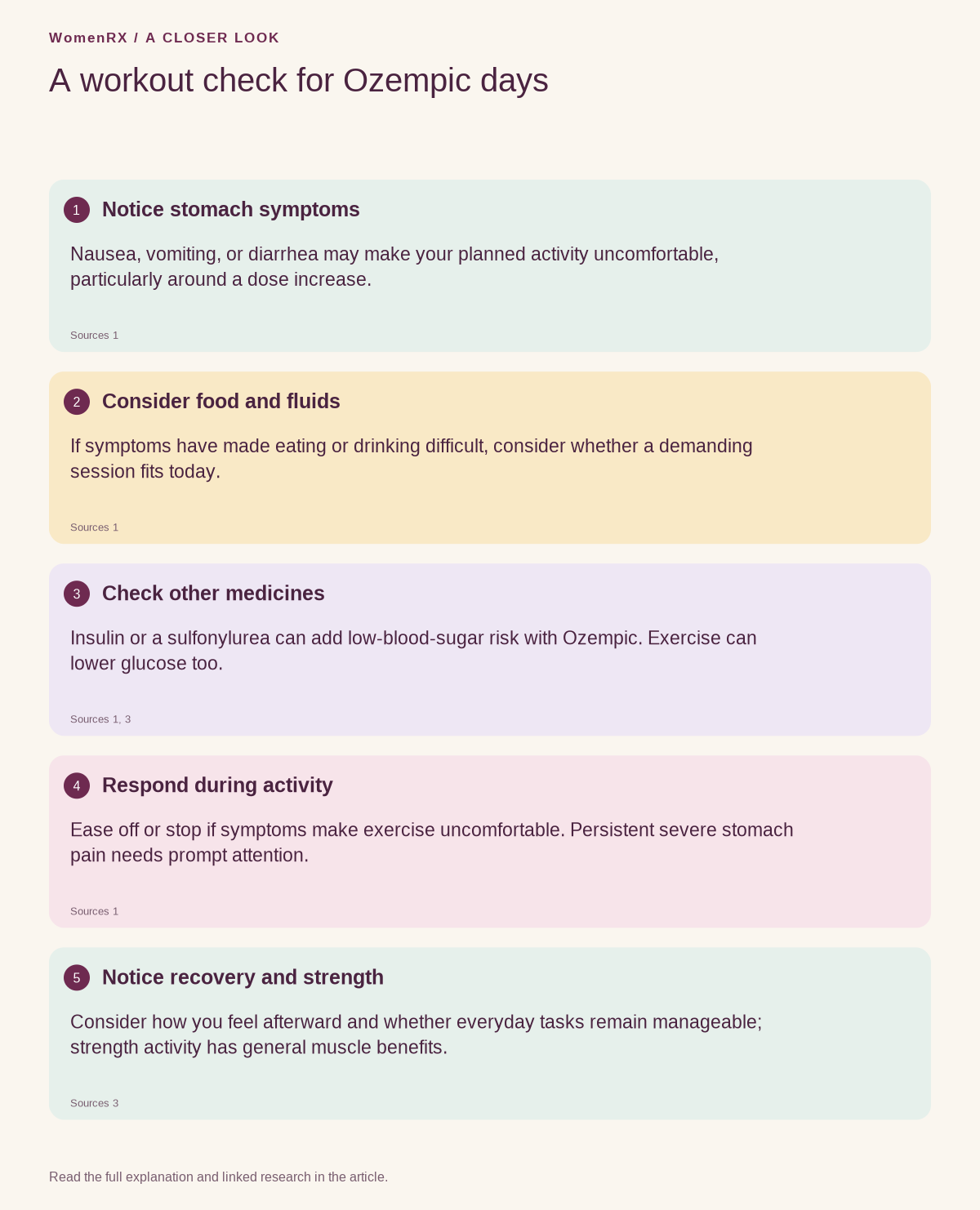
A workout check for Ozempic days
Notice stomach symptoms: Nausea, vomiting, or diarrhea may make your planned activity uncomfortable, particularly around a dose increase.1
Consider food and fluids: If symptoms have made eating or drinking difficult, consider whether a demanding session fits today.1
Check other medicines: Insulin or a sulfonylurea can add low-blood-sugar risk with Ozempic. Exercise can lower glucose too.13
Respond during activity: Ease off or stop if symptoms make exercise uncomfortable. Persistent severe stomach pain needs prompt attention.1
Notice recovery and strength: Consider how you feel afterward and whether everyday tasks remain manageable; strength activity has general muscle benefits.3
Read the figure as text
Use these checks to decide whether today’s plan fits, needs to be lighter, or should wait.- Notice stomach symptoms: Nausea, vomiting, or diarrhea may make your planned activity uncomfortable, particularly around a dose increase.1
- Consider food and fluids: If symptoms have made eating or drinking difficult, consider whether a demanding session fits today.1
- Check other medicines: Insulin or a sulfonylurea can add low-blood-sugar risk with Ozempic. Exercise can lower glucose too.13
- Respond during activity: Ease off or stop if symptoms make exercise uncomfortable. Persistent severe stomach pain needs prompt attention.1
- Notice recovery and strength: Consider how you feel afterward and whether everyday tasks remain manageable; strength activity has general muscle benefits.3
Sources you can check
- OZEMPIC (SEMAGLUTIDE) INJECTION, SOLUTION [A-S MEDICATION SOLUTIONS] | US prescribing information and patient instructionsAccessed 2026-09-25Return to first citation
- Dietary Supplements for Exercise and Athletic Performance - Health Professional Fact SheetAccessed 2026-09-25Return to first citation
- Benefits of Exercise: MedlinePlusAccessed 2026-09-25Return to first citation
- Effect of GLP-1 receptor agonists at doses for obesity management on muscle health: systematic review and meta-analysis of randomized controlled trials (RCTs).Laverde LP, Muñoz-Velandia OM, Alfonso D, Gómez Medina AM. · International journal of obesity (2005) · 2026Return to first citation
- LEAN mass Preservation with Resistance Exercise and Protein during semaglutide and tirzepatide therapy (LEAN-PREP study): a protocol for a randomised controlled trial.Alawadhi AA, Alroudhan D, Alsaeed DJ, Almarshad BW, Alshehabi DH, Allahou BA, Mashankar A, Al Ozairi E, Gray S. · BMJ open · 2026Return to first citation
- Lean Mass and Musculoskeletal Preservation in GLP-1-Based Obesity Treatment: Nutrition, Exercise, Supplementation, and Monitoring Strategies.Šantić R, Martinović L, Pavlović N, Rušić D, Kumrić M, Martinović D, Tičinović Kurir T, Božić J. · Metabolites · 2026Return to first citation