Buspirone for Anxiety: What to Expect and Review
Buspirone is a prescription anxiety medicine taken regularly, and finding a dose that works can take several weeks.
Buspirone is an anxiety medicine taken on a regular schedule, not a pill to save for a sudden anxious moment. MedlinePlus describes twice-daily use and says it may take several weeks to reach a dose that works for you. Follow your prescription, take it consistently with or without food, and review side effects and other medicines with your prescriber. 3
Where buspirone fits
If you’ve been prescribed buspirone, the first distinction is between treating ongoing anxiety and getting through an anxious moment right now. Buspirone is used to treat anxiety. Its regular dosing and the time it can take to reach a dose that works make it different from a medicine you would expect to use only when anxiety suddenly spikes. That’s worth clarifying if you were hoping for immediate relief. 3
Anxiety treatment can also include psychotherapy, medication, or both. For example, cognitive behavioral therapy focuses on changing how you respond to the thoughts and situations that bring on anxiety. Buspirone doesn’t have to carry the whole treatment plan by itself. 1
Make the prescription routine clear
MedlinePlus describes buspirone tablets as taken twice daily. Follow the schedule on your prescription rather than changing how often you take it. Take each dose consistently in relation to food: either always with food or always without it. Your prescriber may begin with a low dose and adjust it over time, and it may take several weeks before you reach a dose that works for you. 3
That delay can make the early days confusing. A useful follow-up question is, “When should we check whether this dose is helping?” Tell your prescriber what anxiety is still interrupting, such as sleep, work, or ordinary plans, along with any effects that make the medicine hard to take. Keep follow-up appointments rather than changing the dose on your own. 3
If you miss a dose, MedlinePlus says to take it when you remember unless it’s almost time for the next one. In that case, skip the missed dose and return to your regular schedule. Don’t double up. 3
Check interactions before adding something new
Give your prescriber and pharmacist a list of everything you take, including prescriptions, over-the-counter products, vitamins, and supplements. This matters when starting buspirone and before starting, stopping, or changing another medicine while you take it. 3
Some items deserve a specific mention. Tell them if you take, or have recently stopped taking, a monoamine oxidase inhibitor (MAOI). MedlinePlus names medicines such as phenelzine and selegiline, as well as linezolid and methylene blue, and asks about use within the past two weeks. The nonprescription stomach medicine cimetidine may also interact with buspirone. These aren’t reasons to guess at a safe interval yourself; they’re reasons to check the complete medicine list before making a change. 3
Alcohol can add to buspirone-related drowsiness. MedlinePlus advises avoiding alcohol while taking it and avoiding large amounts of grapefruit or grapefruit juice. Buspirone itself may make you drowsy, so wait until you know how it affects you before driving or operating machinery. 3
Notice side effects without losing sight of the goal
Dizziness, nausea, headache, nervousness, trouble sleeping, and fatigue are among the effects MedlinePlus lists. Let your prescriber know if a side effect is severe or doesn’t go away. A follow-up is a chance to weigh what has changed in your anxiety against what taking the medicine feels like day to day. 3
Some symptoms call for a prompt call rather than waiting for that visit. MedlinePlus says to call your doctor immediately for a rash or swelling of the face, mouth, or throat; a fast or irregular heartbeat; or a cluster of symptoms such as agitation, fever, sweating, confusion, and severe muscle stiffness or twitching. 3
If you’re pregnant or breastfeeding
Tell your prescriber if you’re pregnant, planning a pregnancy, or breastfeeding, so the discussion can include both your anxiety and the limits of what’s known about buspirone. Don’t make a medication change based on a single study. 3
In a prospective pregnancy registry, researchers evaluated 68 women who had taken buspirone in the first trimester, including four twin pregnancies. They observed no major malformations among the 72 infants. That’s reassuring as an observation, but the group was small and the analysis had no matched comparison group, so it cannot establish that buspirone carries no risk. 2
Breastfeeding evidence is limited too. In a study of milk samples from nine mothers taking buspirone, the drug was below the study’s detection limit in every sample, while low levels of an active metabolite were found; no adverse effects were reported in the exposed infants. Those findings help inform a conversation, but nine families cannot settle questions about uncommon effects or long-term exposure. A separate review likewise notes limited information about long-term use during breastfeeding, particularly when nursing a newborn or preterm infant. 54
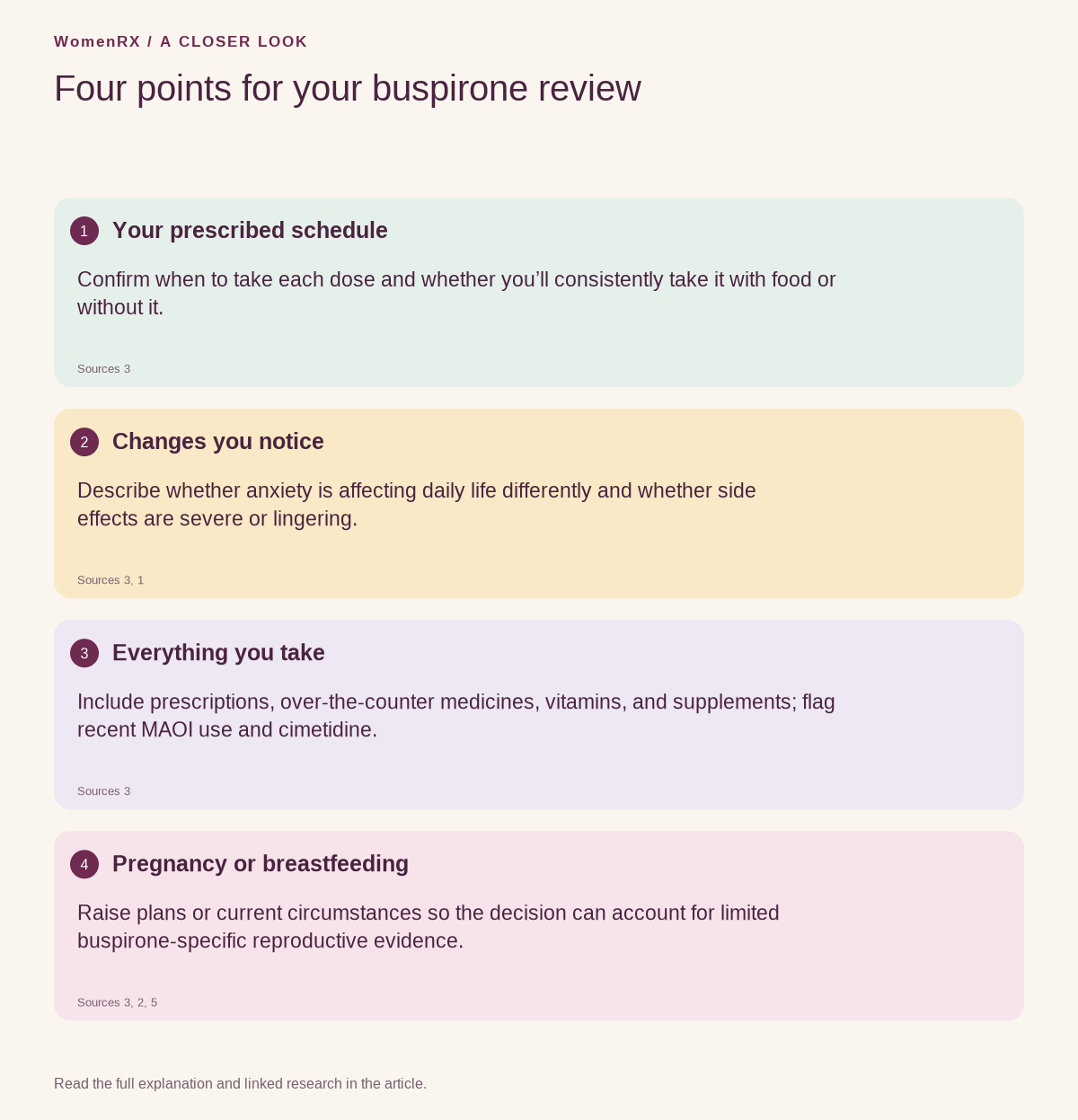
Four points for your buspirone review
Your prescribed schedule: Confirm when to take each dose and whether you’ll consistently take it with food or without it.3
Changes you notice: Describe whether anxiety is affecting daily life differently and whether side effects are severe or lingering.31
Everything you take: Include prescriptions, over-the-counter medicines, vitamins, and supplements; flag recent MAOI use and cimetidine.3
Pregnancy or breastfeeding: Raise plans or current circumstances so the decision can account for limited buspirone-specific reproductive evidence.325
Read the figure as text
Use these prompts to connect your daily routine with the questions that matter at follow-up. This is a discussion aid, not a symptom score.- Your prescribed schedule: Confirm when to take each dose and whether you’ll consistently take it with food or without it.3
- Changes you notice: Describe whether anxiety is affecting daily life differently and whether side effects are severe or lingering.31
- Everything you take: Include prescriptions, over-the-counter medicines, vitamins, and supplements; flag recent MAOI use and cimetidine.3
- Pregnancy or breastfeeding: Raise plans or current circumstances so the decision can account for limited buspirone-specific reproductive evidence.325
More questions, answered
What should I ask at a medication review?
Ask when to assess whether buspirone is helping, which side effects to report, and whether anything on your full medicine and supplement list needs attention. If pregnancy or breastfeeding is relevant, bring that up before changing your treatment. 3
Sources you can check
- Anxiety: MedlinePlusAccessed 2026-09-25Return to first citation
- Pregnancy outcomes after first-trimester exposure to buspirone: prospective longitudinal outcomes from the MGH National Pregnancy Registry for Psychiatric Medications.Freeman MP, Szpunar MJ, Kobylski LA, Harmon H, Viguera AC, Cohen LS. · Archives of women's mental health · 2022Return to first citation
- Buspirone: MedlinePlus Drug InformationAccessed 2026-09-25Return to first citation
- Buspirone2006Return to first citation
- Alleviating anxiety while breastfeeding: evaluating buspirone transfer into human milk.Krutsch K, Campbell L, Baker T, Datta P. · Archives of women's mental health · 2024Return to first citation