Berberine Versus Wegovy: Comparing Evidence, Not Nicknames
Berberine hasn’t shown a clear BMI benefit in women with PCOS, while a large Wegovy trial measured substantial weight loss against placebo.
Berberine hasn’t been shown to work as a substitute for prescription semaglutide. Across seven randomized trials involving 497 women with PCOS, berberine did not clearly lower BMI compared with placebo or no treatment. In a separate 68-week trial, adults taking Wegovy lost more weight than those taking placebo. These weren’t head-to-head studies, so their results can’t establish a direct difference between the products. 3 7
Why the nickname falls short
Calling berberine “nature’s Ozempic” makes two different kinds of products sound interchangeable. They aren’t. Goldenseal is a plant that contains berberine, and goldenseal-containing products are discussed as dietary supplements; semaglutide is a prescription medicine. A supplement’s plant origin doesn’t establish that it works like a prescription drug, or that its benefits and risks are comparable. 1 3 6
The comparison also gets ahead of the evidence. The PCOS trials and the Wegovy trial don’t directly compare berberine with semaglutide. Instead, they include berberine trials in women with polycystic ovary syndrome (PCOS) and a large semaglutide weight-management trial in adults with overweight or obesity. Those populations and study questions aren’t the same. 3 7
What berberine research in women shows
A systematic review included 12 randomized trials of berberine in women with PCOS. These studies examined reproductive and metabolic outcomes, not simply whether berberine helps people with obesity lose weight. Across seven trials with 497 participants, berberine did not clearly lower BMI compared with placebo or no treatment. The results varied substantially across trials, adding uncertainty to that finding. In a separate comparison with metformin, berberine also didn’t show a clear BMI improvement; that estimate came from four trials with 262 participants. 7
Some PCOS findings involved measures such as cholesterol, waist circumference, or hormone levels. Those results may matter to people with PCOS, but they don’t prove that berberine is an effective obesity treatment for women without PCOS, or that it produces weight loss comparable to semaglutide. The review itself concluded there was no solid evidence that berberine improved live birth or other clinical outcomes in women with PCOS. 7
This distinction is useful if you see a berberine claim based on a result from a specific group of women: ask whether the study measured weight, who took part, and what the comparison group received. A change in a metabolic measure isn’t automatically evidence of meaningful or sustained weight loss.
What the prescription trial can tell us
The Wegovy prescribing information describes a 68-week randomized, placebo-controlled trial of 1,961 adults with obesity or overweight plus a weight-related condition. Seventy-four percent of participants were women; people with type 2 diabetes were excluded. At week 68, estimated mean body weight had fallen 14.9% from baseline in the Wegovy injection group and 2.4% in the placebo group. Both groups also received diet and physical-activity support. The prescribing information says weight reduction was observed regardless of sex, but it doesn’t give a separate weight-loss estimate for women in this trial. 3
That is evidence of a weight-loss effect against placebo in the population studied, not a measured advantage over berberine. The berberine review pooled BMI findings in women with PCOS, while the Wegovy trial reported percent change in body weight in a different population over 68 weeks. Putting those numbers side by side cannot tell you how the products would compare if tested in the same people. 3 7
There’s also a difference in product oversight. In the US, dietary supplements don’t require FDA premarket review or approval in the way prescription medicines do. Manufacturers are responsible for product safety and truthful labeling, and supplement products can vary in ingredients and amounts. Results from a study of one preparation may not apply to a different supplement or combination product. 1
That doesn’t mean every supplement is ineffective or every prescription treatment is right for every person. It means the products shouldn’t be treated as substitutes based on a nickname. Obesity treatment choices can depend on other health conditions as well as a person’s goals and preferences. 2
Interactions and pregnancy deserve special care
Berberine isn’t automatically low-risk because it comes from a plant. A toxicology review of Berberis plants and their alkaloids identifies possible interactions involving drug-metabolizing CYP enzymes and P-glycoprotein, but the review doesn’t establish a specific interaction for every berberine product or medication. Weight-loss supplements more broadly can interact with medicines, and their formulations may differ. If you take medication, bring the exact product label, including other ingredients, when reviewing it with a prescriber or pharmacist. 1 5
Wegovy has different, more product-specific interaction information. Its prescribing information says delayed stomach emptying may affect absorption of oral medicines and calls for closer clinical or laboratory monitoring with certain medicines, including those with a narrow therapeutic index. It also identifies a greater risk of low blood sugar when Wegovy is used with insulin or insulin-releasing medicines such as sulfonylureas. These are known considerations for Wegovy, not evidence that berberine has the same interactions. 3
If you’re pregnant or breastfeeding, don’t assume berberine is safe. The PCOS review’s pregnancy findings don’t establish safety. For breastfeeding, LactMed discusses goldenseal specifically: it says transfer of goldenseal components into breast milk is unknown and describes a concern that berberine can displace bilirubin in newborns. Most sources it cites recommend avoiding newborn exposure to goldenseal. This does not establish how much berberine from a standalone product might reach a breastfed baby, and it doesn’t remove the potential concern about berberine exposure. 6 7
Pregnancy also changes the prescription-treatment discussion. Separate US prescribing information for semaglutide tablets, not the Wegovy injection information used for the weight-loss comparison above, says human pregnancy data are insufficient to evaluate certain risks and reports reproductive effects in pregnant animals. Those animal findings cannot predict an individual human outcome, but neither product should be assumed safe in pregnancy based on its weight-loss research. 4 7
A better question than “Is it natural Ozempic?”
Ask what evidence supports the exact product for your situation. For berberine, that means checking whether the study involved people like you, measured weight outcomes, and tested the same formulation. For prescription treatment, it means looking at reported weight-loss outcomes as well as whether the medicine fits your medical circumstances. Those questions make the comparison more useful than a marketing nickname.
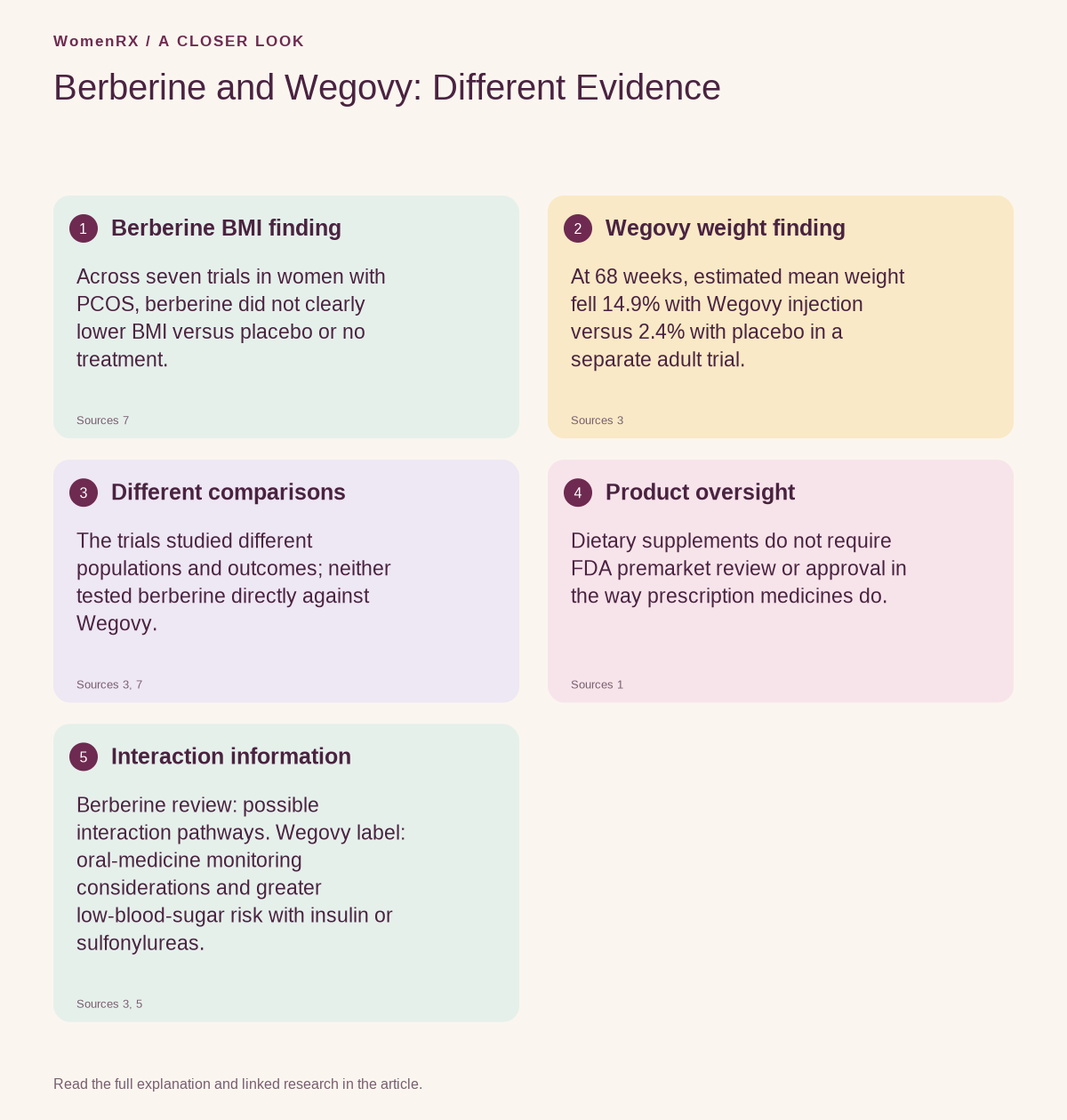
Berberine and Wegovy: Different Evidence
Berberine BMI finding: Across seven trials in women with PCOS, berberine did not clearly lower BMI versus placebo or no treatment.7
Wegovy weight finding: At 68 weeks, estimated mean weight fell 14.9% with Wegovy injection versus 2.4% with placebo in a separate adult trial.3
Different comparisons: The trials studied different populations and outcomes; neither tested berberine directly against Wegovy.37
Product oversight: Dietary supplements do not require FDA premarket review or approval in the way prescription medicines do.1
Interaction information: Berberine review: possible interaction pathways. Wegovy label: oral-medicine monitoring considerations and greater low-blood-sugar risk with insulin or sulfonylureas.35
Read the figure as text
Compare what each weight finding measures, alongside differences in product oversight and interaction information.- Berberine BMI finding: Across seven trials in women with PCOS, berberine did not clearly lower BMI versus placebo or no treatment.7
- Wegovy weight finding: At 68 weeks, estimated mean weight fell 14.9% with Wegovy injection versus 2.4% with placebo in a separate adult trial.3
- Different comparisons: The trials studied different populations and outcomes; neither tested berberine directly against Wegovy.37
- Product oversight: Dietary supplements do not require FDA premarket review or approval in the way prescription medicines do.1
- Interaction information: Berberine review: possible interaction pathways. Wegovy label: oral-medicine monitoring considerations and greater low-blood-sugar risk with insulin or sulfonylureas.35
More questions, answered
Does berberine have evidence for weight loss in women with PCOS?
Some PCOS trials measured body-size outcomes. Across seven randomized trials with 497 participants, berberine did not clearly lower BMI compared with placebo or no treatment, and results varied substantially between trials. That doesn’t establish berberine as a general weight-loss treatment. 7
What does the breastfeeding concern about goldenseal mean for berberine?
LactMed’s discussion concerns goldenseal, a plant that contains berberine. It says transfer of goldenseal components into breast milk is unknown and that most sources recommend avoiding newborn exposure to goldenseal. Berberine itself raises the bilirubin-displacement concern; the discussion does not establish how much berberine from a standalone product reaches a breastfed baby. 6
Sources you can check
- Dietary Supplements for Weight Loss - Health Professional Fact SheetAccessed 2026-09-25Return to first citation
- Obesity: MedlinePlusAccessed 2026-09-25Return to first citation
- WEGOVY (SEMAGLUTIDE) INJECTION, SOLUTION WEGOVY (SEMAGLUTIDE) TABLET [NOVO NORDISK PHARMACEUTICAL INDUSTRIES, LP] | US prescribing information and patient instructionsAccessed 2026-09-25Return to first citation
- OZEMPIC (ORAL SEMAGLUTIDE) TABLET RYBELSUS (ORAL SEMAGLUTIDE) TABLET [NOVO NORDISK PHARMACEUTICAL INDUSTRIES, LP] | US prescribing information and patient instructionsAccessed 2026-09-25Return to first citation
- Balancing efficacy and risk: A toxicological review and safety transformation of Berberis plants and their alkaloids.Ma J, Lan X, Luo X, Jing Y, Yin Y, Du H, Li Q, Fan G. · Phytomedicine : international journal of phytotherapy and phytopharmacology · 2026Return to first citation
- Goldenseal2006Return to first citation
- The Effect of Berberine on Reproduction and Metabolism in Women with Polycystic Ovary Syndrome: A Systematic Review and Meta-Analysis of Randomized Control Trials.Xie L, Zhang D, Ma H, He H, Xia Q, Shen W, Chang H, Deng Y, Wu Q, Cong J, Wang CC, Wu X. · Evidence-based complementary and alternative medicine : eCAM · 2019Return to first citation