Alternatives to Rybelsus for Type 2 Diabetes
If Rybelsus isn’t working for you, the reason matters: another tablet, an injection, or a change to your current combination may solve different problems.
Alternatives to Rybelsus include metformin, an SGLT2 inhibitor, a DPP-4 inhibitor, an injectable GLP-1 medicine, or insulin. They aren’t interchangeable: some offer a different way to take treatment, while others may better address glucose levels that remain above your goal. The best discussion starts with why Rybelsus isn’t a fit and what your treatment needs to accomplish. 178
Start with the reason you need a change
Rybelsus is an oral form of semaglutide used to improve blood glucose control in adults with type 2 diabetes. Semaglutide tablets have been studied on their own and with other diabetes medicines. That means the next step isn’t always a one-for-one replacement: depending on your current treatment, it could be a switch, an addition, or a different combination. 18
Consider two examples. If your glucose has improved but taking the tablet consistently is difficult, a different routine may matter most. If you can take it consistently but your glucose remains above your agreed goal, the discussion is more about whether your treatment needs to change. Cost, side effects, other health conditions, and your daily schedule also affect which plan is workable. 38
Compare metformin, SGLT2 inhibitors, and DPP-4 inhibitors
Metformin is a common treatment to consider if you aren’t already taking it. It’s used alone or with other medicines for type 2 diabetes and helps your body handle insulin. It generally comes as a tablet, though other oral forms exist. Metformin can cause side effects, and its use can be associated with vitamin B12 deficiency. If you already take metformin with Rybelsus, the question is whether to keep it while changing another part of your treatment. 27
SGLT2 inhibitors are another treatment category to discuss, particularly if you need an option outside the GLP-1 family. In a single-center, retrospective study of people with type 2 diabetes who continued treatment for at least six months, both the oral semaglutide group and the SGLT2-inhibitor group had reductions in HbA1c and weight from their own starting values. The groups differed at baseline, some people were already taking the other medicine, and people who stopped treatment before six months were excluded. Those results can’t tell you which choice would work better for you. The study also recorded discontinuations involving dehydration, urinary tract infection, or frequent urination in the SGLT2-inhibitor group, useful practical issues to raise if they’re relevant to your health history. Combination use was studied; that alone isn’t a recommendation to take both. 3
DPP-4 inhibitors are oral medicines worth distinguishing from oral semaglutide. In a small, open-label randomized study, people already taking a DPP-4 inhibitor either stayed on it or switched to oral semaglutide. After 24 weeks, the switch group had greater improvement in HbA1c and measures of glucose variability. That result describes a switch-versus-continuation comparison in people already taking a DPP-4 inhibitor. It doesn’t decide which medicine is appropriate if semaglutide is unsuitable or poorly tolerated. 4
An injection changes the routine, not automatically the answer
If the tablet routine is the main obstacle, an injectable GLP-1 medicine offers a different way to take treatment. Oral Rybelsus and injectable semaglutide shouldn’t be treated as interchangeable simply because they contain the same active ingredient. A review of randomized trials in adults with type 2 diabetes whose glucose wasn’t adequately controlled on oral medicines compared once-weekly injectable semaglutide with other injectable GLP-1 medicines and basal insulin. It found differences in glucose and weight outcomes, but it did not compare those treatments as direct replacements for Rybelsus. 16
That review cannot tell you whether switching from Rybelsus to an injection would change your side effects. Separately, it found more gastrointestinal adverse events and treatment discontinuation with injectable semaglutide than with basal insulin, though the certainty of those findings was low. If side effects are driving your decision, say which ones you’re having rather than assuming a new formulation will feel different. 6
Insulin is another option for some people with type 2 diabetes when other medicines aren’t enough. It’s given by injection, and there are different types with different patterns of action. It isn’t simply a stronger version of Rybelsus; choosing it changes how glucose treatment is managed day to day. 78
Bring pregnancy plans into the decision early
If you’re planning a pregnancy, are pregnant, or are breastfeeding, mention that before settling on an alternative. The Rybelsus prescribing information says human pregnancy data are insufficient to assess its risks and notes risks seen in animal studies. Type 2 diabetes treatment may need to change when pregnancy is planned, while blood glucose control remains part of the decision. Metformin also has pregnancy and breastfeeding considerations, so a switch shouldn’t be assumed suitable without reviewing the specific medicine and your situation. 127
The comparisons above aren’t a women-specific ranking. The SGLT2-inhibitor study included women but did not report a separate treatment result for them in the cited findings; it also excluded pregnant people. The DPP-4 comparison and injectable-treatment review likewise don’t establish which alternative works best for women at a particular life stage. 346
A useful way to narrow the conversation is to name the problem you want a new plan to fix: glucose still above goal, a routine you can’t reliably follow, side effects, or difficulty obtaining the medicine. Then compare the options that address that problem, including whether they would replace or accompany what you already take. 18
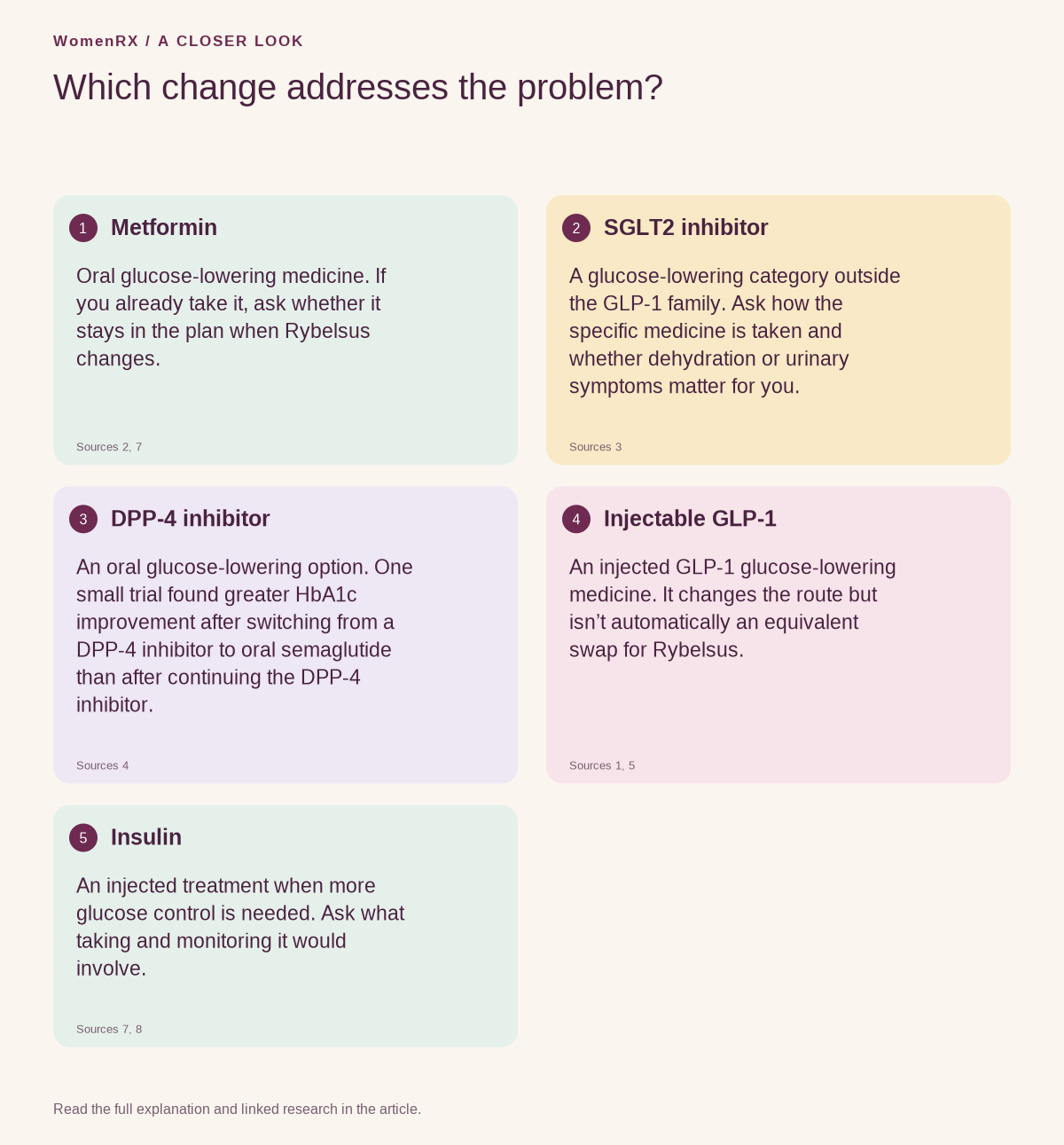
Which change addresses the problem?
Metformin: Oral glucose-lowering medicine. If you already take it, ask whether it stays in the plan when Rybelsus changes.27
SGLT2 inhibitor: A glucose-lowering category outside the GLP-1 family. Ask how the specific medicine is taken and whether dehydration or urinary symptoms matter for you.3
DPP-4 inhibitor: An oral glucose-lowering option. One small trial found greater HbA1c improvement after switching from a DPP-4 inhibitor to oral semaglutide than after continuing the DPP-4 inhibitor.4
Injectable GLP-1: An injected GLP-1 glucose-lowering medicine. It changes the route but isn’t automatically an equivalent swap for Rybelsus.15
Insulin: An injected treatment when more glucose control is needed. Ask what taking and monitoring it would involve.78
Read the figure as text
These are different treatment conversations, not a ranking of medicines.- Metformin: Oral glucose-lowering medicine. If you already take it, ask whether it stays in the plan when Rybelsus changes.27
- SGLT2 inhibitor: A glucose-lowering category outside the GLP-1 family. Ask how the specific medicine is taken and whether dehydration or urinary symptoms matter for you.3
- DPP-4 inhibitor: An oral glucose-lowering option. One small trial found greater HbA1c improvement after switching from a DPP-4 inhibitor to oral semaglutide than after continuing the DPP-4 inhibitor.4
- Injectable GLP-1: An injected GLP-1 glucose-lowering medicine. It changes the route but isn’t automatically an equivalent swap for Rybelsus.15
- Insulin: An injected treatment when more glucose control is needed. Ask what taking and monitoring it would involve.78
Sources you can check
- OZEMPIC (ORAL SEMAGLUTIDE) TABLET RYBELSUS (ORAL SEMAGLUTIDE) TABLET [NOVO NORDISK PHARMACEUTICAL INDUSTRIES, LP] | US prescribing information and patient instructionsAccessed 2026-09-25Return to first citation
- Metformin: a medicine to treat type 2 diabetes - NHSAccessed 2026-09-25Return to first citation
- Retrospective comparison of the clinical effects of oral semaglutide and SGLT2 inhibitors treatment in patients with type 2 diabetes.Omori Y, Usui R, Yamazaki Y, Kuwata H, Hamamoto Y, Yamada Y, Seino Y. · Journal of diabetes investigation · 2026Return to first citation
- Effects of switching from dipeptidyl peptidase 4 inhibitors to oral semaglutide on oxidative stress and glycemic variability in patients with type 2 diabetes: an open-label, prospective, randomized, multicenter, parallel-group comparison study.Ohara M, Yokoyama H, Seino H, Fujikawa T, Kohata Y, Takahashi N, Irie S, Terasaki M, Mori Y, Fukui T, Yamagishi SI. · Diabetology & metabolic syndrome · 2025Return to first citation
- Comparison of the efficacy and safety of 10 glucagon-like peptide-1 receptor agonists as add-on to metformin in patients with type 2 diabetes: a systematic review.Xie Z, Hu J, Gu H, Li M, Chen J. · Frontiers in endocrinology · 2023Return to first citation
- Efficacy and Safety of Once-Weekly Semaglutide Versus Basal Insulin and Other GLP-1 Receptor Agonists in Adults With Type 2 Diabetes Uncontrolled on Oral Antidiabetic Drugs: A Systematic Review and Pairwise Meta-Analysis.Aljulajil FA, Rabbani U. · Cureus · 2026Return to first citation
- Treatment for type 2 diabetes - NHSAccessed 2026-09-25Return to first citation
- Diabetes Medicine | Insulin | MedlinePlusAccessed 2026-09-25Return to first citation