A Morning Glucose Rise: Reading the Overnight Pattern
A higher reading before breakfast can have more than one explanation, so the overnight pattern matters more than a single number.
The dawn phenomenon is one possible pattern: glucose stays relatively steady overnight, then rises in the early morning before breakfast, without an overnight low. A high morning reading alone can’t confirm it. Looking at the overnight curve or readings, medication timing, and whether the pattern repeats can help your care team distinguish it from other explanations. Don’t change medication on your own. 4 3 1
What makes a rise look like the dawn phenomenon?
Your body releases glucose into the bloodstream, and insulin helps move that glucose into cells. In the early morning, hormone changes can increase the liver’s glucose output and make the body less responsive to insulin. If insulin isn’t sufficient for that change, glucose may rise before breakfast. 4
The useful clue is the shape of the overnight pattern. A dawn-pattern rise follows glucose that was comparatively steady during the night, with no preceding low. The term describes a pattern, not a diagnosis you can make from one fasting result. Researchers also use different ways to define the rise on continuous glucose monitors (CGMs), and glucose can vary from day to day. 4 3
Compare the night with the morning
A morning reading shows where glucose ended up, but not how it got there. If you already use a CGM, its overnight trace may show whether glucose was steady, climbed for several hours, or was high earlier in the night. A series of readings taken according to your existing care plan can also help show whether the pattern repeats. CGM readings are useful for seeing a curve, but small changes can be affected by sensor error. 4
These patterns point to different questions for your care team:
- Steady overnight, then rising before breakfast: This can fit the dawn phenomenon.
- High during the night and still high in the morning: The issue may be sustained overnight elevation rather than a rise that starts near morning. 3
- A low reading overnight, followed by a high one: That is a different pattern from the dawn phenomenon as it is commonly defined. The overnight low matters in its own right; don’t assume the morning number tells you why it happened. 4
- A rise on only one morning: It may not reflect a repeatable pattern. Compare readings taken in the same way and note the timing before drawing conclusions. Glucose and CGM estimates can fluctuate. 4
A care team may use CGM or planned overnight checks to clarify the pattern. That doesn’t mean you need to start waking yourself for extra checks: ask what, if anything, makes sense for your current plan.
Why medication timing belongs in the picture
Different insulin types start working at different speeds and last for different lengths of time. So, when you discuss a morning rise, the type and timing of your prescribed medicines can help your team understand what the overnight pattern means. Bring the medication schedule you actually follow, alongside the readings. Don’t shift, add, or stop diabetes medicine based on a single result; medication changes should be discussed with your care team. 1
A practical example: if your CGM is fairly steady for much of the night and then trends upward before breakfast, that gives a different picture from glucose that was already elevated at bedtime and stayed high. In either case, the graph is information for reviewing your plan, not an instruction to adjust it yourself. 3
Pregnancy calls for a different conversation
If you’re pregnant or have gestational diabetes, ask your care team which glucose goals and monitoring plan apply to you. Gestational diabetes has its own treatment context, and treatment may include medication or insulin; don’t use general advice about morning readings as a substitute for your pregnancy-specific plan. 1 2
What to share with your care team
If the rise keeps showing up, share the overnight and morning readings together rather than only the fasting result. Include when you measured, whether the reading came from a CGM or a meter, and the timing of your medicines. Ask whether the overnight pattern fits a dawn rise, whether something else better explains it, and whether your current plan needs review. The goal is to understand the pattern together, not to guess at a dose.
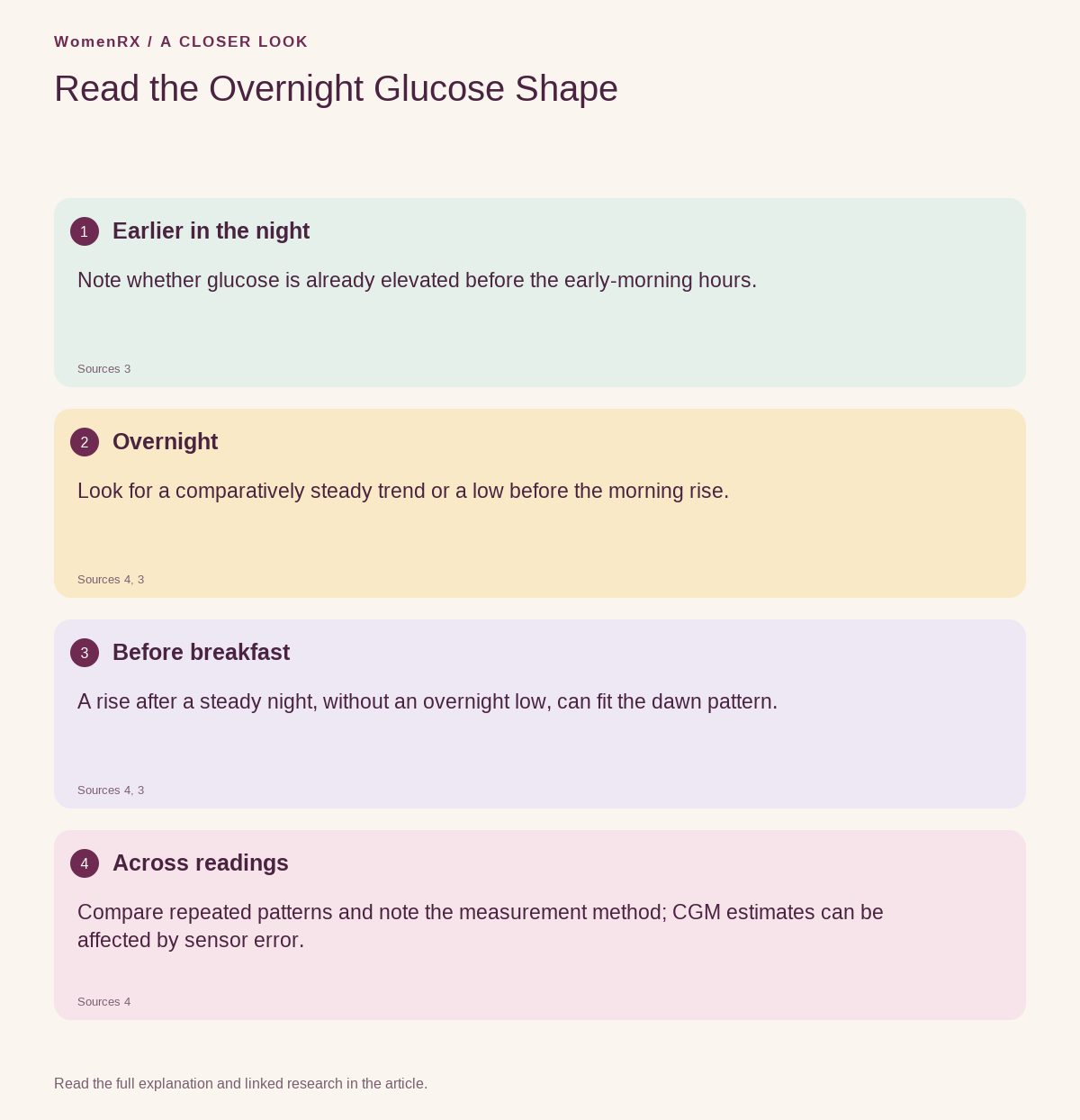
Read the Overnight Glucose Shape
Earlier in the night: Note whether glucose is already elevated before the early-morning hours.3
Overnight: Look for a comparatively steady trend or a low before the morning rise.43
Before breakfast: A rise after a steady night, without an overnight low, can fit the dawn pattern.43
Across readings: Compare repeated patterns and note the measurement method; CGM estimates can be affected by sensor error.4
Read the figure as text
A morning value becomes more useful when you can compare it with the hours before breakfast. These are pattern clues to discuss, not a way to diagnose yourself.- Earlier in the night: Note whether glucose is already elevated before the early-morning hours.3
- Overnight: Look for a comparatively steady trend or a low before the morning rise.43
- Before breakfast: A rise after a steady night, without an overnight low, can fit the dawn pattern.43
- Across readings: Compare repeated patterns and note the measurement method; CGM estimates can be affected by sensor error.4
More questions, answered
Should I change my insulin if my morning glucose is high?
No. A high morning reading by itself doesn’t show which change, if any, would be appropriate. Insulin types differ in how quickly they work and how long they last, so discuss the overnight pattern and your medication schedule with your care team before changing treatment. 1
Sources you can check
- Diabetes Medicine | Insulin | MedlinePlusAccessed 2026-09-25Return to first citation
- Diabetes - NHSAccessed 2026-09-25Return to first citation
- Inverse Association Between the Dawn Phenomenon and Thyroid Feedback Quantile-Based Index in Type 2 Diabetes Using Continuous Glucose Monitoring: A Cross-Sectional Study.Xia Y, Chen HJ, Yan RN, Zhu XW, Zhao H, Ding B, Hu Y. · Diabetes, metabolic syndrome and obesity : targets and therapy · 2025Return to first citation
- A probabilistic computation framework to estimate the dawn phenomenon in type 2 diabetes using continuous glucose monitoring.Barua S, Glantz N, Larez A, Bevier W, Sabharwal A, Kerr D. · Scientific reports · 2024Return to first citation