Tart Cherry Supplements: Forms, Amounts, and Safety
Tart cherry studies use different products and amounts, so a study serving isn’t a proven standard dose or a guarantee of safety.
There’s no established standard dose for tart cherry supplements. Studies have used juice, concentrate, and powder, with amounts that vary by goal and product; results from one form can’t be assumed to apply to another. Short-term studies offer limited safety information, but they don’t establish long-term safety or safety during pregnancy or breastfeeding. 1 2 3
Start with the goal, not the number
Tart cherry products are sold as juice, concentrate, and powder. The amount used in a study only makes sense alongside its form, product, and goal. A serving of juice isn’t automatically equivalent to a spoonful of concentrate or a capsule of powder, and a study amount isn’t a recommended dose.
For example, a sleep review described a study using 240 mL of cherry juice twice daily for two weeks in adults over 50. A separate trial listed in a review of cognitive studies used 480 mL of juice daily for 12 weeks in older adults. Those are examples of what researchers studied for different outcomes, not instructions for what to take. 1 4
A small trial of powdered Vistula tart cherry used a low-dose powder containing 60-78 mg of anthocyanins. It measured short-term changes in blood metabolites, not whether that amount improves a health condition or is an appropriate serving for everyday use. The researchers also note that tart cherry products can differ in composition. 2
Compare the product with the study
Before choosing a product, check:
- Form: Is it juice, concentrate, or powder? Look for the form used in the research relevant to your goal.
- Amount per serving: Check whether the label’s serving is measured as juice volume, concentrate volume, or powder weight. Don’t compare the numbers as if they were interchangeable.
- Product details: Note the tart cherry variety and any listed active-ingredient amount. A study of one variety or preparation may not match a product made differently. 2
- Study goal and duration: A short study looking at blood markers, sleep, or a gout measure cannot establish that the same product works for another purpose or is safe to use long term. 1 2 3
If the label doesn’t make clear what’s in a serving, or you can’t tell how it matches the product used in a study, the studied amount may not help you choose. There isn’t enough evidence here to turn different research servings into one general dose.
What the safety evidence can tell you
In a 28-day trial, 50 people with gout received placebo or one of several amounts of tart cherry concentrate twice daily. Researchers recorded 24 adverse events; one, high blood sugar, was considered possibly related to the concentrate. This is useful short-term information from a specific group, but it doesn’t show how often unwanted effects occur among people generally or establish long-term safety. 3
That gout trial included people taking allopurinol and found that its use did not change tart cherry’s effect on serum urate. The trial does not establish that tart cherry has no interactions with allopurinol or with other medicines. It also found no significant effect of concentrate dose on serum urate over the 28-day study, so tart cherry shouldn’t be treated as a proven way to lower that measure. 3
The sleep review included seven intervention studies, but the studies differed in product, amount, duration, and participants. It supports treating safety and effectiveness conclusions cautiously rather than assuming that results from a short trial apply to regular use. 1
Pregnancy, breastfeeding, and women-specific findings
The available studies don’t establish a safe or effective supplement amount during pregnancy or breastfeeding. Studies involving adults or older adults aren’t a substitute for evidence in these life stages. The sleep review included participants without age or gender restrictions, but its summary doesn’t establish a dose or result specific to women. A small acute study of powdered Vistula tart cherry included three women and nine men; it measured blood metabolites over hours, not pregnancy, breastfeeding, or long-term outcomes. 1 2
If you’re pregnant or breastfeeding, or take medicine and are considering regular tart cherry use, ask a clinician or pharmacist about the specific product. Bring the label, including the serving size and listed ingredients. That makes it easier to discuss the actual product rather than treating all tart cherry forms as the same.
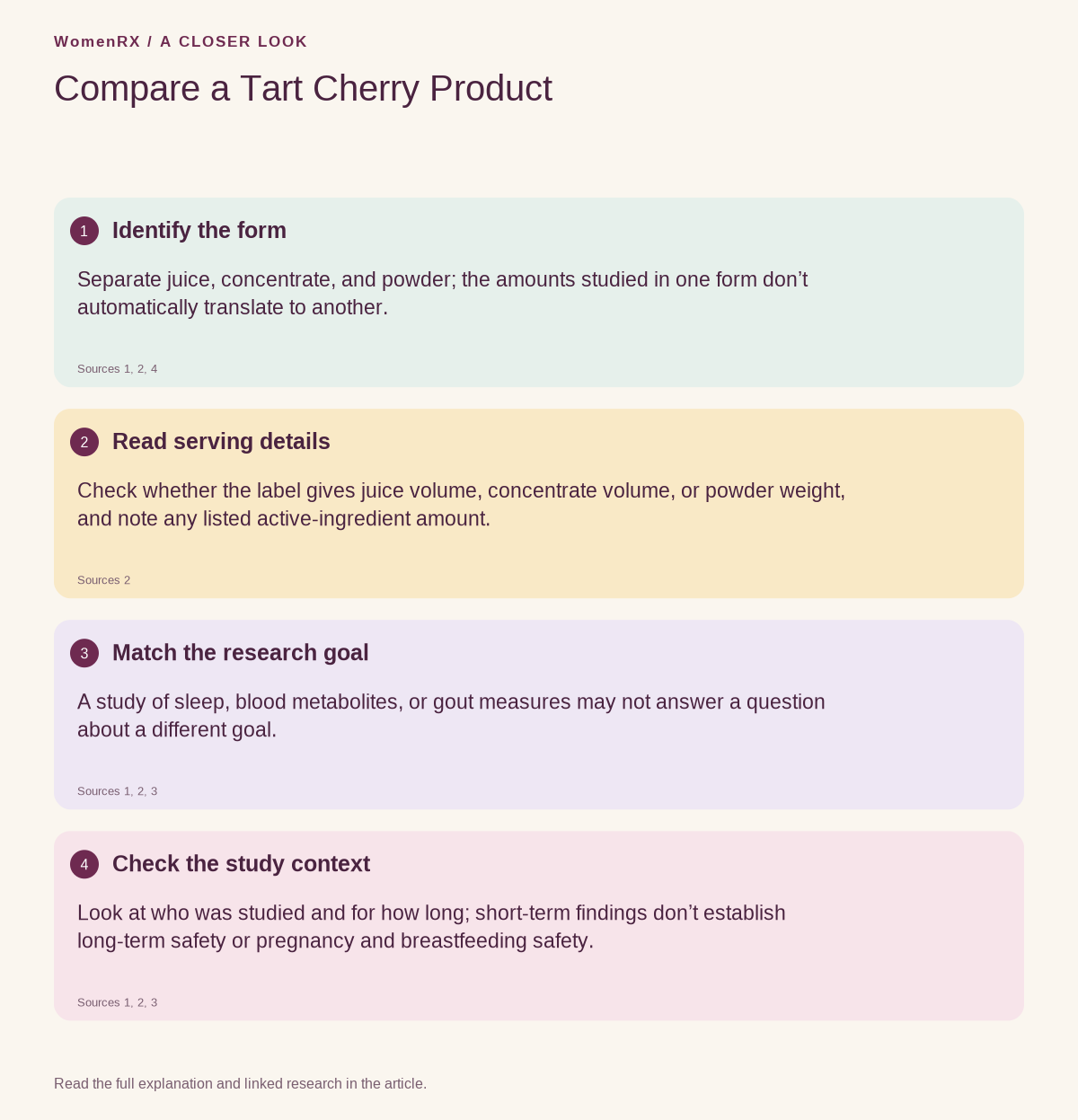
Compare a Tart Cherry Product
Identify the form: Separate juice, concentrate, and powder; the amounts studied in one form don’t automatically translate to another.124
Read serving details: Check whether the label gives juice volume, concentrate volume, or powder weight, and note any listed active-ingredient amount.2
Match the research goal: A study of sleep, blood metabolites, or gout measures may not answer a question about a different goal.123
Check the study context: Look at who was studied and for how long; short-term findings don’t establish long-term safety or pregnancy and breastfeeding safety.123
Read the figure as text
Use these checks to see whether a product matches a study, without treating a research serving as a recommended dose.- Identify the form: Separate juice, concentrate, and powder; the amounts studied in one form don’t automatically translate to another.124
- Read serving details: Check whether the label gives juice volume, concentrate volume, or powder weight, and note any listed active-ingredient amount.2
- Match the research goal: A study of sleep, blood metabolites, or gout measures may not answer a question about a different goal.123
- Check the study context: Look at who was studied and for how long; short-term findings don’t establish long-term safety or pregnancy and breastfeeding safety.123
More questions, answered
Does a tart cherry study amount tell me how much to take?
No. It tells you what researchers tested for a particular product, group, and goal. The studies used different forms and amounts, and they don’t establish one standard dose for general use. 1 2 4
Does tart cherry concentrate interact with allopurinol?
A 28-day gout trial found that allopurinol use did not change tart cherry’s effect on serum urate. That finding doesn’t establish that the products have no interaction, and it doesn’t answer questions about other medicines. 3
Sources you can check
- The Effect of Tart Cherry on Sleep Quality and Sleep Disorders: A Systematic Review.Barforoush F, Ebrahimi S, Abdar MK, Khademi S, Morshedzadeh N. · Food science & nutrition · 2025Return to first citation
- Plasma-Induced Changes in the Metabolome Following Vistula Tart Cherry Consumption.Squires E, Walshe IH, Cheung W, Bowerbank SL, Dean JR, Wood J, McHugh MP, Plattner S, Howatson G. · Nutrients · 2024Return to first citation
- Lack of effect of tart cherry concentrate dose on serum urate in people with gout.Stamp LK, Chapman P, Frampton C, Duffull SB, Drake J, Zhang Y, Neogi T. · Rheumatology (Oxford, England) · 2020Return to first citation
- The effect of plant active substances on cognitive function in healthy older adults: a systematic review and network meta-analysis of randomized controlled trials.Feng X, Fan S, Wei F. · Frontiers in pharmacology · 2025Return to first citation