Tart Cherry Supplements: What Human Studies Actually Test
Tart cherry studies use different forms, amounts, and outcomes, so a result for one product or goal may not apply to another.
Human studies have tested tart cherry juice or concentrate around exercise, juice in adults with ulcerative colitis, and powder around a purine-rich meal. The studied schedules differ, and exercise recovery results have not been consistent. To compare a product fairly, match its form and stated amount to the study, then check whether researchers measured your goal and included women with results reported separately. 1 2 3 4
Tart cherry research doesn’t point to one best supplement for every goal. A juice used in an exercise study isn’t automatically equivalent to a powder capsule, and a result for ulcerative-colitis symptoms doesn’t establish a sleep or recovery benefit. The useful comparison is specific: what form and amount did the study use, for how long, and what outcome did it measure?
Exercise: the product and the activity matter
In a randomized crossover study, 12 recreational cyclists, including four women, drank tart cherry juice or a sports drink. They consumed 300 mL per day for four days before and two days after exercise. On the exercise day, the test drink providing carbohydrate was taken 45 minutes before a 90-minute cycling session and a 10-kilometer time trial. The researchers found no difference between drinks in time-trial performance or the other measured exercise and recovery outcomes. The results were not reported separately for women. 1
A different crossover trial studied nine male water-polo players. They consumed 90 mL per day of Montmorency tart cherry concentrate for six days, diluted into drinks. The study found no difference from placebo in its performance or recovery measures. Because the participants were all men and the sport was water polo, this trial can’t tell you whether the result applies to women or other kinds of exercise. 2
These studies tested different sports and schedules, and neither showed an advantage on the measured outcomes. A 2026 study in young active men also reported changes in muscle proteins after seven days of tart cherry supplementation, but not faster recovery of muscle function. A laboratory change is not the same as a faster return of strength or performance. 5
If you’re comparing an exercise product with these trials, look for the same form and a clearly stated amount. A label that says “tart cherry” alone doesn’t show that the product matches the juice or concentrate used in a study. The cycling trial gives a juice volume and schedule; the water-polo trial gives a concentrate volume and schedule. Those are distinct preparations, so don’t treat their amounts as interchangeable. 1 2
Other goals have their own evidence
A placebo-controlled trial studied 35 adults with mild to moderate ulcerative colitis. Participants took 60 mL per day of Montmorency tart cherry juice for six weeks. Compared with placebo, the tart-cherry group had greater improvements in quality of life, reported disease activity, and fecal calprotectin, a stool marker. This is a promising finding in a specific group with ulcerative colitis, not evidence that tart cherry treats other digestive symptoms or improves general wellness. The report doesn’t provide women-specific results. 3
A small crossover study looked at concentrated tart cherry powder and the uric-acid response to a purine-rich meal. It included 25 adults with mildly elevated uric acid, 10 of them women. The capsules contained concentrated powder with 20.7 mg of proanthocyanins; participants took two capsules a day for a week and also tested the supplement around the meal. The study found no significant difference between tart cherry and placebo in uric-acid levels or the measured uric-acid response. It didn’t report results separately for women. The abstract does not specify the mass of powder in the capsules, which limits dose-matching to a product that lists only powder weight. 4
What these studies can tell you about sleep
The trials described here measured exercise outcomes, ulcerative-colitis outcomes, or responses to a meal. They don’t establish whether tart cherry improves sleep. If sleep is your reason for considering a product, look for a human study that actually measures sleep and uses a form and amount you can compare with the product. Evidence for another outcome doesn’t answer that question. 1 2 3 4 5
A practical product-to-study check
Before using a research finding to judge a product, check:
- Form: Was the study testing juice, concentrate, or powder? Don’t assume one form matches another.
- Amount and schedule: Compare the reported amount and length of use. For example, the exercise trials used 300 mL per day of juice or 90 mL per day of concentrate, while the ulcerative-colitis trial used 60 mL per day of juice. 1 2 3
- Measured outcome: Did the researchers measure your goal, such as sleep, soreness, or a specific performance test?
- Participants: Were women included? If they were, did the study report their results separately? In the cycling study, four women participated, but sex-specific results weren’t reported. The water-polo trial enrolled only men. 1 2
- Comparison: Was the product compared with placebo or another drink? A result against a sports drink answers a different comparison than a result against placebo. 1 2 3 4
If the product label doesn’t give enough detail to compare its form or amount with a study, the match is unclear. That doesn’t prove the product can’t work; it means that particular study doesn’t establish what to expect from it.
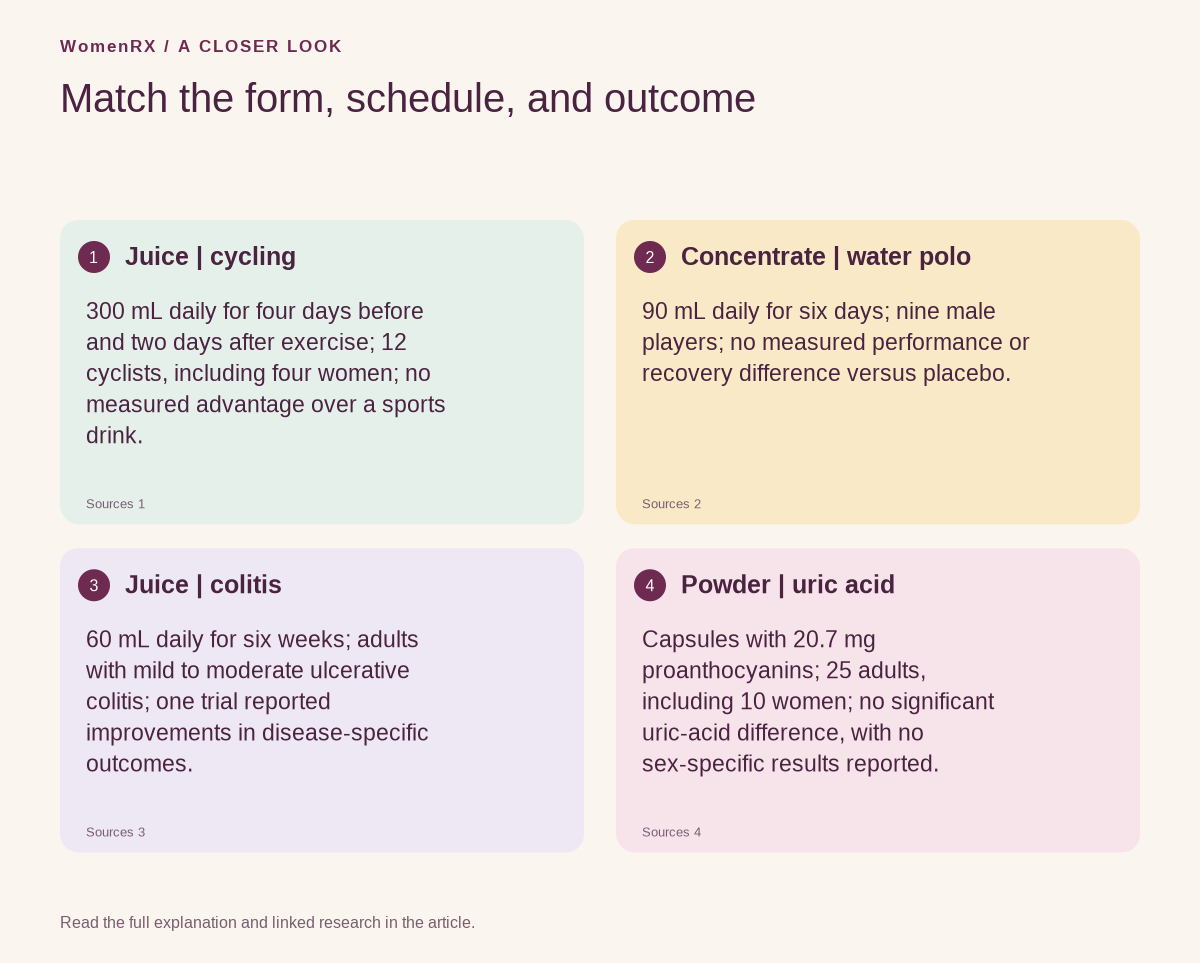
Match the form, schedule, and outcome
Juice | cycling: 300 mL daily for four days before and two days after exercise; 12 cyclists, including four women; no measured advantage over a sports drink.1
Concentrate | water polo: 90 mL daily for six days; nine male players; no measured performance or recovery difference versus placebo.2
Juice | colitis: 60 mL daily for six weeks; adults with mild to moderate ulcerative colitis; one trial reported improvements in disease-specific outcomes.3
Powder | uric acid: Capsules with 20.7 mg proanthocyanins; 25 adults, including 10 women; no significant uric-acid difference, with no sex-specific results reported.4
Read the figure as text
These examples show what human studies actually tested, including where the participant group or reported product details limit a comparison.- Juice | cycling: 300 mL daily for four days before and two days after exercise; 12 cyclists, including four women; no measured advantage over a sports drink.1
- Concentrate | water polo: 90 mL daily for six days; nine male players; no measured performance or recovery difference versus placebo.2
- Juice | colitis: 60 mL daily for six weeks; adults with mild to moderate ulcerative colitis; one trial reported improvements in disease-specific outcomes.3
- Powder | uric acid: Capsules with 20.7 mg proanthocyanins; 25 adults, including 10 women; no significant uric-acid difference, with no sex-specific results reported.4
Sources you can check
- The effect of tart cherry juice compared to a sports drink on cycling exercise performance, substrate metabolism, and recovery.Gao R, Rapin N, Andrushko JW, Farthing JP, Gordon J, Chilibeck PD. · PloS one · 2024Return to first citation
- Effect of tart cherry juice on recovery and next day performance in well-trained Water Polo players.McCormick R, Peeling P, Binnie M, Dawson B, Sim M. · Journal of the International Society of Sports Nutrition · 2016Return to first citation
- Health Benefits of Montmorency Tart Cherry Juice Supplementation in Adults with Mild to Moderate Ulcerative Colitis; A Placebo Randomized Controlled Trial.Sinclair J, McLaughlin G, Allan R, Brooks-Warburton J, Lawson C, Goh S, Desai T, Bottoms L. · Life (Basel, Switzerland) · 2025Return to first citation
- Effects of Acute and One-Week Supplementation with Montmorency Tart Cherry Powder on Food-Induced Uremic Response and Markers of Health: A Proof-of-Concept Study.Gonzalez DE, Kendra JA, Dickerson BL, Yoo C, Ko J, McAngus K, Martinez V, Leonard M, Johnson SE, Xing D, Sowinski RJ, Rasmussen CJ, Kreider RB. · Nutrients · 2024Return to first citation
- Tart cherry supplementation causes differential regulation of skeletal muscle proteome after eccentric exercise.Sabou V, O'Leary M, Jackman SR, Struszczak L, Bozbas E, Metcalf B, Tang JCY, Philo M, Kroon PA, Bowtell JL. · Frontiers in nutrition · 2026Return to first citation