Tart Cherry Juice, Concentrate, and Capsules: What to Check
A juice, a concentrate, and a capsule aren’t interchangeable: compare the actual serving, ingredients, and what human studies have examined.
Start with the form and serving size. Two short human trials tested specific tart cherry concentrates, not capsules. In a 28-day gout trial, researchers reported 24 adverse events, with one considered possibly related to concentrate; a six-week ulcerative colitis trial reported one adverse event. Neither establishes long-term safety or answers pregnancy and breastfeeding questions. Check your product’s ingredients rather than assuming the forms are equivalent. 1 2
Start with the form, not the front-label promise
“Tart cherry” can mean a drink, a concentrated liquid, or a capsule. Those forms may differ in serving size, ingredients, and the amount of cherry material they provide. A study of one concentrate doesn’t establish that a juice or capsule has the same effects or safety profile.
The human studies examined particular liquid products. One randomized trial gave 50 people with gout a tart cherry concentrate or placebo for 28 days. Another gave adults with mild-to-moderate ulcerative colitis a specific Montmorency concentrate for six weeks. Neither trial tested capsules or establishes how every product on a store shelf compares. 1 2
Compare the label in practical terms
Juice: Look at the serving size and added ingredients, then check total carbohydrates and sugars if those matter for your dietary needs. “Juice” on the front doesn’t tell you whether the product is a ready-to-drink beverage or a concentrated product meant to be diluted.
Concentrate: Check how much concentrate counts as one serving and whether the label gives directions for dilution. In the ulcerative colitis trial, the particular concentrate supplied 80 calories, 19 grams of carbohydrates, and 15 grams of sugars per 30 mL, according to its manufacturer. Those figures describe that study product, not all concentrates. 2
Capsules or extracts: Read the amount per serving, the listed ingredients, and whether the label describes a whole-fruit powder or an extract. These studies don’t establish a capsule dose or show that capsules are equivalent to the liquids studied. If the label doesn’t make clear what one serving contains, you can’t reliably compare it with a trial product.
A useful comparison is to put the serving size, carbohydrates and sugars, additional ingredients, and form side by side. This helps separate a dietary choice from claims that imply a particular extract has been tested for a specific outcome.
What the safety findings can, and can’t, tell you
In the gout trial, researchers reported 24 adverse events; one, hyperglycemia, was considered possibly related to the concentrate. The study involved 50 people and lasted 28 days. This is a limited snapshot, not proof that other people will have the same reaction or that the product is safe with long-term use. 1
In the six-week ulcerative colitis trial, one adverse event was reported. That finding applies to the trial’s specific product and participants; it doesn’t settle safety for other forms or for longer use. 2
If you track sugars or carbohydrates, use your product’s label rather than assuming a small serving has a negligible amount. Ingredients beyond cherry may also matter for your dietary needs, so check the full label, not just the product name.
Medicines, pregnancy, and breastfeeding
The gout trial included participants taking allopurinol as well as participants not taking urate-lowering medicine. Allopurinol use did not change the study’s findings about serum urate. That does not establish that tart cherry products have no interactions with all medicines, or that combining them is beneficial. 1
The described trials don’t answer whether concentrated tart cherry products are safe during pregnancy or breastfeeding. They also can’t be used to judge ordinary cherries eaten as food or to treat eating cherries and taking a concentrated supplement as equivalent exposures. 1 2
Keep the product separate from the health claim
A trial finding for a particular liquid product and a particular group of adults doesn’t establish that another form will help with sleep, soreness, inflammation, or another concern. The right comparison is product-specific: what was actually studied, in whom, for how long, and in what form? For safety decisions, the label and your dietary or medicine needs matter more than a broad “tart cherry” claim.
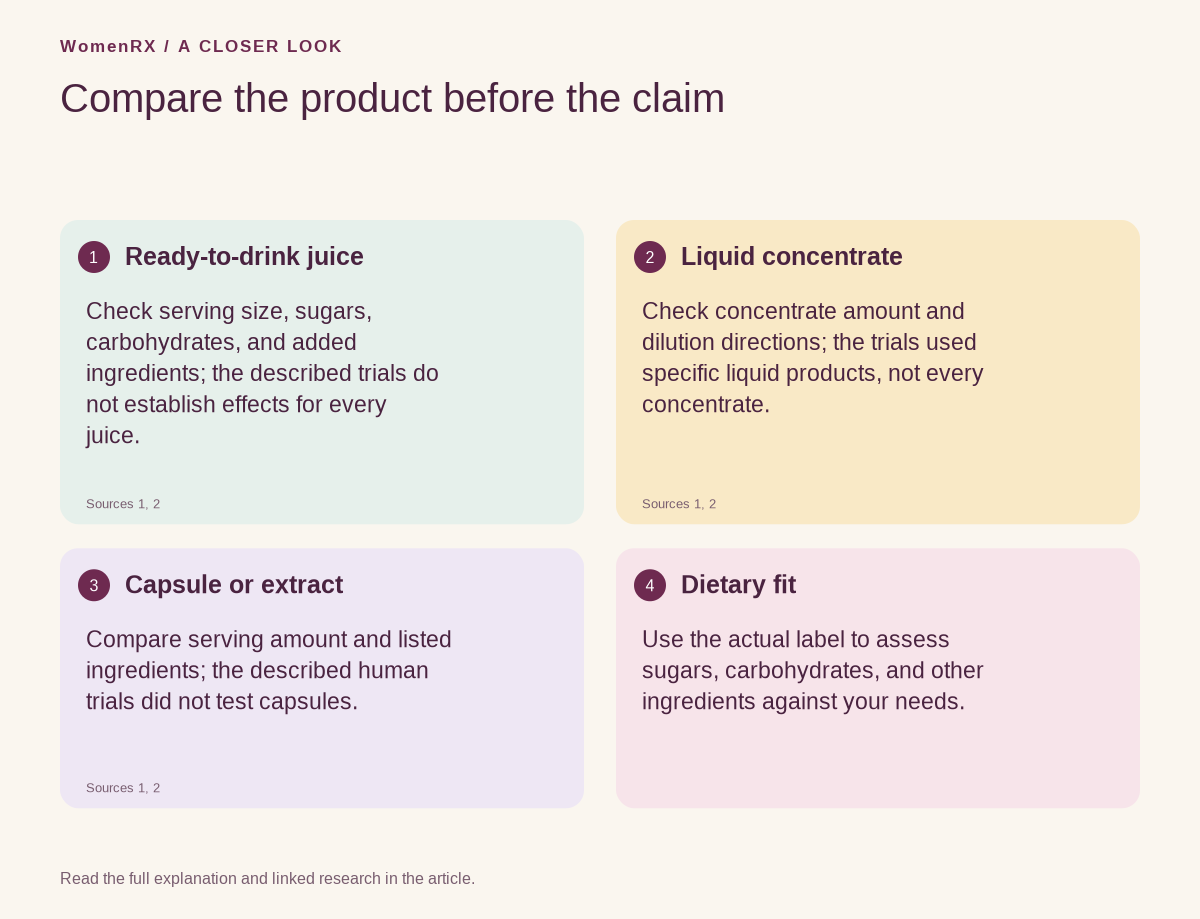
Compare the product before the claim
Ready-to-drink juice: Check serving size, sugars, carbohydrates, and added ingredients; the described trials do not establish effects for every juice.12
Liquid concentrate: Check concentrate amount and dilution directions; the trials used specific liquid products, not every concentrate.12
Capsule or extract: Compare serving amount and listed ingredients; the described human trials did not test capsules.12
Dietary fit: Use the actual label to assess sugars, carbohydrates, and other ingredients against your needs.
Read the figure as text
These forms differ in what to inspect and in how directly the described human trials apply.- Ready-to-drink juice: Check serving size, sugars, carbohydrates, and added ingredients; the described trials do not establish effects for every juice.12
- Liquid concentrate: Check concentrate amount and dilution directions; the trials used specific liquid products, not every concentrate.12
- Capsule or extract: Compare serving amount and listed ingredients; the described human trials did not test capsules.12
- Dietary fit: Use the actual label to assess sugars, carbohydrates, and other ingredients against your needs.
More questions, answered
Does tart cherry concentrate interact with allopurinol?
In a 28-day trial in people with gout, allopurinol use did not modify the concentrate’s effect on serum urate. That result doesn’t show that tart cherry products are interaction-free with all medicines, or that they replace prescribed treatment. 1
Are tart cherry capsules as well studied as juice?
Not in the human trials described here. Those studies tested particular liquid products, so their results and reported adverse events can’t be assumed to apply to capsules. 1 2
Sources you can check
- Lack of effect of tart cherry concentrate dose on serum urate in people with gout.Stamp LK, Chapman P, Frampton C, Duffull SB, Drake J, Zhang Y, Neogi T. · Rheumatology (Oxford, England) · 2020Return to first citation
- Health Benefits of Montmorency Tart Cherry Juice Supplementation in Adults with Mild to Moderate Ulcerative Colitis; A Placebo Randomized Controlled Trial.Sinclair J, McLaughlin G, Allan R, Brooks-Warburton J, Lawson C, Goh S, Desai T, Bottoms L. · Life (Basel, Switzerland) · 2025Return to first citation